
EV Battery Replacement Cost in India 2026: Battery Life, Warranty, Prices & Everything You Need to Know
If you’re thinking about buying an EV in India, or you already own one and the warranty clock is ticking, there’s one question that eventually crosses every owner’s mind: what happens — and what will it cost — if the battery needs replacing?
It’s a fair worry. The battery pack is the single most expensive part of an electric car, often 30 to 45 percent of what you paid for the vehicle. But here’s the short answer before we get into the details: the EV battery replacement cost in India is genuinely high if you’re paying out of pocket, but very few owners actually end up paying it, because warranties on every major EV sold in India today run for 8 years or longer, and real-world batteries are proving to last well beyond that.
This guide walks through what actually determines the cost, what different manufacturers cover, what a replacement realistically costs by vehicle segment, and what you should actually be checking before you buy — new or used.
A quick note on numbers before we start: Indian carmakers almost never publish an official “battery replacement price” the way they publish a spare-part price for, say, a bumper. What you’ll find in this article is a mix of confirmed warranty terms (which are official and verifiable) and cost estimates drawn from industry sources, repair networks and specialist EV service providers. Every price that isn’t an official manufacturer figure is clearly marked as an estimate.
EV Battery Replacement Cost in India: Quick Overview
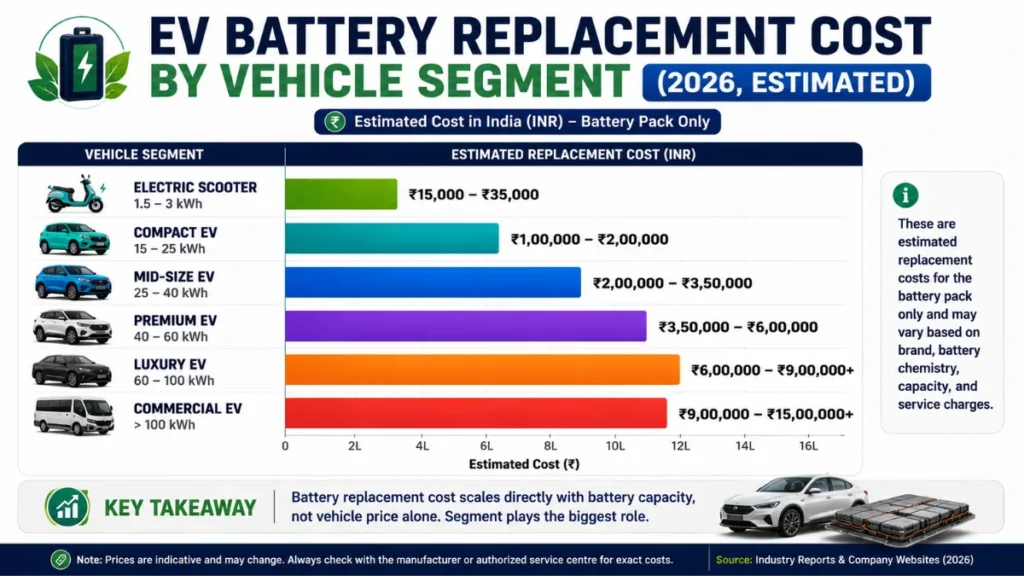
Here’s a snapshot before we go deep. These are indicative, all-in figures (pack plus fitment) collected from industry and specialist EV repair sources, not official manufacturer price lists.
| EV Type | Typical Battery Capacity | Approx. Battery Replacement Cost (Estimated) |
|---|---|---|
| Electric Scooter (entry-level) | 2–3 kWh | ₹45,000 – ₹75,000 |
| Electric Scooter (premium/long-range) | 3.7–5.2 kWh | ₹75,000 – ₹1,20,000 |
| Small Electric Car (hatchback/city car) | 17–30 kWh | ₹3 lakh – ₹6 lakh |
| Mid-Size Electric Car (compact/mid SUV) | 40–60 kWh | ₹6 lakh – ₹12 lakh |
| Premium/Long-Range Electric Car (SUV/sedan) | 60–80 kWh | ₹10 lakh – ₹18 lakh |
| Luxury Electric Car | 80–108 kWh | ₹18 lakh – ₹38 lakh |
These ranges are wide on purpose — the actual number depends heavily on the specific model, battery chemistry, whether it’s a full pack or a module-level repair, and your city’s labour rates. Treat this table as a way to understand scale, not as a quote.
How Much Does an EV Battery Cost in India?
An EV battery pack isn’t just a block of cells. What you’re actually paying for when you replace one includes:
- The cells themselves — the lithium-ion chemistry inside, which is the biggest chunk of the cost
- Battery capacity — measured in kWh (kilowatt-hours); simply put, this is how much energy the pack can store, and bigger packs cost proportionally more
- Battery chemistry — LFP (Lithium Iron Phosphate) packs are generally cheaper and more heat-tolerant, which matters a lot in Indian summers, while NMC (Nickel Manganese Cobalt) packs are more energy-dense but often costlier
- The pack casing and cooling system — the metal enclosure, the liquid cooling loop, and thermal management hardware that keeps cells at a safe temperature
- The Battery Management System (BMS) — the electronics that monitor each cell, balance charging, and protect against overheating or overcharging; a new pack usually needs its BMS recalibrated or replaced with it
- Labour — removing and refitting a battery pack requires trained technicians working with high-voltage systems, and this isn’t a job for a regular garage
- Software pairing — many EVs need the new pack to be “married” to the car’s software before it will accept charge properly
- GST and logistics — taxes and the cost of safely transporting and disposing of the old pack
Because of this mix, no two replacement quotes look identical, even for the same model, which is exactly why manufacturers are reluctant to publish a single fixed price.
EV Battery Replacement Cost Per kWh
The most useful way to estimate cost is on a per-kWh basis. Based on 2026 industry estimates from Indian EV service and repair sources, battery replacement in India currently works out to roughly ₹15,000 to ₹25,000 per kWh installed, with some sources citing a slightly lower ₹15,000–₹22,000 band as localisation under India’s PLI (Production Linked Incentive) cell manufacturing push brings costs down.
This is an industry estimate, not an official manufacturer figure, and it moves with global lithium-ion cell prices, import duties, and how much of the pack is assembled locally.
Here’s an illustrative calculation using that estimate:
40 kWh battery × ₹18,000/kWh (mid-point estimate) = approximately ₹7.2 lakh estimated pack cost
60 kWh battery × ₹18,000/kWh (mid-point estimate) = approximately ₹10.8 lakh estimated pack cost
Remember, this is before labour, taxes on top, or any regional variation — treat it as a ballpark, not a quote you can hold a dealer to.
EV Battery Replacement Cost by Popular Models in India
None of the manufacturers below have published an official, itemised out-of-warranty battery replacement price list to the public. What follows is a mix of confirmed warranty terms (official) and cost ranges reported by EV specialist repair networks and automotive publications (estimated). Where no credible estimate exists, that’s stated plainly.
| Model | Battery Capacity | Battery Warranty (Official) | Estimated Replacement Cost |
|---|---|---|---|
| Tata Tiago EV | 19.2 / 24 kWh | 8 years/1,60,000 km (standard) | Manufacturer replacement price not publicly disclosed |
| Tata Punch EV | 25 / 35 kWh | 8 years/1,60,000 km (standard) | Manufacturer replacement price not publicly disclosed |
| Tata Nexon EV (45 kWh LR) | 45 kWh | Lifetime (15 yrs/unlimited km) for 1st owner; 8 yrs/1.6 lakh km for 2nd owner | Estimated ₹4 lakh – ₹8 lakh |
| Tata Curvv EV | 45 / 55 kWh | Lifetime (15 yrs/unlimited km) for 1st owner | Manufacturer replacement price not publicly disclosed |
| MG Comet EV | 17.3 kWh | Lifetime (unlimited km) for 1st owner; 8 yrs/1.2 lakh km otherwise | Manufacturer replacement price not publicly disclosed |
| MG Windsor EV | 38 / 50 kWh | Lifetime (unlimited km/year) for 1st owner; 8 yrs/1.6 lakh km otherwise | Manufacturer replacement price not publicly disclosed |
| MG ZS EV | ~50.3 kWh | 8 years/1,50,000 km | Manufacturer replacement price not publicly disclosed |
| Hyundai Creta Electric | 42 / 51.4 kWh | 8 years/1,60,000 km | Manufacturer replacement price not publicly disclosed |
| Hyundai Ioniq 5 | 72.6 kWh | 8 years/1,60,000 km | Estimated ₹14 lakh – ₹20 lakh |
| Mahindra XUV400 | 34.5 / 39.4 kWh | 8 years/1,60,000 km | Manufacturer replacement price not publicly disclosed |
| Mahindra BE 6 | 59 / 79 kWh | Lifetime for 1st owner; 10 yrs/2,00,000 km for subsequent owners | Estimated ₹5 lakh – ₹10 lakh |
| Mahindra XEV 9e | 59 / 79 kWh | Lifetime for 1st owner; 10 yrs/2,00,000 km for subsequent owners | Manufacturer replacement price not publicly disclosed |
| BYD Atto 3 | 49.9 / 60.5 kWh | 8 years/1,60,000 km | Estimated ₹6 lakh – ₹18 lakh (estimates vary widely by source) |
| BYD Seal | 61.4 / 82.6 kWh | 8 years/1,60,000 km | Estimated ₹6 lakh – ₹10 lakh (base); larger pack at the higher end |
| Kia EV6 | ~77.4 kWh | 8 years/1,60,000 km (in line with Kia India’s EV warranty norm) | Estimated ₹14 lakh – ₹20 lakh |
A few honest caveats on this table: the Atto 3 estimates in particular vary a great deal between sources (some quote ₹6–10 lakh, others ₹15–18 lakh), which tells you how immature public battery-pricing data still is in India. Treat any single figure with caution and always get a written quote from an authorised service centre before making a decision.
How Long Does an EV Battery Last in India?
This is really two separate questions: how long is the battery warranted for, and how long does it actually last.
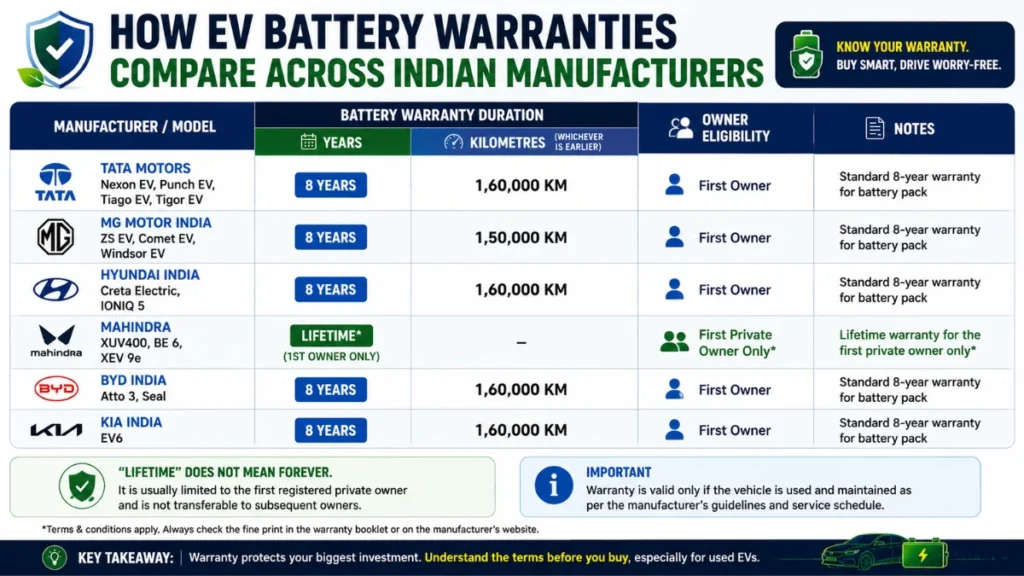
Warranty duration: Most electric cars sold in India in 2026 carry an 8-year or 1,60,000 km high-voltage battery warranty, whichever comes first. Tata, Hyundai, Mahindra, MG (on most models) and BYD broadly follow this template, and several manufacturers now go further with “lifetime” cover for the first owner — which in India specifically means 15 years from first registration with unlimited kilometres (Tata), or a reduced 10-year/2,00,000 km term that kicks in if the car changes hands (Mahindra).
Real-world lifespan: Independent estimates suggest a well-maintained lithium-ion EV battery in Indian conditions can realistically last 10 to 12 years or more, retaining somewhere around 70 to 80 percent of its original capacity by that point. In plain terms, this means the car’s battery is very likely to outlast the warranty itself, and for most owners, likely to outlast how long they actually keep the car.
Lifespan in kilometres depends on charge cycles rather than distance alone. LFP batteries (used in the BYD Atto 3, the entry Tata Tiago EV, and the MG Comet, among others) are typically rated for 2,500 to 3,500 full charge cycles, while NMC batteries (used in the Nexon EV, MG ZS EV, Mahindra XUV400, and Hyundai’s EVs) tend to sit lower, at roughly 1,200 to 1,500 cycles before significant degradation sets in, though this varies by manufacturer and thermal management design.
Indian climate is a genuine factor here. Sustained high temperatures accelerate battery wear, particularly for NMC chemistry, which is one reason LFP has become the preferred choice for entry and mid-range Indian EVs — it copes better with heat and doesn’t need as aggressive a cooling system.
What Is EV Battery Degradation?
Battery degradation simply means the pack’s ability to hold a full charge slowly reduces over time and use. It happens to every lithium-ion battery — in your phone, your laptop, and your EV — and it is completely normal, not a sign that something is wrong.
Here’s a practical example. Say your EV’s battery originally provided 400 km of real-world range on a full charge. If the battery degrades by 10 percent after several years of use, you would realistically expect closer to 360 km on a full charge, not 400 km. That’s a noticeable but very liveable change for most daily commutes.
This is an important point: degradation does not automatically mean your battery needs replacing. A battery that has degraded to 85 or even 75 percent of its original capacity is still a functioning, safe battery — it just holds a bit less charge than when new. Most manufacturer warranties guarantee a minimum capacity retention (commonly around 70 percent) over the warranty period specifically because some gradual loss is expected and considered normal, not a defect.
When Should an EV Battery Be Replaced?
There’s a real difference between normal wear and an actual problem, and understanding this distinction can save you a lot of money and unnecessary anxiety.
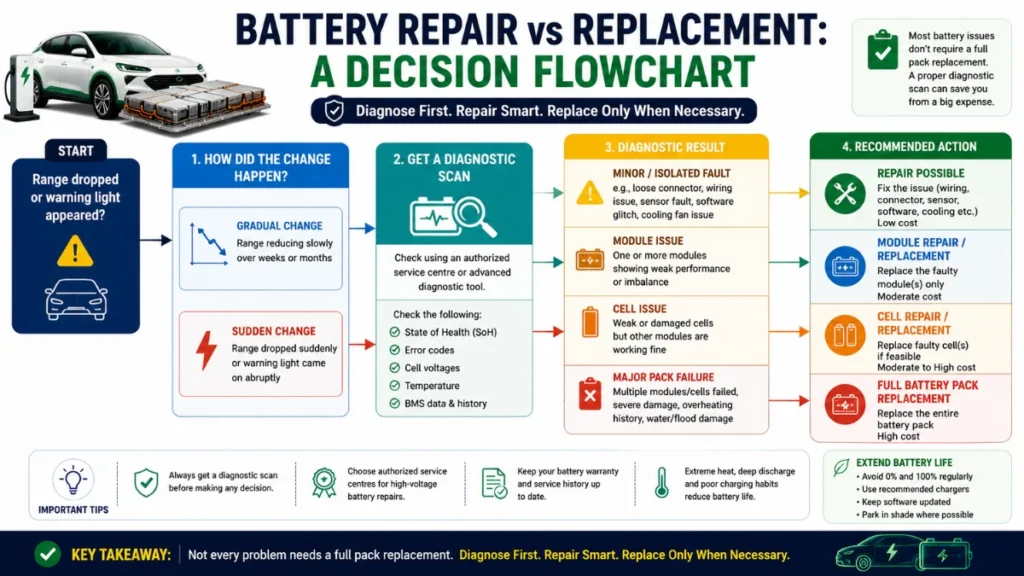
Normal degradation shows up as a slow, gradual drop in range over years — this needs monitoring, not replacement.
A genuine issue is different, and usually shows up as one or more of the following:
- A sudden, sharp drop in range rather than a gradual one
- Warning lights or battery fault codes on the dashboard
- The car refusing to charge past a certain percentage, or charging much slower than before
- Unusual heat, swelling, or any visible damage to the pack after an accident or flooding
- Individual cell or module failure, which is often a localised fault rather than a whole-pack problem
In many of these cases, especially module or cell-level faults, a full pack replacement isn’t actually necessary — repair at the module level can resolve the issue at a fraction of the cost. Thermal damage from a fire, deep flood exposure, or a serious accident, however, usually does mean the whole pack needs replacing for safety reasons, because a compromised high-voltage pack is not something to take a chance on.
EV Battery Warranty in India
This is arguably the single most important thing to understand before buying an EV in India, because it directly determines your financial exposure.
| Manufacturer | Model(s) | Battery Warranty | Notes |
|---|---|---|---|
| Tata Motors | Harrier.ev, Curvv.ev, Nexon.ev 45 kWh | Lifetime: 15 years/unlimited km (1st owner) | Drops to 8 yrs/1.6 lakh km (Curvv, Nexon) or 10 yrs/2 lakh km (Harrier) on resale |
| Tata Motors | Tiago EV, Punch EV, Nexon EV 30 kWh | 8 years/1,60,000 km | Standard EV warranty |
| Mahindra | BE 6, XEV 9e | Lifetime, unlimited km (1st private owner) | Drops to 10 years/2,00,000 km on resale |
| Mahindra | XUV400 | 8 years/1,60,000 km | Standard EV warranty |
| MG Motor | Windsor EV, Windsor Pro | Lifetime, unlimited km/year (1st owner) | Reverts to 8 years/1,60,000 km on resale |
| MG Motor | Comet EV | Lifetime, unlimited km (1st owner) | Reverts to 8 years/1,20,000 km on resale |
| MG Motor | ZS EV | 8 years/1,50,000 km | Not covered under lifetime scheme |
| Hyundai | Creta Electric, Ioniq 5 | 8 years/1,60,000 km | Extendable via Hyundai’s Shield of Trust package |
| BYD | Atto 3, Seal | 8 years/1,60,000 km | Extendable mileage add-ons available |
| Kia | EV6 | 8 years/1,60,000 km (broadly in line with Kia’s global EV norm for India) | Confirm exact terms with dealer at purchase |
A few things worth understanding about what “lifetime” and standard warranties actually cover, and don’t:
- Capacity floor: Most warranties promise replacement or repair only if usable battery capacity (State of Health, or SoH) falls below a defined threshold — commonly around 70 percent — within the warranty window. Gradual loss above that floor is considered normal and isn’t covered.
- First owner only: “Lifetime” warranties in India are almost always tied to the first registered private owner. Selling the car resets the clock to a shorter, defined term.
- Commercial use exclusions: Vehicles registered for commercial or trade use, ride-hailing, or company fleet perk schemes often don’t qualify for the longest warranty tiers, even from the first owner.
- Damage exclusions: Warranty typically doesn’t cover battery damage from flooding, accidents, unauthorised repairs, or use of non-approved chargers or third-party battery components.
- Transfer requirements: On some brands, the second owner must formally notify the manufacturer of the ownership change for any warranty transfer to apply — skipping this step can forfeit cover.
Because policies genuinely differ model to model and even trim to trim, don’t assume your car’s warranty matches what you read about a different variant of the same nameplate — always confirm the exact terms for your specific vehicle from the manufacturer or an authorised dealer.
Can an EV Battery Be Repaired Instead of Replaced?
Yes, in many cases — and this is one of the most underused options among Indian EV owners who assume “battery problem” automatically means “buy a whole new pack.”
EV battery packs are built from multiple modules, and each module contains multiple individual cells. When a fault is localised:
- Module-level replacement swaps out only the damaged section of the pack, typically saving a meaningful percentage compared to a full pack — some industry estimates put this saving in the 20 to 40 percent range compared to full replacement.
- Cell-level repair, done by specialist third-party technicians, can go even further in cost savings, though this route is less standardised and warranty coverage may not apply if done outside an authorised network.
- BMS (Battery Management System) faults are often just an electronics or sensor problem, not a cell problem at all, and are usually far cheaper to fix than people assume.
- Cooling system issues — a failed coolant pump or blocked cooling loop — can mimic battery performance problems but are mechanical fixes, not battery replacements.
- Connector and wiring faults are also common misdiagnoses that get mistaken for “battery failure” when the actual fix is inexpensive.
One point that can’t be stressed enough: high-voltage EV battery systems carry genuine electrocution and fire risk if handled incorrectly. This work should only be done by manufacturer-authorised service centres or genuinely qualified EV-specialist technicians with the right safety equipment and training — not a regular neighbourhood garage, however good they are with petrol or diesel engines.
What Happens When an EV Battery Warranty Expires?
Warranty expiry isn’t a cliff edge — it just means you’re now financially responsible if something goes wrong. In practice, Indian owners in this position generally have several realistic paths:
- Keep driving as normal. If the battery is healthy, which is the most likely scenario for most owners, there’s nothing to do differently.
- Live with reduced range. Mild degradation is often simply absorbed into daily habits without any action needed.
- Get a professional health check. A diagnostic scan (typically a few thousand rupees) tells you the actual State of Health rather than relying on guesswork.
- Module or cell-level repair, if a specific fault is identified, at a fraction of full pack cost.
- Full pack replacement, if the whole pack has genuinely failed or degraded beyond a usable point — the least common but most expensive outcome.
- Sell the vehicle. A car with a known, documented battery health report can still fetch reasonable resale value, especially with service history to back it up.
- Move to a new EV, factoring in that resale value plus any exchange or upgrade schemes the manufacturer may offer.
How Much Does EV Battery Replacement Affect the Total Cost of Ownership?
When comparing an EV to a petrol or CNG car in India, the battery replacement risk is one factor among several, not the whole picture.
Where EVs typically save money:
- Running cost per km is significantly lower than petrol, especially when charged at home overnight on standard domestic tariffs (roughly ₹3–10 per unit depending on your state and DISCOM slab)
- Fewer moving mechanical parts generally means lower routine maintenance costs — no engine oil, no clutch, no exhaust system
Where EVs carry additional risk:
- The battery replacement cost itself, if it’s ever needed outside warranty
- Faster depreciation on some early-generation EV models, partly due to public uncertainty around battery life
- Insurance premiums that can run higher than equivalent petrol cars, given the cost of the battery pack itself
For the significant majority of owners who keep a car for 8 to 10 years or trade it in before then, the battery warranty period comfortably covers their ownership window, and the running-cost savings on electricity versus petrol typically outweigh the theoretical replacement risk over that time. The maths changes if you plan to keep a car for 12–15+ years or drive very high annual mileage, in which case understanding your specific model’s warranty terms becomes more important, not less.
Does EV Battery Replacement Make an EV Not Worth Buying?
No — but it’s a legitimate factor to weigh alongside everything else, not a reason to dismiss EVs outright.
Consider it alongside:
- Warranty strength — an 8-year standard warranty or a lifetime warranty for the first owner both meaningfully reduce your real financial risk
- Battery life — real-world data increasingly shows batteries outlasting the vehicles they’re fitted to
- Your daily usage pattern — a car driven modestly and charged sensibly degrades slower than one driven hard and fast-charged constantly
- Charging habits — this is genuinely within your control, and matters more than most owners realise
- How long you plan to keep the car — most owners sell or upgrade well within the warranty period anyway
- Manufacturer support and service network reach — a wider network means easier diagnostics and faster resolution if something does go wrong
- Resale value — this is improving as buyers become more comfortable with EV ownership and as battery health-check tools become more accessible
The honest takeaway: battery replacement cost should be one line item in your decision, checked carefully, not the single deciding factor.
How to Extend EV Battery Life
These are general good-practice habits for Indian conditions. Always check your specific owner’s manual, since manufacturer recommendations can differ:
- Avoid charging to 100% every single day unless you genuinely need the full range for that day’s trip — regularly charging to around 80% is gentler on most lithium-ion chemistries
- Avoid letting the battery run down to near-zero repeatedly — try to plug in before it drops too low
- Prefer AC (slow) charging for daily use and treat DC fast charging as a top-up tool for longer trips, not your default method
- Park in shade where possible during peak Indian summer heat, since sustained high temperatures accelerate degradation
- Follow the manufacturer’s recommended charging method and cable, and avoid unbranded or third-party fast chargers where the car doesn’t officially support them
- Keep up with software updates and scheduled services — many manufacturers push over-the-air or dealer-level updates that improve battery management
- Don’t leave the car sitting uncharged for very long periods, especially in extreme heat, if you’re not driving it regularly
How to Check EV Battery Health Before Buying a Used EV
For a used EV, battery health matters more than the car’s age or odometer reading alone. Here’s a practical checklist:
| What to Check | Why It Matters |
|---|---|
| Full service history | Confirms the battery has been maintained per manufacturer schedule |
| Remaining battery warranty | Directly affects your financial exposure as the next owner |
| State of Health (SoH), if available | Gives an actual percentage figure rather than guesswork on real remaining capacity |
| Real-world range test | Compare the car’s actual range on a full charge against its original claimed range |
| Charging behaviour of the previous owner | Frequent DC fast charging and habitual 100% charging can indicate faster wear |
| Dashboard warning lights or fault codes | Any active battery-related warning is a red flag needing investigation before purchase |
| Professional diagnostic scan | The single most reliable way to know actual battery condition — don’t skip this |
| Accident or flood damage history | Water ingress or crash damage to the battery pack is a serious safety and cost concern |
| Documented battery replacement history | If the pack has already been replaced once, find out why, and check the new pack’s own warranty status |
Get an independent diagnostic scan done wherever possible, even if it costs a small fee — it’s far cheaper than an unpleasant surprise a few months into ownership.
EV Battery Replacement vs Buying a New EV
If you’re weighing whether to replace an out-of-warranty battery or simply move to a new vehicle, here’s how the two options generally compare:
| Factor | Replace Battery | Buy New EV |
|---|---|---|
| Initial cost | High (lakhs, depending on pack size) but no other new-vehicle costs | Higher overall, but includes latest tech and full fresh warranty |
| Warranty | New warranty typically applies only to the replaced pack, not the whole car | Full vehicle and battery warranty from day one |
| Vehicle condition | Rest of the car is already known/aged | Everything is new |
| Technology | Existing (older) platform and features retained | Latest range, charging speed, and safety tech |
| Financing | Often paid out of pocket or via a repair loan; fewer financing options | Standard car loan options widely available |
| Long-term value | Extends life of a known, paid-off vehicle | Resets depreciation clock, higher ongoing loan/EMI commitment |
Replacing the battery generally makes more financial sense when the rest of the car is in good shape, you’re attached to the vehicle, and the replacement cost is a smaller fraction of a new car’s price. Buying new tends to make more sense when the vehicle is otherwise aging, when newer models offer significantly better range or tech for similar money, or when the replacement quote approaches a large share of a new car’s cost.
Frequently Asked Questions
How much does it cost to replace an EV battery in India?
It varies by vehicle segment and battery size. Industry estimates suggest roughly ₹15,000–₹25,000 per kWh installed, which works out to about ₹45,000–₹1.2 lakh for an electric scooter and anywhere from ₹4 lakh to ₹38 lakh for an electric car, depending on battery capacity. These are estimates, not official manufacturer prices.
How many years does an EV battery last?
Most manufacturer warranties run 8 years or 1,60,000 km, with several brands now offering lifetime cover for the first owner. Real-world data suggests actual batteries commonly last 10 to 12 years or more with reasonable capacity retention, though this depends on usage and charging habits.
Is EV battery replacement covered under warranty?
Yes, within the warranty period, if the battery’s usable capacity drops below the manufacturer’s defined threshold (commonly around 70 percent) due to a genuine defect. Normal gradual degradation above that threshold generally isn’t covered, since it’s considered expected wear.
How much does a Tata EV battery cost?
Tata Motors has not published an official public replacement price for its EV battery packs. Estimates for the Nexon EV 45 kWh pack run in the ₹4–8 lakh range, but this is an industry estimate, not a confirmed Tata price. Note that the Nexon EV 45 kWh, Curvv EV, and Harrier EV now carry lifetime battery warranty for first owners, which significantly reduces the chance of ever facing this cost.
Can an EV battery be repaired?
Often, yes. Many issues are module-level, cell-level, or electronics (BMS/cooling system) faults that can be repaired without replacing the entire pack, at a meaningfully lower cost than a full replacement. This should always be done by authorised or genuinely qualified EV technicians.
What happens after an EV battery warranty expires?
Nothing changes immediately — you simply become financially responsible for any future repair or replacement. Most owners never notice a difference, since batteries typically remain healthy well past the warranty period.
Can an EV battery last 10 years?
Yes, this is realistic and increasingly common in real-world Indian usage, particularly with disciplined charging habits (avoiding constant 100% charges and deep discharges) and LFP battery chemistry, which tends to degrade more slowly than NMC.
How do I check EV battery health?
Get a professional diagnostic scan done, which reports the battery’s State of Health (SoH) as a percentage of original capacity. This is far more reliable than judging health from range alone, especially on a used vehicle.
Is replacing an EV battery cheaper than buying a new EV?
Usually yes, if the rest of the car is in good condition and the replacement cost is a smaller fraction of what a comparable new EV would cost. It becomes less clear-cut if the replacement quote is very high relative to the car’s remaining value, in which case a new vehicle may make more financial sense.
Does fast charging reduce EV battery life?
Frequent, heavy reliance on DC fast charging can contribute to faster degradation over time compared to regular AC charging, particularly in hot climates. Occasional fast charging for long trips is generally fine; making it your everyday habit is where it can add up.
Conclusion
The battery replacement conversation in India has genuinely shifted over the last couple of years. A few years ago, “what if the battery dies” was a legitimate reason for hesitation. Today, with 8-year warranties as the baseline across every major manufacturer and several brands now offering lifetime cover for first owners, the actual financial risk for most buyers is far smaller than it might feel from the outside.
That said, don’t judge an EV purely on the headline battery replacement number you read online — those figures are almost always estimates, and they vary enormously by model and source. What actually protects you is understanding your specific car’s warranty terms, checking manufacturer support and service network reach in your city, driving and charging sensibly, and — if you’re buying used — treating battery health as more important than the car’s age or odometer reading. Get a proper diagnostic scan, ask for service history, and don’t take a seller’s word for battery condition.
Do that, and battery replacement cost becomes one factor to weigh sensibly among many, rather than the single deciding worry in your EV buying decision.