
EV Charging Cost Calculator: Cost to Charge Any Car or Scooter in India
If you’re trying to figure out your EV charging cost in India, the short answer is this: multiply how much energy your battery needs by your electricity rate, then add a bit extra for charging losses. That’s it. The tricky part is that “how much energy” and “your electricity rate” are different for every person, every vehicle, and every state — which is exactly why a simple formula is more useful than any single number you’ll find floating around the internet.
This guide walks you through the actual EV charging cost calculator formula, gives you worked examples for electric cars and electric scooters, and shows you how to estimate your daily, monthly and yearly charging bill — using your own numbers, not someone else’s assumptions.
Quick Answer / Key Takeaway
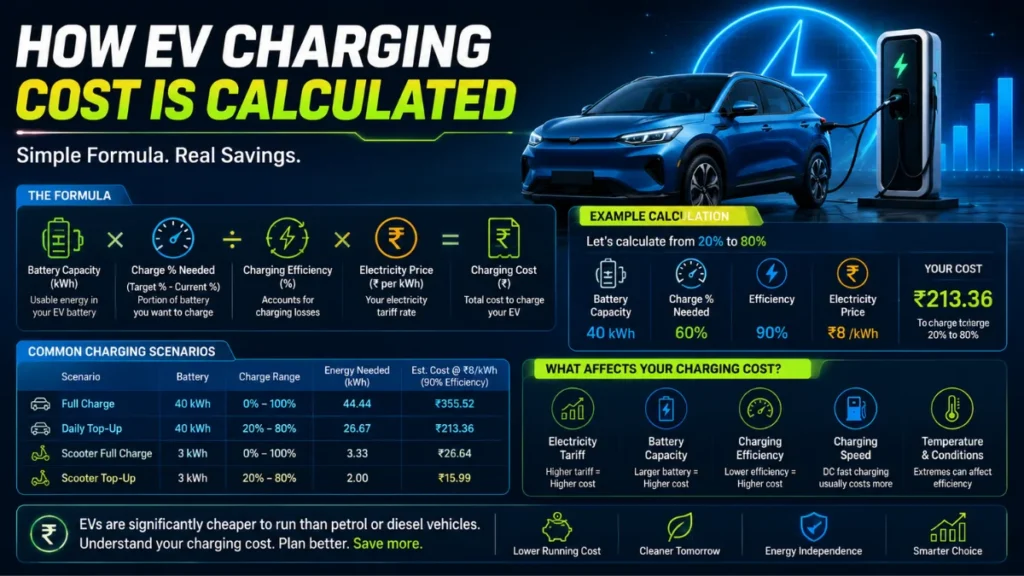
Charging cost = (Battery capacity × % charged ÷ charging efficiency) × your electricity rate per kWh.
For example, charging a 40 kWh car battery from 20% to 80% (a 60% top-up) at an example electricity rate of ₹8/kWh and 90% charging efficiency costs roughly ₹213. A small 3 kWh scooter battery doing the same 20–80% top-up costs around ₹16. Your actual numbers will differ based on your state’s electricity tariff and your vehicle’s real-world charging efficiency — which is why we’ve built the calculator below to use your own inputs.
EV Charging Cost Calculator
Enter your own numbers to get an accurate estimate. (On the live version of this page, this section becomes an interactive calculator — the fields and logic are listed below so you can also do this manually or on a spreadsheet.)
Inputs:
- Battery capacity (kWh) — check your vehicle’s spec sheet or owner’s manual
- Current battery percentage (%)
- Target battery percentage (%)
- Electricity price per kWh (₹/kWh) — check your latest electricity bill, not just the “headline” rate
- Charging efficiency (%) — 85–92% is a reasonable planning range for most home AC charging setups; use 90% if you don’t know your exact figure
Outputs:
- Energy required by the battery (kWh)
- Estimated electricity drawn from the grid (kWh) — this is what actually shows up on your meter
- Estimated charging cost (₹)
- Cost per 1% of battery charged (₹)
- Cost per 100 km (if you also enter your real-world efficiency in km/kWh)
How the Calculator Works
The calculator runs on three simple formulas:
| Step | Formula | What it tells you |
|---|---|---|
| 1. Energy required by battery | Battery Capacity × (Target % − Current %) ÷ 100 | How much energy the battery itself needs to reach your target charge |
| 2. Grid electricity required | Energy Required ÷ Charging Efficiency | How much electricity is actually pulled from your wall socket or charger, including losses |
| 3. Charging cost | Grid Electricity Required × Electricity Tariff (₹/kWh) | Your final rupee cost for that charging session |
You can also derive cost per 1% charged by dividing the total charging cost by the number of percentage points added, and cost per 100 km by dividing your electricity rate by your real-world km/kWh efficiency, then multiplying by 100.
How to Calculate EV Charging Cost Manually (Step-by-Step Example)
Let’s say you have an electric car with these details:
- Battery capacity: 40 kWh
- Current charge: 20%
- Target charge: 80%
- Electricity tariff: ₹8/kWh (example assumption — check your own bill)
- Charging efficiency: 90% (example assumption)
Step 1 — Energy required by the battery
40 kWh × (80 − 20) ÷ 100 = 40 × 0.60 = 24 kWh
This is the actual energy that needs to land inside the battery.
Step 2 — Grid electricity required
24 kWh ÷ 0.90 = 26.67 kWh
Because no charger is 100% efficient, you draw more from the grid than the battery actually stores. This is the number your electricity meter will register.
Step 3 — Charging cost
26.67 kWh × ₹8/kWh = ₹213.33, or about ₹213
Step 4 — Cost per 1% charged
₹213.33 ÷ 60 percentage points = ₹3.56 per 1%
So charging this 40 kWh car from 20% to 80% costs roughly ₹213 at an example rate of ₹8/kWh — a number you can scale up or down proportionally once you know your own electricity rate.
How Much Does It Cost to Charge an Electric Car in India?
Charging an electric car in India typically costs somewhere between ₹100 and ₹700 for a full charge, depending on battery size and your electricity rate — there’s no single “correct” figure because tariffs and battery capacities both vary widely.
Domestic electricity tariffs in India aren’t uniform. They differ by state, by the electricity distribution company (DISCOM) serving your area, and by which consumption slab you fall into — many states use a slab system where the per-unit rate rises as your monthly usage increases. On top of the headline per-unit rate, your bill may also include fixed charges, fuel/power purchase cost adjustments, and electricity duty, so your effective marginal cost per kWh can be noticeably different from the number printed at the top of the tariff card. Because of this, always plug in the rate from your own recent electricity bill rather than relying on a number you saw on a website — including this one.
Full-Charge Cost by Battery Capacity
Assumptions used for this table: electricity tariff of ₹8/kWh (example) and charging efficiency of 90% (example). These are illustrative, not universal prices.
| Battery Capacity | Energy for Full Charge (0→100%) | Grid Electricity Required | Approximate Charging Cost |
|---|---|---|---|
| 20 kWh | 20 kWh | 22.22 kWh | ₹178 |
| 30 kWh | 30 kWh | 33.33 kWh | ₹267 |
| 40 kWh | 40 kWh | 44.44 kWh | ₹356 |
| 50 kWh | 50 kWh | 55.56 kWh | ₹444 |
| 60 kWh | 60 kWh | 66.67 kWh | ₹533 |
| 75 kWh | 75 kWh | 83.33 kWh | ₹667 |
| 100 kWh | 100 kWh | 111.11 kWh | ₹889 |
To get your own numbers, replace ₹8/kWh with your actual tariff and 90% with your charger’s actual efficiency, then recalculate using the formulas above.
For help figuring out the right charger and setup for home charging, see our home charging setup guide.
How Much Does It Cost to Charge an Electric Scooter?
Charging an electric scooter is far cheaper than a car simply because the battery is much smaller — typically 2–6 kWh versus 20–100+ kWh for cars. A full charge on a small scooter battery can cost as little as ₹15–₹45 at an example tariff of ₹8/kWh.
Scooter Charging Cost (20% → 80%)
Assumptions: electricity tariff ₹8/kWh (example), charging efficiency 90% (example).
| Battery Capacity | Energy for 20→80% | Grid Electricity Required | Approximate Charging Cost |
|---|---|---|---|
| 2 kWh | 1.2 kWh | 1.33 kWh | ₹10.67 |
| 3 kWh | 1.8 kWh | 2.00 kWh | ₹16.00 |
| 4 kWh | 2.4 kWh | 2.67 kWh | ₹21.33 |
| 5 kWh | 3.0 kWh | 3.33 kWh | ₹26.67 |
| 6 kWh | 3.6 kWh | 4.00 kWh | ₹32.00 |
These battery sizes are illustrative ranges commonly seen across electric scooters sold in India, not specifications of any particular model — always check your own vehicle’s spec sheet for the exact battery capacity.
This is a big part of why electric scooters are so cheap to run: a petrol scooter doing the same daily commute can easily cost 8–15 times more per kilometre in fuel, even before you factor in engine servicing.
How Much Does It Cost to Charge an EV From 20% to 80%?
Charging from 20% to 80% costs roughly 60% of what a full 0–100% charge would cost, because you’re only adding 60 percentage points of charge instead of 100.
Many EV owners are advised to habitually charge within the 20–80% band rather than always going to 100%, since partial charging is generally gentler on lithium-ion batteries and reduces time spent at full charge. However, this isn’t a universal rule — recommended charging habits can vary by vehicle, battery chemistry (such as LFP vs NMC packs) and manufacturer guidance, so it’s worth checking your own owner’s manual rather than assuming one practice fits every EV.
20–80% Charging Cost for Cars
Assumptions: ₹8/kWh (example), 90% efficiency (example).
| Battery Capacity | Energy for 20→80% | Grid Electricity Required | Approximate Cost |
|---|---|---|---|
| 20 kWh | 12 kWh | 13.33 kWh | ₹107 |
| 30 kWh | 18 kWh | 20.00 kWh | ₹160 |
| 40 kWh | 24 kWh | 26.67 kWh | ₹213 |
| 50 kWh | 30 kWh | 33.33 kWh | ₹267 |
| 60 kWh | 36 kWh | 40.00 kWh | ₹320 |
| 75 kWh | 45 kWh | 50.00 kWh | ₹400 |
| 100 kWh | 60 kWh | 66.67 kWh | ₹533 |
20–80% Charging Cost for Scooters
| Battery Capacity | Energy for 20→80% | Grid Electricity Required | Approximate Cost |
|---|---|---|---|
| 2 kWh | 1.2 kWh | 1.33 kWh | ₹11 |
| 3 kWh | 1.8 kWh | 2.00 kWh | ₹16 |
| 4 kWh | 2.4 kWh | 2.67 kWh | ₹21 |
| 5 kWh | 3.0 kWh | 3.33 kWh | ₹27 |
| 6 kWh | 3.6 kWh | 4.00 kWh | ₹32 |
Why Does My EV Use More Electricity Than the Battery Capacity? (Charging Losses Explained)
A 40 kWh battery doesn’t necessarily draw exactly 40 kWh from your meter for a full charge — it typically draws somewhat more, because charging is never a perfectly lossless process.
Here’s what happens between your wall socket and your battery:
- AC-to-DC conversion: Home charging usually supplies alternating current (AC), but batteries store energy as direct current (DC). The onboard charger has to convert AC to DC, and that conversion isn’t 100% efficient — some energy is lost as heat.
- Charger and cable efficiency: The charging equipment itself — the onboard charger, the cable, the connectors — has its own small inefficiencies.
- Battery management system (BMS) overhead: The BMS constantly monitors cell voltage, temperature and balancing, which consumes a small amount of power during charging.
- Heat generation: Some energy is simply lost as heat across the charging circuit, especially at higher charging speeds.
- Thermal management: If your vehicle actively cools or warms the battery pack during charging (common in hot Indian summers or cold winters in the hills), that consumes additional electricity that doesn’t go into the battery itself.
- Standby/auxiliary draw: Small amounts of power may go toward the vehicle’s onboard electronics while it’s plugged in.
There’s no single universal “charging loss percentage” that applies to every vehicle, charger and condition — it depends on the charger type, ambient temperature, cable quality and vehicle design. For planning purposes, assuming 85–92% charging efficiency (example range) for typical home AC charging is reasonable, and we’ve used 90% as an illustrative figure throughout this article. If you want a more accurate number for your own vehicle, compare your odometer-based energy consumption against your metered electricity draw over a few charging cycles.
How Much Does an EV Cost Per Kilometre?
The simplest way to work out EV running cost per km is:
Cost per 100 km = Electricity price per kWh × Electricity consumed per 100 km
Or, if you know your efficiency in km per kWh:
Cost per km = Electricity price per kWh ÷ Real-world efficiency (km/kWh)
Worked Example — Electric Car
- Real-world efficiency: 6 km/kWh (example assumption)
- Electricity tariff: ₹8/kWh (example)
Cost per km = ₹8 ÷ 6 = ₹1.33 per km Cost per 100 km = ₹8 × (100 ÷ 6) = ₹133
Worked Example — Electric Scooter
- Real-world efficiency: 40 km/kWh (example assumption)
- Electricity tariff: ₹8/kWh (example)
Cost per km = ₹8 ÷ 40 = ₹0.20 per km Cost per 100 km = ₹8 × (100 ÷ 40) = ₹20
EV Cost Per Km Examples
| Vehicle Type | Efficiency (example) | Electricity Rate (example) | Cost per km | Cost per 100 km |
|---|---|---|---|---|
| Electric car | 6 km/kWh | ₹8/kWh | ₹1.33 | ₹133 |
| Electric car (efficient) | 8 km/kWh | ₹8/kWh | ₹1.00 | ₹100 |
| Electric scooter | 40 km/kWh | ₹8/kWh | ₹0.20 | ₹20 |
| Electric scooter (city, AC-heavy) | 30 km/kWh | ₹8/kWh | ₹0.27 | ₹27 |
Real-world efficiency can swing quite a bit from the numbers above depending on:
- Traffic and stop-start driving
- Average speed
- Air conditioning use
- Weather and ambient temperature
- Driving style (aggressive acceleration vs smooth driving)
- Tyre pressure
- Vehicle load (passengers and luggage)
- Highway driving vs city driving
- How much regenerative braking recovers
- Battery temperature
Because of this, treat the km/kWh figure you use in the calculator as your own observed average rather than a brochure number, wherever possible.
Daily, Monthly and Annual EV Charging Cost
Once you know your cost per km, working out your running budget is just multiplication.
Worked Example — Electric Car
Assumptions: 40 km daily driving, 6 km/kWh efficiency, ₹8/kWh electricity rate (all example figures).
- Daily electricity consumption: 40 km ÷ 6 km/kWh = 6.67 kWh
- Daily cost: 6.67 kWh × ₹8 = ₹53.33
- Monthly cost (×30): ₹1,600
- Annual cost (×365): ₹19,467
Worked Example — Electric Scooter
Assumptions: 30 km daily commute, 40 km/kWh efficiency, ₹8/kWh electricity rate.
- Daily electricity consumption: 30 km ÷ 40 km/kWh = 0.75 kWh
- Daily cost: 0.75 kWh × ₹8 = ₹6
- Monthly cost (×30): ₹180
- Annual cost (×365): ₹2,190
Daily/Monthly/Yearly Cost Example
| Vehicle | Daily km | Efficiency | Daily Cost | Monthly Cost | Annual Cost |
|---|---|---|---|---|---|
| Electric car | 40 km | 6 km/kWh | ₹53 | ₹1,600 | ₹19,467 |
| Electric scooter | 30 km | 40 km/kWh | ₹6 | ₹180 | ₹2,190 |
Remember, these figures don’t include charging losses at the socket-to-meter level for daily driving estimates based on odometer efficiency — real-world efficiency figures (km/kWh) generally already reflect losses that occur during driving, but if you’re calculating from battery capacity and charge sessions instead, apply the charging-efficiency formula shown earlier.
Home Charging vs Public Charging
Home charging is usually the cheapest way to charge an EV in India, because you’re paying your normal domestic electricity tariff rather than a separate commercial rate set by a charging network operator.
Public charging stations, on the other hand, often price electricity at a premium over typical residential rates, partly because they’re usually billed under a commercial electricity connection, and partly to cover infrastructure costs, land rent, maintenance and sometimes a parking or session fee. Public DC fast chargers in particular tend to be priced higher per kWh than home AC charging, even though they save you significant time.
We haven’t listed specific public charging network prices here, because these change frequently and vary by operator, city and charger type — always check the current per-kWh or per-minute rate on the charging network’s own app or website before you plug in.
| Factor | Home Charging | Public Charging |
|---|---|---|
| Typical tariff basis | Domestic electricity rate | Commercial/charging-network rate |
| Charging speed | Usually slower (AC) | Often faster (AC or DC) |
| Convenience | High — charge overnight | Depends on charger availability |
| Extra fees | Rare | Parking/session fees possible |
| Best for | Daily top-ups | Long trips, emergency top-ups |
If you’re setting up charging at home, see our guides on portable EV chargers and charging extension cables.
AC Charging vs DC Fast Charging
AC charging uses your home or a public AC charge point to supply alternating current, which the vehicle’s onboard charger converts to DC before it reaches the battery. It’s typically slower — often taking several hours for a meaningful top-up — but it’s gentler on the battery and is what most home charging setups use.
DC fast charging skips the onboard charger’s conversion step by supplying DC directly to the battery from an external, more powerful charging unit. This is why DC fast chargers can add a large amount of charge in a short time, and it’s the technology behind most public “fast charging” stations. The trade-off is that DC fast charging is usually priced higher per kWh than home AC charging and generates more heat, which is one reason manufacturers often recommend it for occasional top-ups rather than daily use.
What Can Increase or Reduce EV Charging Cost?
Factors that increase cost:
- Charging in a higher electricity tariff slab (crossing into a higher consumption bracket on your bill)
- Using public DC fast charging regularly instead of home AC charging
- Lower charging efficiency (older or poor-quality chargers, long/thin extension cables)
- Frequent battery thermal management in extreme heat or cold
- Charging to 100% unnecessarily often
Factors that reduce cost:
- Charging at home during off-peak hours if your DISCOM offers time-of-day tariffs
- Keeping your charger and cables in good condition
- Charging within the 20–80% band where manufacturer guidance supports it
- Driving efficiently — smooth acceleration, reasonable speeds, well-inflated tyres
- Using rooftop solar to offset grid electricity where available
How We Calculate EV Charging Cost
At EVIndiaToday, our charging cost figures come from a transparent, three-part methodology:
- Manufacturer specifications — where we reference a specific vehicle’s battery capacity, we use figures published by the manufacturer. We do not estimate or guess battery sizes.
- Electricity tariff information — actual tariff figures are sourced from official state electricity regulatory commission (SERC) orders and DISCOM tariff schedules, and are clearly dated. Where we haven’t verified a current rate, we use a clearly labelled illustrative figure (such as ₹6, ₹8, ₹10 or ₹12/kWh) instead of presenting a guess as fact.
- Illustrative assumptions — charging efficiency, real-world km/kWh figures and similar variables are stated as example assumptions, not measured claims, unless we specify otherwise.
We haven’t physically bench-tested every vehicle mentioned on this site, and we don’t claim to. Where first-hand testing data would strengthen an article, we’ll say so explicitly rather than implying it.
EV Charging Cost vs Petrol Running Cost
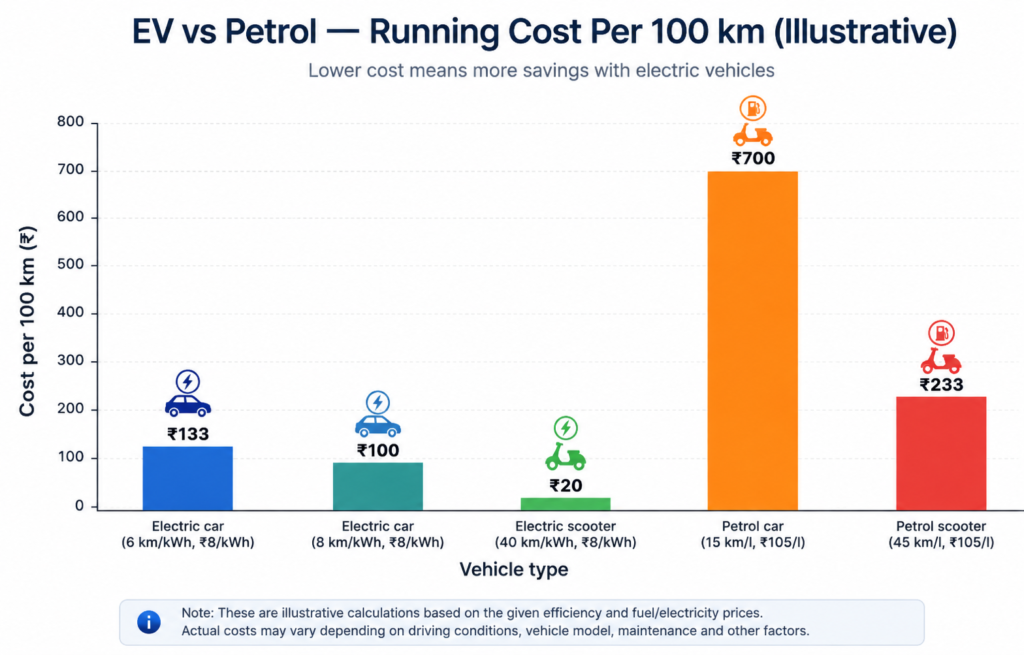
At an example electricity rate of ₹8/kWh and 6 km/kWh efficiency, an electric car costs roughly ₹1.33 per km to run. A comparable petrol car doing around 15 km/litre, with petrol priced at an example ₹105/litre, works out to roughly ₹7 per km — over five times more per kilometre in this illustration.
For a deeper, side-by-side breakdown covering purchase price, maintenance and total cost of ownership — not just running cost — see our full EV vs petrol vs diesel cost comparison.
EV Running Cost Per 100 km vs Petrol Vehicle
EV vs Petrol — Running Cost Per 100 km (Illustrative) X-axis: Vehicle type Y-axis: Cost per 100 km (₹) Data points:
Practical Tips to Reduce EV Charging Costs
- Check your electricity bill for your actual marginal rate, not just the headline tariff — fixed charges and surcharges affect your real cost per unit.
- Ask your DISCOM whether a time-of-day (ToD) tariff is available, and shift charging to off-peak hours if so.
- Keep your charging cable and connectors in good condition to avoid unnecessary efficiency losses.
- Avoid unnecessary 100% charges if your vehicle’s guidance supports 20–80% daily charging.
- Compare public charging network rates before relying on them for regular use — they can add up quickly.
- If you have rooftop solar, look into whether it can be routed to offset your EV charging load.
Key Takeaways
- EV charging cost = (Energy needed ÷ charging efficiency) × your electricity tariff.
- Electricity tariffs vary by state, DISCOM and consumption slab — always use your own rate, not a number from an article.
- Charging efficiency losses mean you’ll draw somewhat more electricity than your battery’s rated capacity.
- 20–80% charging costs roughly 60% of a full charge, before accounting for losses.
- Home charging is generally cheaper than public charging; DC fast charging trades a higher price for speed.
- Even with conservative assumptions, EV running cost per km tends to come in well below petrol running cost per km.
FAQs
How much does it cost to fully charge an electric car in India?
It depends on your battery size and electricity rate, but as an example, a 40 kWh battery charged fully at ₹8/kWh with 90% efficiency costs roughly ₹356. Smaller batteries cost proportionally less, larger ones more. Always check your own electricity tariff, since rates vary significantly by state and consumption slab.
How much does it cost to charge an electric scooter?
Electric scooters typically have 2–6 kWh batteries, so a full charge can cost as little as ₹18–₹53 at an example rate of ₹8/kWh. This is one of the biggest cost advantages scooters have over petrol two-wheelers, since the battery is so much smaller than a car’s.
How much does an EV cost per kilometre?
Using an example of ₹8/kWh electricity and 6 km/kWh efficiency, an electric car costs about ₹1.33 per km. A scooter at 40 km/kWh works out to roughly ₹0.20 per km. Your actual cost depends on your real-world efficiency and local tariff, so treat these as starting estimates.
Is home charging cheaper than public charging?
Generally yes. Home charging uses your normal domestic electricity tariff, while public charging stations are usually billed under commercial rates and may add parking or session fees. DC fast chargers in particular tend to cost more per kWh than home AC charging, though they charge much faster.
How much does it cost to charge an EV from 20% to 80%?
A 20–80% charge uses 60% of the battery’s rated capacity before accounting for charging losses. For a 40 kWh battery at an example ₹8/kWh and 90% efficiency, that works out to roughly ₹213. Smaller and larger batteries scale proportionally using the same formula.
2 thoughts on “EV Charging Cost Calculator: Cost to Charge in India”