
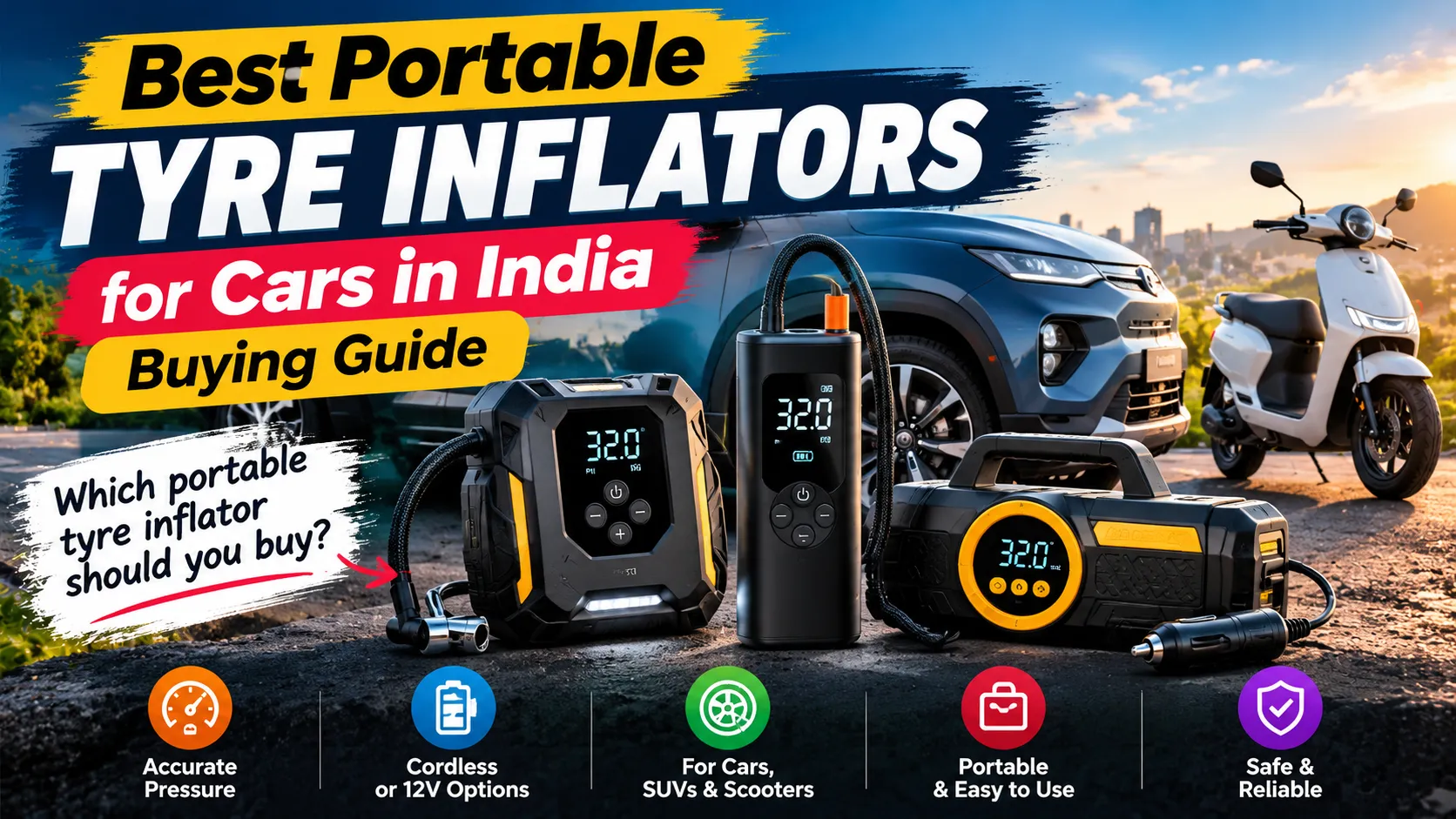
Which portable tyre inflator should you buy?
Buy a 12V wired inflator if you mainly top up tyres from your car and want no battery worries. Buy a cordless inflator if you want to use it anywhere, including on scooters and at home. Check three things first: a pressure display with auto shut-off, a pressure range that suits your tyres, and warranty support. No single model suits everyone.
Quick-selection table
| If you are… | Suitable type | Check this first | Main limitation |
|---|---|---|---|
| A city driver who tops up tyres occasionally | Cordless or 12V | Auto shut-off, readable display | A cordless unit’s battery may be flat when needed |
| A highway traveller | 12V wired, or dual-power | Cord reach to all four tyres | Needs the car’s 12V socket to work |
| An EV owner | Same as any car | Socket compatibility, tyre pressure from the manual | EVs don’t need a special inflator, and TPMS doesn’t replace manual checks |
| An electric scooter owner | Compact cordless | Valve fit, low-pressure accuracy | Car-sized units may be bulky or too coarse for scooter pressures |
| Someone who wants maximum portability | Small cordless | Battery size, charging port | Smaller batteries may need recharging between uses |
| A budget buyer | Entry-level wired or cordless | Warranty, display accuracy | Cheaper units may have weaker connectors and sparse support |
What is a portable tyre inflator?
A portable tyre inflator (also called a portable air compressor for a car) is a small electric pump that pushes air into a tyre through a hose and nozzle. A motor drives a piston, and a gauge shows the pressure. Better units let you set a target pressure and stop automatically.
It is different from three other things:
- Tyre repair kit or puncture service: these fix a leak, while an inflator only adds air.
- Petrol-pump air machine: this is a fixed machine at a station. A portable inflator lets you check pressure at home, at the right time.
- Manual foot pump: this needs no power but needs effort and time.
Why car and EV owners need one
Tyre pressure drops slowly over time and changes with temperature. A portable inflator helps with:
- Checking and correcting pressure before a long trip.
- Routine monthly top-ups without visiting a petrol pump.
- Slow leaks that need topping up until you reach a tyre shop.
- Keeping a basic accessory in the boot for emergencies.
Electric cars and scooters need the same tyre care as petrol vehicles. They don’t universally need a special inflator. EVs are often heavier, which makes correct pressure more important, but you should follow the manufacturer’s figure.
A tyre-pressure monitoring system (TPMS) warns you when pressure falls well below the recommended level. It does not replace a proper gauge reading. A Mopar owner manual explains that TPMS warns relative to the cold placard pressure, so you should still check each tyre yourself.
Types of portable tyre inflators in India
Inflator-type comparison table
| Feature | 12V wired | Cordless (rechargeable) | Dual-power (battery + 12V cord) |
|---|---|---|---|
| Power source | Car’s 12V socket | Built-in battery, usually USB-C charged | Battery, plus a cord for the car socket |
| Portability | Moderate; tied to the vehicle | High | Moderate to high |
| Needs a vehicle socket | Yes | No | Only in wired mode |
| Battery considerations | None | Charging, ageing, temperature | Same as cordless |
| Typical use | Car boot, long trips | Cars, scooters, bikes, home | Users wanting a backup |
| Key drawback | Useless if the socket doesn’t work | Flat battery means no inflation | Often costlier |
Some models also support 230V AC, such as the AGARO TI2157, which lists both 12V DC and 230V AC. No type is always faster or better. Performance depends on the product, tyre size and conditions.
Best portable tyre inflators in India: product comparison
How this list was compiled: I included models with at least some manufacturer, retailer or launch-announcement specifications that could be checked online. The tables below separate what each source states from what is not specified. I could not confirm live retailer prices on the research date. Price references are from the sources named and may be outdated. Re-check on Amazon.in, Flipkart or the brand’s site before buying. Performance figures are manufacturer claims, not independent test results.
Specifications (as stated by sources)
| Product | Type | Max pressure | Power | Stated features |
|---|---|---|---|---|
| Bergmann Typhoon BCT-150D | 12V wired | Not specified in sources reviewed | 12V, 3 m cord | Metal body, digital gauge, preset and auto cut-off, LED light, braided hose |
| AGARO TI2157 | Wired, dual power | 150 PSI | 12V DC or 230V AC, 4 m cord | 120W motor, 35 L/min, auto shut-off, LED, PSI/kPa/bar/kgf-cm² |
| Qubo Smart Pro (HIA02BL001) | 12V wired | 150 PSI | 12V DC, 3 m cord | 5 air-fill modes, auto-stop at preset |
| Portronics Vayu 3.0 | Cordless | 150 PSI | 4,000 mAh battery | 17 L/min, preset modes, LED display, flashlight |
| Portronics Vayu 5.0 | Cordless | 150 PSI | 3 × 1,500 mAh | 23 L/min, dual-line display, auto stop, flashlight |
| Portronics Vayu 7.0 | Compact cordless | Custom up to 150 PSI | 2 × 2,000 mAh, Type-C | Auto shut-off, SOS light, 5W USB power-bank output |
| AGARO Atom | Cordless | 150 PSI | 4,500 mAh, USB-C | 90W motor, auto shut-off, digital display, LED |
Price references, warranty and limits
| Product | Price reference (source) | Warranty | Main limitation | Suits |
|---|---|---|---|---|
| Bergmann Typhoon BCT-150D | From ₹2,549 – ₹2,849 on amazon | 12 Months | Needs the car socket; one owner review reports a burnt 12V connector after four years | Car owners wanting a sturdy wired unit |
| AGARO TI2157 | From ₹1,500 – ₹1,700 on amazon | 12 Months | Price and warranty not confirmed | Car plus home use |
| Qubo Smart Pro | From ₹2,350 – ₹2,500 on amazon | 6 Months | Higher price, and the same listing is vague on pressure range | Buyers wanting presets and warranty |
| Portronics Vayu 3.0 | From ₹1,549 – ₹1,749 on amazon | 12 Months | Battery claim is the manufacturer’s | Cordless cars and bikes |
| Portronics Vayu 5.0 | From ₹999 – ₹1,199 on amazon | 12 months | Launch price, which may have changed | Budget cordless buyers |
| Portronics Vayu 7.0 | From ₹1,429 – ₹1,699 on amazon | 12 Months | Small battery; the stated airflow figure is unclear | Portability |
| AGARO Atom | From ₹1,169 – ₹1,299 on amazon | 12 Months | Weak price source | Cordless buyers who verify price first |
Qubo caution: Qubo sells several models, and listings conflict on battery size and power type for similar-sounding names. Check the exact model number before buying.
Recommendations (based on researched specifications, not testing)
- Budget cordless: Portronics Vayu 5.0. It has a stated 23 L/min airflow, a 12-month warranty and a modest launch price. Limitation: the price may have changed. The Vayu 7.0 had a lower launch price but a smaller battery.
- Cordless with the largest battery: Portronics Vayu 3.0 (4,000 mAh). Portronics claims it can fill four car tyres per charge. AGARO Atom lists 4,500 mAh, but I found no reliable price or warranty. Limitation: runtime depends on tyre size and starting pressure.
- Wired, car-focused: Bergmann Typhoon BCT-150D. The brand states 0–30 psi in about two minutes on a small 145/70 R12 tyre. That is a small tyre, so don’t expect the same on bigger car or SUV tyres.
- Occasional highway trips and home use: AGARO TI2157. It has a 4 m cord and works on 12V or 230V. Limitation: price and warranty are unverified.
- Portability: Portronics Vayu 7.0. It’s compact and doubles as a power bank. Limitation: it is a small-battery unit.
No product here is “best overall.” The evidence available doesn’t support naming one.
Important features to check before buying
Pressure measurement: PSI and bar
PSI (pounds per square inch) and bar are both units of tyre pressure. 1 bar is about 14.5 PSI. Always use your vehicle’s recommended pressure. Many cars list it on a placard or label near the driver’s door, in the fuel-flap area, or in the owner’s manual. The figure printed on the tyre sidewall is generally the tyre’s maximum pressure, not the recommended operating pressure. An NHTSA service bulletin makes the same distinction and says to adjust when tyres are cold.
Pressure accuracy
An inaccurate display leads to wrong inflation. Some listings claim accuracy figures (for example, ±1 psi on Qubo marketing), but these are manufacturer claims. It is wise to verify with a separate gauge.
Maximum pressure versus practical performance
A 150 PSI maximum tells you the highest pressure the pump can reach. It does not tell you how fast or how well it fills a car tyre at 30–35 PSI.
Inflation speed
Speed depends on tyre size, starting pressure, target pressure, battery level or power supply, and temperature. Advertised times use different tyre sizes, so don’t compare them directly.
Automatic shut-off
You set a target and the pump stops. This reduces the chance of overinflation. Still re-check with a gauge, since the shut-off can differ slightly from the true reading.
Wired versus cordless
Wired units need a working 12V socket and enough cord to reach all tyres (3–4 m for the models above). Cordless units need a charged battery and a charging routine.
Battery capacity
Larger mAh numbers suggest more runtime but don’t guarantee it. Check charging time, how the battery behaves in heat, and whether the battery can be replaced.
Display, controls and lighting
A backlit display, a unit switch (PSI/bar) and a work light help at night. Preset modes are convenient, but make sure you can set a custom figure.
Noise and heat
Compressors get hot. Follow the manual’s rest periods and duty-cycle limits. Bergmann claims a metal body sheds heat better than plastic, but I found no independent test.
Build quality, warranty and service
Check the hose, the nozzle lock, the power plug and the included accessories. Look for a stated warranty period and a service route.
Which inflator suits a car, SUV or electric scooter?
| Vehicle | What matters | Practical advice |
|---|---|---|
| Hatchback or sedan | Cord reach, speed, accuracy | Most wired or cordless units listed here fit this use |
| SUV or larger tyres | Duty cycle, flow rate, runtime | Larger tyres take longer; prefer units that state flow and rest limits |
| EV car | Same as any car | Use the manual’s pressure; don’t assume EVs need special equipment |
| Electric scooter | Valve fit, low-pressure accuracy, size | Choose a compact unit, and check your valve and the manual |
Tyre size and the manufacturer’s requirements differ between vehicles. Don’t copy a pressure figure from another car. Use the owner’s manual or placard for your exact model.
For scooters, a compact two-wheeler inflator may be more practical. The Portronics Vayu Nano is positioned for two-wheelers and shows PSI and bar. It lists support for motorcycles up to 45 PSI and a claimed 0–35 PSI in under five minutes. It has a short 7.5 cm hose and small 2 × 600 mAh batteries, so check that it reaches your scooter’s valve. Never inflate beyond the recommended pressure just because the inflator allows it.
Budget, mid-range and premium: what should you spend?
Based on the listings I found, price references fall roughly into these indicative bands:
- Entry (about ₹1,800–2,400): launch prices of Vayu 7.0 and Vayu 5.0, and an unconfirmed AGARO Atom listing below this range. You get cordless convenience and basic auto shut-off.
- Mid (about ₹2,800–2,900): Bergmann Typhoon’s listed prices. You pay for a metal body, a longer cord and a stated flow rate.
- Higher (about ₹4,500): a single retailer listing for Qubo Smart Pro. I couldn’t verify a reliable premium band beyond this.
These are not market statistics. They come from a few listings with different dates.
What the extra money buys: cordless freedom, a better display, presets, a longer cord, accessories and a clearer warranty. Essentials: accurate pressure display, auto shut-off, usable cord or battery and warranty. Conveniences: power-bank output, SOS light and a storage bag. A pricier unit is worth it only if it adds something you will use.
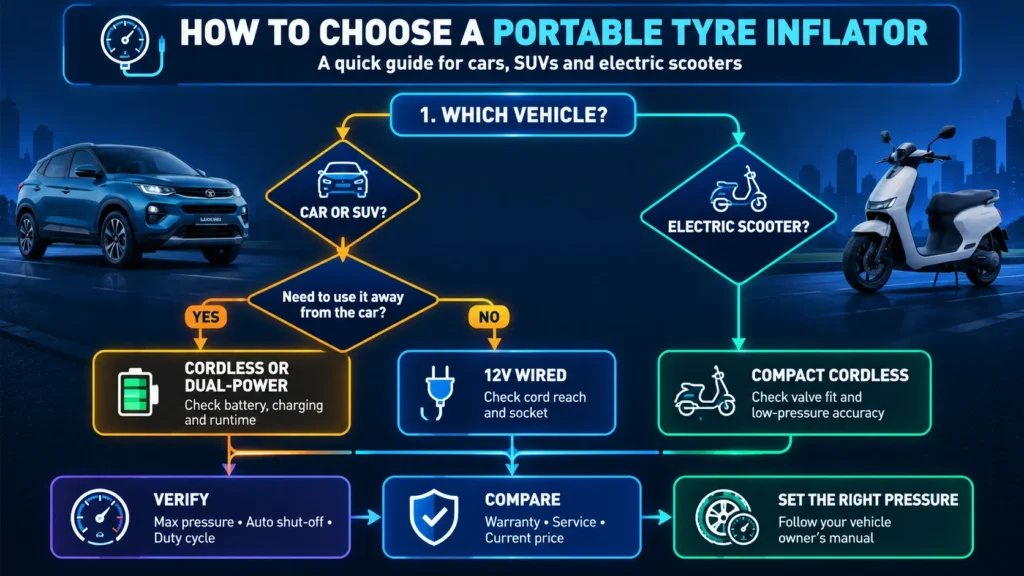
How to choose a portable tyre inflator
How to use a portable tyre inflator correctly
This is a general procedure. Your inflator’s manual and your vehicle’s manual take precedence.
- Park on level ground in a safe place, switch off the engine as the manual advises, and engage the parking brake.
- Find the recommended cold tyre pressure on the placard or in the owner’s manual.
- Inspect the tyre and valve for cuts, bulges, nails or a damaged valve.
- Connect the inflator and power it as the manual instructs: plug into the 12V socket, or use a charged battery.
- Select the unit (PSI or bar) and set the target pressure, if supported.
- Inflate while watching the display, and observe the manufacturer’s run-time and rest limits.
- Disconnect the nozzle and check pressure again, since a little air escapes as the nozzle comes off.
- Let the unit cool, coil the cord, and store it dry.
Stop and get professional help if the tyre keeps losing air, has a bulge or sidewall damage, won’t hold pressure, or the inflator overheats.
Safety precautions and common mistakes
- Overinflating: don’t go above the recommended pressure just because the inflator allows it. Inflating to the sidewall maximum is a common mistake.
- Using an inaccurate gauge: cross-check with a separate gauge.
- Ignoring cold-tyre pressure: warm tyres read higher.
- Exceeding duty cycle or ignoring overheating: stop and let it cool.
- Wrong connector or power source: use the cable and socket the manual specifies.
- Leaving it unattended if the manual says not to.
- Expecting an inflator to fix a puncture: it only adds air.
- Inflating a damaged, unseated or unsafe tyre: don’t. Call roadside assistance or a tyre shop.
Sealants and repair kits don’t fix every puncture, and the Mopar manual cited above notes that aftermarket sealants may make TPMS sensors inoperable. Persistent pressure loss, sidewall damage or repeated deflation call for professional inspection or replacement.
Portable tyre inflator buying checklist
- Fits your tyre valves (car, scooter) and works for your tyre size
- Pressure range covers your recommended pressure
- Accurate, readable display (PSI/bar)
- Auto shut-off with adjustable target
- Power source matches how you will use it
- Cord or hose reaches all four tyres
- Battery size, charging port and time (cordless)
- Duty cycle and overheat protection stated
- Storage bag or compact body
- Warranty period and service route stated
- Current price checked on the retailer’s page
Final recommendation: which inflator is right for you?
- Occasional city driver: a basic cordless unit or a 12V wired unit with auto shut-off is enough.
- Frequent highway traveller: a wired 12V model with a long cord, or a dual-power model, avoids battery worries.
- EV owner: choose by tyre size and usage. Set pressure from your EV’s manual.
- Electric scooter owner: a compact cordless inflator with a valve fit you have confirmed.
- Portability first: a small cordless unit, accepting a smaller battery.
- Affordable option: an entry-level cordless or wired unit, but confirm the warranty before you buy.
Frequently asked questions
Which portable tyre inflator is best for a car in India?
There is no single best model. A wired 12V inflator with auto shut-off suits most car owners, while a cordless unit suits those who want to use it anywhere. Compare pressure range, display accuracy, cord or battery, warranty and current price before buying.
Is a cordless or 12V tyre inflator better?
Neither is always better. A 12V inflator avoids battery charging but needs a working car socket. A cordless one is more portable but depends on a charged battery. Dual-power models offer both, usually at a higher price.
Can a portable tyre inflator be used for an electric scooter?
Often yes, if the nozzle fits your valve and the pressure display is readable at low pressures. Compact cordless models are usually easier to carry. Always use the pressure given in your scooter’s manual, not the inflator’s maximum.
How much does a portable tyre inflator cost in India?
Listings I found ranged from roughly ₹1,800 to ₹4,600, but they came from launch reports and retailer pages of differing dates. Prices and offers change often, so check the current price on the retailer’s page before buying.
Can a portable tyre inflator repair a puncture?
No. An inflator only adds air. It may help you reach a tyre shop with a slow leak, but a punctured, bulging or damaged tyre needs professional repair or replacement. Don’t keep inflating a tyre that won’t hold pressure.
If you own an electric car and are setting up a home-charging space, choosing the right extension cable is important. Read our guide to 7 Best EV Charging Extension Cables in India (Safe Guide) to understand what to consider before buying an EV charging extension cable.