
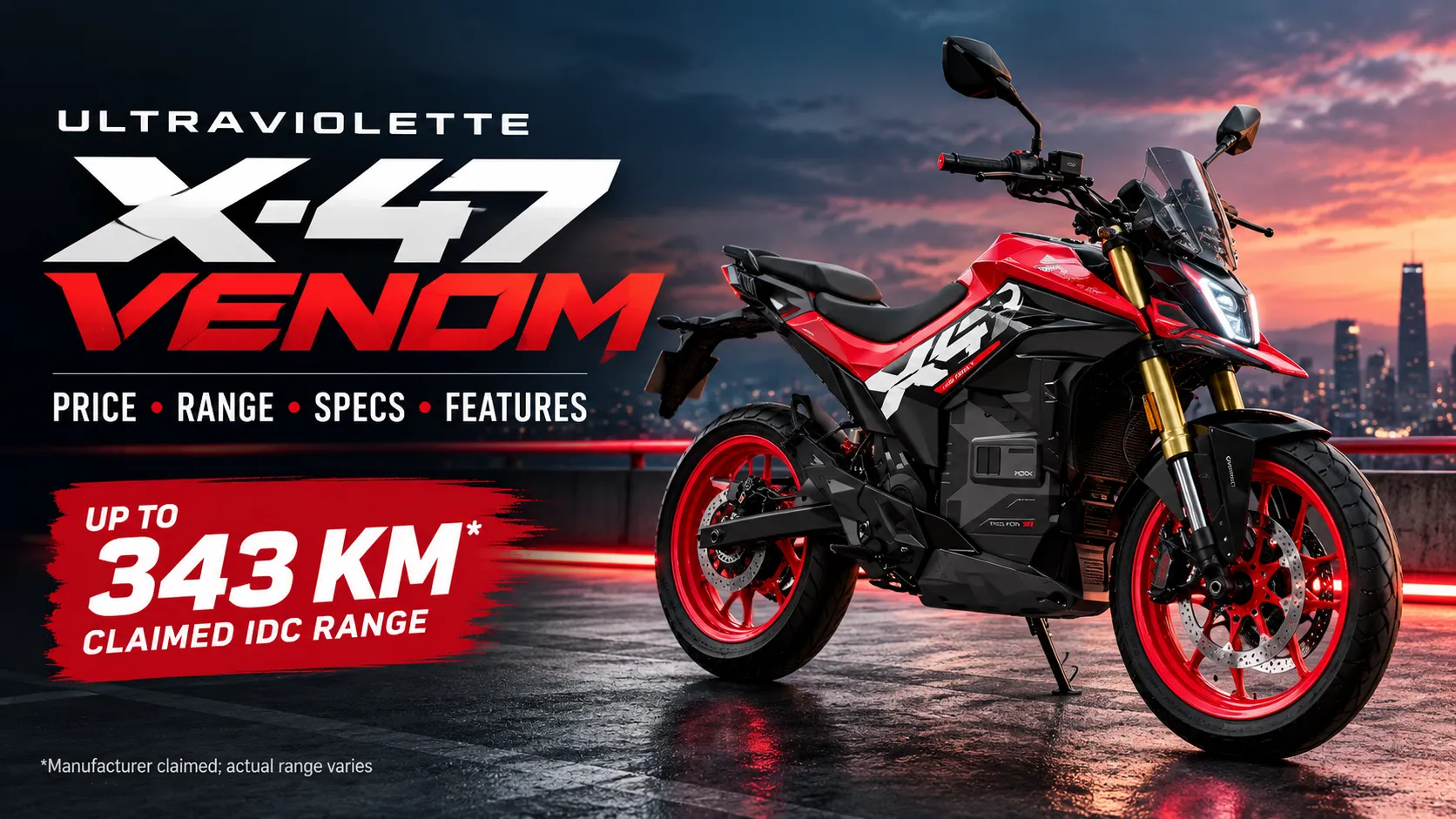
The Ultraviolette X-47 Venom is a fully electric crossover motorcycle that Bengaluru-based Ultraviolette Automotive launched in India on 22 October 2026. The introductory ex-showroom starting price is ₹2.65 lakh (Bengaluru) for the first 5,000 customers. It is the first Ultraviolette model on the company’s new VX-100 100V platform, and it comes with a 7.5 kWh or an 11 kWh battery.
Ultraviolette claims an IDC range of 227 km (7.5 kWh) or 343 km (11 kWh), a 30 kW (about 40 hp) motor, a 155 km/h top speed and 0–100 km/h in 5.9 seconds. Bookings opened on launch day and deliveries are scheduled for November 2026, according to Autocar Professional.
This guide cross-checks the manufacturer’s specification sheet against launch reports. Every performance and range number below is a manufacturer claim unless stated otherwise. We have not ridden or tested the motorcycle, and we found no independent road test or real-world range test on launch day.
Ultraviolette X-47 Venom at a glance
| Specification | Information |
|---|---|
| Motorcycle | Ultraviolette X-47 Venom |
| Vehicle type | Electric crossover motorcycle |
| Launch date | 22 October 2026 |
| Introductory starting price | ₹2.65 lakh ex-showroom, Bengaluru (first 5,000 customers) |
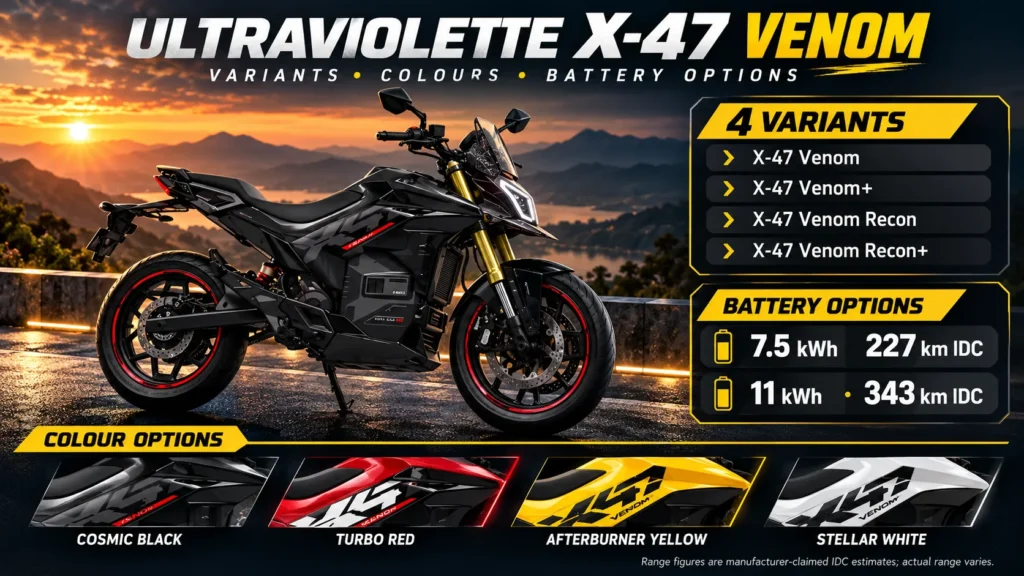
| Variants | X-47 Venom, Venom+, Venom Recon, Venom Recon+ |
| Battery options | 7.5 kWh (SRB-7.5) and 11 kWh (SRB-11), both 100V |
| Peak motor power | 30 kW (about 40 hp) |
| Peak motor torque / rear-wheel torque | 90 Nm / 550 Nm |
| Claimed top speed | 155 km/h |
| Claimed 0–60 / 0–100 km/h | 2.7 s / 5.9 s |
| Claimed IDC range | 227 km (7.5 kWh); 343 km (11 kWh) |
| Kerb weight | 180 kg (7.5 kWh); 195 kg (11 kWh) |
| Charging | 1.3 kW portable charger; 1.6 kW on-board charger (Venom+ and Recon+ only); 3 kW boost charger; 12 kW DC fast charging reported in launch coverage |
| Delivery | From November 2026 (company schedule) |
Ultraviolette X-47 Venom launch: what’s new?
X-47 launched the Venom on 22 October 2026 with the introductory price valid for the first 5,000 customers. Team-BHP reports that prices rise by ₹35,000 per variant after that. ZigWheels gives the base model’s regular price as ₹3 lakh. The two reports agree for the base model.
The company also plans a European launch across 20 countries. The Venom is due to be unveiled at the EICMA show in Milan on 3 November, according to Autocar Professional.
The VX-100 platform. The big change is electrical. The Venom is the first Ultraviolette motorcycle on a 100-volt architecture, called VX-100. A higher voltage lets a vehicle move the same power with less current, which generally helps with heat, efficiency and charging speed. Ultraviolette says the new platform brings:
- A new UV LIGHTFURY motor, said to be about 25% lighter and to hold power better at higher speeds.
- A new in-house motor controller, reported to be half the size of the old one with three times the power density. Autocar Professional says it uses silicon-carbide power electronics.
- A battery pack with higher energy density (reported as 20% by Team-BHP and 25% by ZigWheels and Autocar Professional, so we treat it as “20–25%, company claim”) and about 15% less weight.
- Cooling the company describes as twice as effective, which it links to faster charging and wider use of regenerative braking.
- A lithium-ion auxiliary battery in place of a lead-acid one, according to Autocar Professional.
The X-47 Crossover is up to 20 kg heavier than the Ultraviolette X-47 Venom, according to the company.
Ultraviolette X-47 Venom price in India
The Ultraviolette X-47 Venom price in India starts at ₹2,65,000 (ex-showroom, Bengaluru) for the base 7.5 kWh model, as an introductory price. “Ex-showroom” is the vehicle’s price before registration, insurance and other charges. The on-road price is what you actually pay, so it will be higher in most states, though state EV incentives and road-tax rules differ.
On launch day, aggregator sites quoted on-road figures for the base model ranging from about ₹2.72 lakh (ZigWheels, Delhi and Bengaluru) to ₹2.81–3.11 lakh (BikeWale) and about ₹3 lakh–3.08 lakh (BikeJunction). These estimates disagree with each other, so get a written dealer quote that itemises registration, insurance and any charger or accessory cost.
Four-variant price comparison
| Variant | Battery | Claimed IDC range | Introductory ex-showroom price | Important equipment differences |
|---|---|---|---|---|
| X-47 Venom | 7.5 kWh | 227 km | ₹2,65,000 | Standard charger; 3 regen levels; on/off traction control; no navigation, cruise control or radar |
| X-47 Venom+ | 7.5 kWh | 227 km | ₹3,15,000 | Adds 1.6 kW on-board charger, 10 regen levels, 4-level traction control, switchable ABS, navigation, cruise control, premium connectivity, Find My X-47 |
| X-47 Venom Recon | 11 kWh | 343 km | ₹3,75,000 | Adds the larger battery, UV Hypersense radar, front dashcam, crash-protection bars; standard charger |
| X-47 Venom Recon+ | 11 kWh | 343 km | ₹3,99,900 | Adds on-board charger, rear dashcam, park assist with rear-camera view, TPMS and Violette AI as standard |
Design, styling and available colours
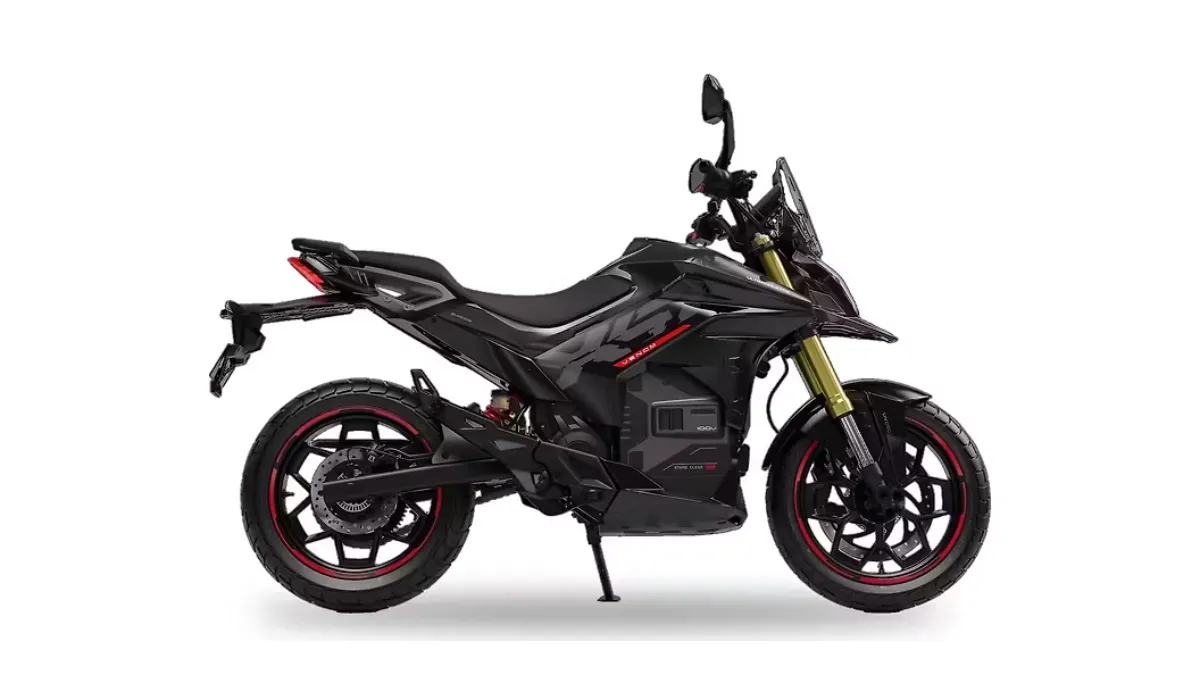
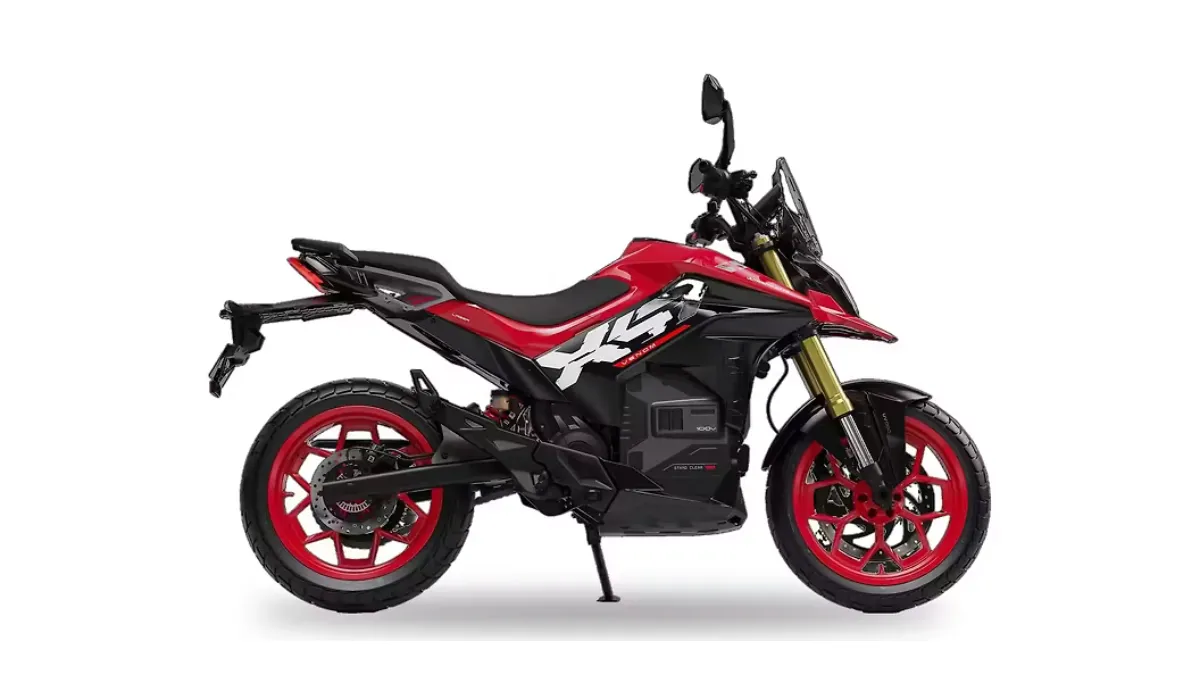
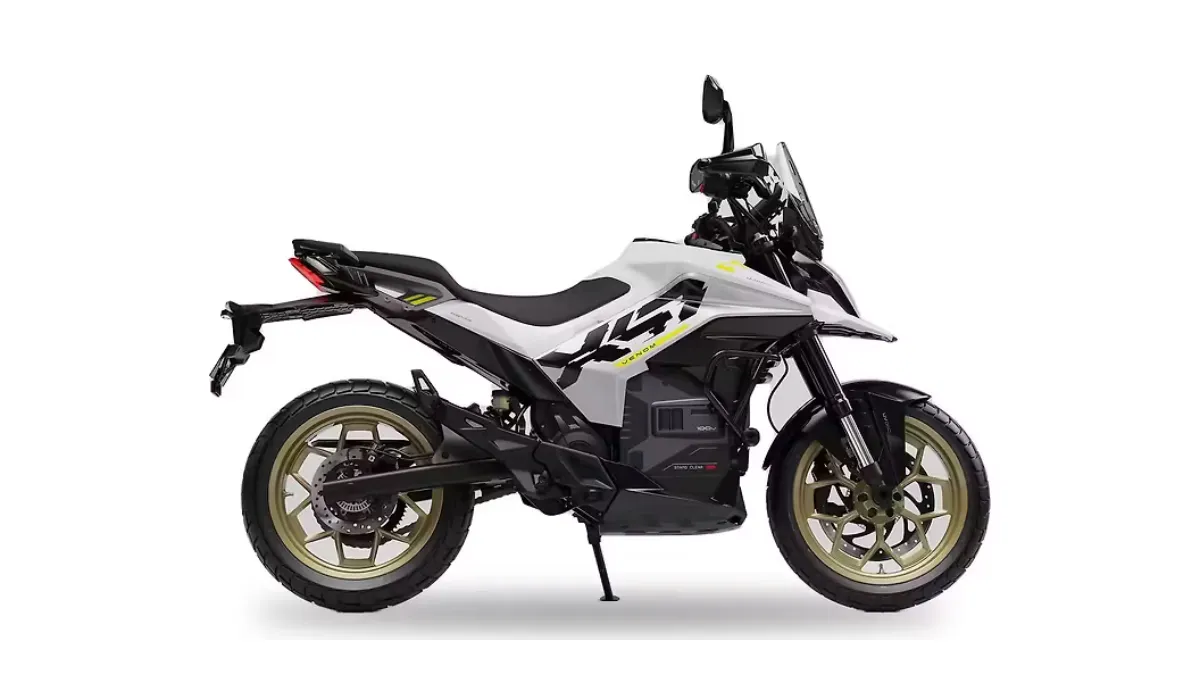
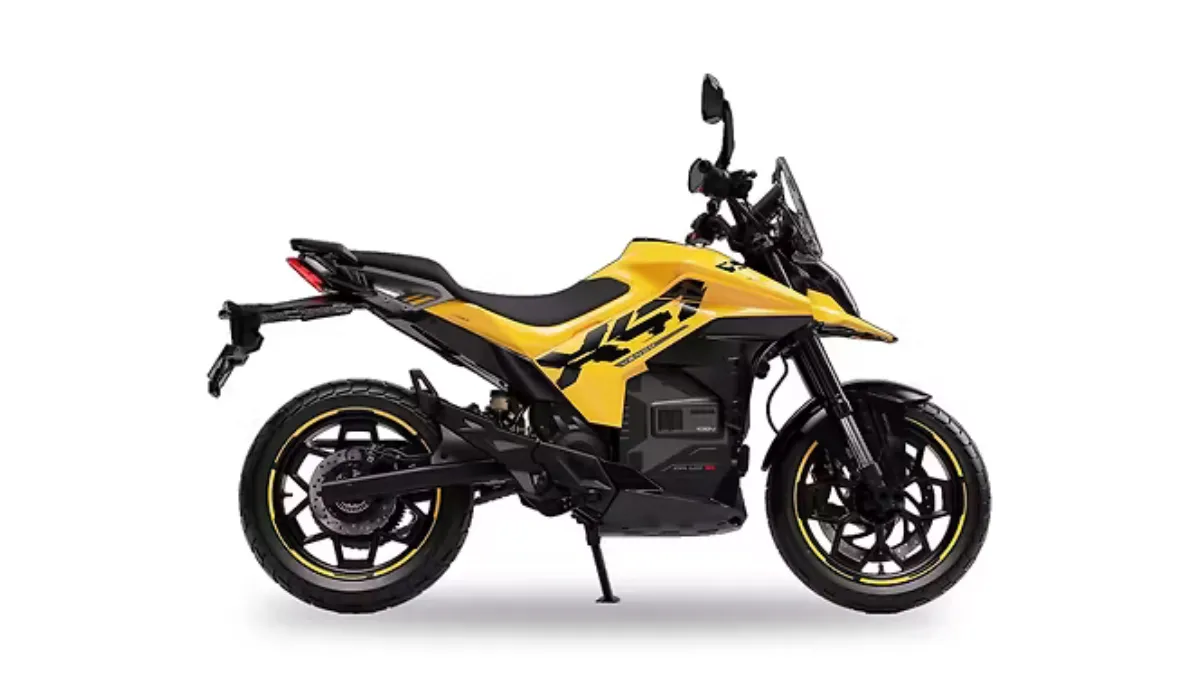
The Ultraviolette X-47 Venom keeps the Crossover’s upright, adventure-leaning stance: a tall windscreen, angular bodywork, knuckle guards and a steel trellis frame with an aluminium bulkhead. The spec sheet describes the design as “upright and ready to fight”, which is marketing language rather than a measurement.
The sheet shows four colours. Each is named with a finish family:
- Afterburner Yellow (Laser)
- Turbo Red (Laser)
- Cosmic Black (Shadow)
- Stellar White (Airstrike)
The sheet’s variant page shows three colour swatches (red, black, yellow) for Venom and Venom+, and four (adding white) for Recon and Recon+. So Stellar White appears to be a Recon-only colour. Confirm availability when booking.
Styling versus function. Colours and graphics change how the bike looks, not how it rides. Functional differences, such as the knuckle guards and bullbar on Recon variants, are equipment and affect protection in a fall. Do not assume a visual accessory is a safety item.
VX-100 platform, electric motor and performance
Per the spec sheet, every variant uses a UV Lightfury IPSM motor (an interior permanent-magnet synchronous motor) with ride-by-wire throttle. Performance figures are identical on both battery sizes:
| Figure | Claim |
|---|---|
| Peak power | 30 kW (40 hp) |
| Peak motor torque | 90 Nm |
| Rear-wheel torque | 550 Nm |
| 0–60 km/h | 2.7 s |
| 0–100 km/h | 5.9 s |
| Top speed | 155 km/h |
Motor torque versus rear-wheel torque. The 90 Nm figure is the torque at the motor. The 550 Nm figure is the torque at the rear wheel, after the drivetrain’s gear reduction multiplies it. The two numbers are not interchangeable, and 550 Nm is not a motor-shaft figure. Dividing one by the other gives roughly 6:1, which is our rough arithmetic and not an official gear ratio.
Ride modes. The sheet names three: Glide, Combat and Ballistic. It attaches average consumption to them (about 40, 52 and 60 Wh/km), which tells us the modes use progressively more energy. Our interpretation is that Glide is meant for relaxed riding and range, and Ballistic for maximum performance. Ultraviolette has not published a full description of each mode’s throttle map in the material we reviewed.
Sustained performance and regeneration. ZigWheels reports Ultraviolette’s claim that Ballistic mode is available from 100% down to 10% charge, compared with about 30% on the earlier platform. It also reports that regenerative braking works from 99% charge, up from 90%. These are company claims and are not independently verified.
Battery, battery safety and thermal management
The two packs are the SRB-7.5 (7.5 kWh) and SRB-11 (11 kWh). A kWh (kilowatt-hour) measures energy stored, like the size of a fuel tank. The 7.5 kWh pack suits shorter daily rides and a lower price. The 11 kWh pack costs more and weighs 15 kg more, and it is the pack for longer trips and fewer charges.
The spec sheet lists these battery protections:
- An all-aluminium, IP67-rated enclosure. IP67 means dust-tight and able to withstand temporary immersion in water. It does not make the bike a submersible.
- A Battery Management System (BMS), the electronics that monitor cell voltage, temperature and current.
- A patented six-level safety system covering mechanical, thermal, electrical, electronic, software and pyro-fuse protection.
- A pyro-fuse, a small charge that physically cuts the high-voltage circuit when a serious fault is detected. Autocar Professional says the company claims a response in two to three milliseconds, and Team-BHP says “microseconds”. We therefore quote the company claim only as “extremely fast”.
These systems reduce risk but cannot eliminate it. No battery maker can honestly guarantee zero risk of failure.
Ultraviolette X-47 Venom range: 227 km or 343 km?
The short answer: 227 km (7.5 kWh) and 343 km (11 kWh) are claimed IDC figures. They are not what most riders will see every day.
What IDC means. IDC stands for Indian Driving Cycle, a standardised test pattern used for certification. It follows a fixed speed profile and does not include highway cruising, aggressive acceleration, a pillion, heavy traffic or hot weather. The sheet lists “IDC est.” beside the 227 km and 343 km figures. Treat them as a way to compare bikes, not a promise.
Range by riding mode (manufacturer estimates)
| Battery | IDC range | Glide (avg. 40 Wh/km) | Combat (avg. 52 Wh/km) | Ballistic (avg. 60 Wh/km) |
|---|---|---|---|---|
| 7.5 kWh | 227 km | 188 km | 150 km | 131 km |
| 11 kWh | 343 km | 275 km | 220 km | 193 km |
All figures match the manufacturer’s spec sheet. Wh/km measures energy consumption per kilometre; lower consumption generally means greater range.
Range estimates: Glide figures align with the stated 40 Wh/km average, but Combat and Ballistic figures show small calculation differences. The reason is unconfirmed.
Real-world range: Speed, traffic, riding mode, load, terrain, tyre pressure and weather affect range. No independent X-47 Venom range test was available, so treat all mode-based figures as manufacturer estimates.
Charging, charging time and fast-charging support
| Charging method | Applicable variant/equipment | 20–80% (7.5 kWh) | 20–80% (11 kWh) | Availability or limitations |
|---|---|---|---|---|
| Portable standard charger, 1.3 kW | Standard-charger models (Venom, Recon) | 3 h 45 min | 5 h 30 min | Listed on the sheet for both battery sizes |
| On-board charger, 1.6 kW | Venom+ and Recon+ only | 3 h 45 min | 5 h 30 min | Sheet shows the same times as the 1.3 kW charger; reason not stated |
| Boost charger, 3 kW | Listed for both battery sizes | 1 h 50 min | 2 h 45 min | Sheet does not say whether it is included, optional or its price |
| 12 kW DC fast charging | Reported in launch coverage; not on the spec sheet | Not confirmed | Not confirmed | Official charging time to be confirmed; compatible networks not confirmed |
Charging notes: The 1.3 kW and 1.6 kW chargers have identical listed charging times. The 3 kW boost charger is faster, while DC fast-charging and full-charge times remain unconfirmed. Charging speed varies with battery temperature and charge level.
Technology and connectivity features
Variant matters here. The sheet shows these by variant:
- 7-inch TFT touchscreen, Qualcomm-powered, Android OS: on all variants.
- Connectivity: the base Venom has standard Wi-Fi and Bluetooth. Venom+, Recon and Recon+ have premium connectivity (LTE, Wi-Fi, Bluetooth). Practically, LTE is what enables features that need a live data link, such as locating the bike.
- On-board navigation and cruise control: Venom+, Recon and Recon+ only. ZigWheels suggests cruise control may be optional on the base model, but the spec sheet does not list it, so confirm at booking. Launch reports say navigation is powered by Mappls.
- Dashcams: Recon has a front dashcam; Recon+ has front and rear. Venom and Venom+ have none. ZigWheels reports recording at 1080p, 30 fps in a loop.
- Park assist: on all variants; Recon+ adds a rear-camera view.
- Find My X-47: Venom+, Recon, Recon+. Not on the base Venom.
- Violette AI (Delta Watch, Lockdown, Anti-Collision Warning System, Crash Alert, Daily Ride Analytics): standard on Recon+, optional on Recon and Venom+, not offered on the base Venom according to the sheet’s wording.
- TPMS (tyre pressure monitoring): standard on Recon+, optional on the others. It warns you of low pressure, which matters because tyre pressure affects range and safety.
- 35 W USB Type-C port, charge-limit setting and Deep Sleep: on all variants. Charge limit lets you stop short of 100% to be gentler on the battery, and Deep Sleep reduces standby drain when the bike is parked for a long time.
A connected feature is only as useful as the network and the app behind it. Features that need LTE will not work without it.
Radar technology and active safety
UV Hypersense is Ultraviolette’s rear radar. The sheet calls it a Gen6 77 GHz long-range radar, fitted to Recon and Recon+ only. The base Venom and Venom+ do not have it. The radar enables:
- Blind-spot detection: warns when a vehicle sits in the area you cannot see in your mirrors.
- Lane-change assist: warns if a vehicle is approaching in the lane you are moving into.
- Overtake alert: flags a vehicle coming up to overtake.
- Rear collision warning: alerts you to a vehicle closing fast from behind.
On Indian roads, where two-wheelers filter through traffic and faster vehicles approach from behind, these alerts could add awareness. The earlier X-47 Crossover was reported at launch to monitor up to 200 metres behind. We found no confirmed range figure for the Venom’s Gen6 unit, so we do not state one.
These are warning systems. They do not brake or steer for you, and they can miss small or fast-moving objects. Treat them as an extra pair of eyes, not a substitute for mirrors and a shoulder check.
Other safety equipment: Dynamic Stability Control and hill-hold on all variants; dual-channel Bosch ABS on all, switchable between mono and dual channel on Venom+, Recon and Recon+; traction control with one level (on/off) on the base Venom and four levels on the others; auto-dimming LED headlight, central brake light, hazard lights and a side-stand sensor on all. Ultraviolette also unveiled a B-Max airbag vest accessory at launch, which is not part of the bike (Autocar Professional).
Suspension, brakes, tyres and mechanical specifications
| Item | Specification (spec sheet) |
|---|---|
| Frame | Steel trellis with aluminium bulkhead |
| Front suspension | 41 mm upside-down fork, preload adjustable |
| Rear suspension | Monoshock, preload adjustable |
| Front brake | 320 mm disc, fixed 4-piston radial caliper |
| Rear brake | 230 mm disc, single-piston floating caliper |
| ABS | Dual-channel Bosch |
| Tyres | Front 110/70 R17; rear 150/60 R17 |
| Tyre model | MRF Revz-AT 03 |
| Wheelbase | 1,385 mm |
| Seat height / saddled seat height | 820 mm / 805 mm |
| Ground clearance | 200 mm |
| Length × width × height | 2,060 × 867 × 1,220 mm |
| Kerb weight | 180 kg (7.5 kWh); 195 kg (11 kWh) |
What this means in practice. An 820 mm seat is tall for many riders, though the saddled height of 805 mm (the figure with a rider’s weight compressing the suspension, as the sheet defines it) helps a little. 200 mm of ground clearance helps over speed breakers and broken roads. The 17-inch wheels and an “AT” (all-terrain) tyre give wide tyre choice and grip on mixed surfaces. At 180–195 kg the Venom is manageable for its class, but weight matters when parking on a slope.
Off-road claims: The crossover styling, knuckle guards and all-terrain tyres do not make this a dirt bike. The sheet gives no off-road capability claim, and we do not make one.
Variant-by-variant feature comparison
| Feature | Venom (7.5 kWh) | Venom+ (7.5 kWh) | Venom Recon (11 kWh) | Venom Recon+ (11 kWh) |
|---|---|---|---|---|
| Claimed IDC range | 227 km | 227 km | 343 km | 343 km |
| Charger | Standard (1.3 kW) | On-board (1.6 kW) | Standard (1.3 kW) | On-board (1.6 kW) |
| Warranty programme | UV Care 3 y / 60,000 km included; UV Care Plus 5 y / 1 lakh km optional | UV Care Plus 5 y / 1 lakh km included | UV Care Plus 5 y / 1 lakh km included; UV Care Max 8 y / 8 lakh km optional | UV Care Plus 5 y / 1 lakh km included; UV Care Max 8 y / 8 lakh km optional |
| Regenerative braking | 3 levels (10 optional) | 10 levels | 10 levels | 10 levels |
| Traction control | 1 level (on/off) | 4 levels | 4 levels | 4 levels |
| ABS | Dual-channel | Switchable mono/dual | Switchable mono/dual | Switchable mono/dual |
| Connectivity | Standard (Wi-Fi + Bluetooth) | Premium (LTE, Wi-Fi, Bluetooth) | Premium | Premium |
| Navigation and cruise control | Not available | Standard | Standard | Standard |
| UV Hypersense radar | Not available | Not available | Standard | Standard |
| Dashcam | Not available | Not available | Front | Front and rear |
| Park assist | Standard | Standard | Standard | Standard, with rear-camera view |
| Find My X-47 | Not available | Standard | Standard | Standard |
| Violette AI | Not available | Optional | Optional | Standard |
| TPMS | Optional | Optional | Optional | Standard |
| Knuckle guard and bullbar | Not available | Not available | Standard | Standard |
All variants also have Dynamic Stability Control, hill-hold, a 35 W USB-C port, charge limit, Deep Sleep, a 7-inch TFT and the 3-year / 30,000 km standard vehicle warranty.
Which upgrade might be worth it? This is editorial interpretation:
- Venom to Venom+ (₹50,000 more): the cheapest step up for navigation, cruise control, finer traction control, 10 regen levels and a 5-year / 1 lakh km battery and drivetrain warranty. Cruise control and navigation matter most if you ride highways.
- Venom+ to Recon (₹60,000 more): you gain the bigger pack and the radar, a front dashcam and crash protection, but you lose the on-board charger. This is the step for longer trips and for the rear-radar warnings.
- Recon to Recon+ (₹24,900 more): by the sheet, you gain the on-board charger, rear dashcam, rear-camera park assist, TPMS and Violette AI as standard. If you would buy TPMS and Violette AI as options anyway, this is the best value step on paper, but option prices are unpublished, so check the quote.
Warranty, maintenance and ownership considerations
The sheet lists a standard vehicle warranty of 3 years or 30,000 km on all variants. Battery and drivetrain cover comes under “UV Care” programmes:
- UV Care: 3 years or 60,000 km, included on the base Venom.
- UV Care Plus: 5 years or 1,00,000 km. Included on Venom+, Recon and Recon+; optional on the base Venom.
- UV Care Max: 8 years or 8,00,000 km (8 lakh km), optional on the 11 kWh variants. Autocar Professional described this launch-day as a battery and motor programme of up to eight years or 8 lakh km “subject to applicable terms”.
The longest programme is not included with every bike. Before paying for an upgrade, ask for the written terms: what counts as battery degradation, whether there is a capacity threshold, which parts are covered, what voids cover, how repairs are done and where service is available. We have not seen the full warranty document.
Electric motorcycles have fewer routine service items than petrol bikes (no engine oil or spark plugs), but they still need brakes, tyres, suspension, chain or belt checks and software updates. We do not have any published service price for the Venom, and we do not claim it is maintenance-free.
Running cost and cost of ownership in India
You can estimate cost per kilometre with this formula:
Cost per km = (Wh per km ÷ charging efficiency) ÷ 1,000 × electricity tariff (₹/kWh)
Battery capacity (kWh) is what the battery stores. The energy you pay for at the meter is higher because of charger losses. Ultraviolette does not publish charging efficiency in the material we reviewed, so this is an assumption.
Illustrative example (not a guarantee). We assume ₹8 per kWh and 88% charging efficiency. You should replace these with your own electricity bill and a measured efficiency.
| Mode (spec-sheet avg.) | Energy drawn from the grid | Estimated cost per km |
|---|---|---|
| Glide, 40 Wh/km | about 45.5 Wh | about ₹0.36 |
| Combat, 52 Wh/km | about 59.1 Wh | about ₹0.47 |
| Ballistic, 60 Wh/km | about 68.2 Wh | about ₹0.55 |
A full charge works out to about 8.5 kWh from the grid for the 7.5 kWh pack (about ₹68) and about 12.5 kWh for the 11 kWh pack (about ₹100), on the same assumptions.
Petrol comparison (illustrative only). At a petrol price of ₹100 per litre and a petrol bike delivering 40 km/l, running cost is ₹2.50 per km. Against ₹0.36–0.55 per km above, the electricity saving is roughly ₹2 per km, or about ₹2,000 for 1,000 km. Change any assumption and the result changes. The comparison leaves out the price gap between the bikes, insurance, servicing, tyre wear, depreciation and any battery replacement cost, none of which we have verified for the Venom. Public charging usually costs more than home charging.
Who should consider buying the X-47 Venom?
Likely suitable for:
- Daily urban commuting: the 7.5 kWh models give a claimed 227 km IDC range, and the on-board charger models avoid carrying a charger. The weight and 820 mm seat height need a test sit.
- Highway use and weekend trips: cruise control (Venom+ and above), radar (Recon and above) and the 11 kWh pack suit this best, provided you can plan charging stops.
- Performance-focused riders: a claimed 5.9 s to 100 km/h is quick by Indian standards.
- Tech and safety-minded buyers: Recon+ has the most complete equipment on the sheet.
- Riders with reliable home charging, because range and charging time are the main limits.
Drawbacks and open questions:
- Intercity touring depends on public charger availability. We have not verified DC compatibility with any network.
- IDC range is not real-world range.
- The Recon+ at ₹3,99,900 is a large step up in price from the base model.
- Weight and the tall seat may not suit shorter riders.
- Radar and connected features are not on every variant, and connectivity features depend on network coverage.
- Resale value and long-term ownership cost are unknown for a bike that has just launched.
We do not call this the “best” electric motorcycle in India. That would need a comparison with its rivals under the same conditions, and none exists yet.
Ultraviolette X-47 Venom vs the previous X-47 Crossover
| Item | X-47 Crossover (2025) | Ultraviolette X-47 Venom (2026) |
|---|---|---|
| Platform | Earlier platform | VX-100 100V |
| Battery options | 7.1 kWh and 10.3 kWh | 7.5 kWh and 11 kWh |
| Claimed IDC range | Up to 323 km | Up to 343 km |
| Claimed top speed | 145 km/h | 155 km/h |
| Weight | Baseline | Up to 20 kg lighter (company claim) |
| Display | 5-inch TFT | 7-inch TFT (BikeDekho) |
| Cruise control and navigation | Varies by variant | Venom+ and above |
| Fast charging | Not covered by the sources we reviewed | 12 kW DC reported |
| Safety hardware | Radar on higher variants | Gen6 radar on Recon and Recon+; pyro-fuse |
| Price (ex-showroom) | ₹2.49–4.59 lakh across variants (Delhi, as listed in June 2026) | ₹2.65–3.99 lakh introductory (Bengaluru) |
The two models are priced in different cities and for different variant lineups, so do not compare these price rows like for like. The earlier model’s figures come from Autocar Professional (launch and range) and Gaadify (prices).
Final verdict: is the Ultraviolette X-47 Venom worth considering?
On paper, the Ultraviolette X-47 Venom is a serious step up from the X-47 Crossover: a larger pack, a faster claimed top speed, less weight, a bigger display and a safety-focused battery design. A claimed 5.9 s to 100 km/h and a 343 km claimed range make it one of the more capable premium electric motorcycles in India on paper.
What is missing is proof. There is no independent range test, no confirmed DC fast-charging time, no published service pricing and no resale history. Everything here is the company’s claim until someone tests it.
The practical choice comes down to trade-offs:
- Base Venom (₹2.65 lakh): the lowest entry price and the 7.5 kWh pack, but no navigation, cruise control, radar or Find My X-47. Suits a rider who mostly commutes and charges at home.
- Venom+ (₹3.15 lakh): the same pack with the on-board charger, cruise control, navigation and connectivity. A good fit if you ride highways but do not need the radar.
- Recon (₹3.75 lakh): the bigger pack plus radar and a front dashcam. The step for longer trips and for the rear warnings.
- Recon+ (₹3.99 lakh): the full equipment list. It costs only ₹24,900 more than Recon, so check the option prices on Recon before deciding.
Before booking, ask for the on-road price, the variant’s exact equipment, the charger you will receive, the written warranty terms and the delivery date. If you can, wait for independent tests.
FAQs
What is the price of the Ultraviolette X-47 Venom in India?
The Ultraviolette X-47 Venom starts at an introductory price of ₹2.65 lakh (ex-showroom, Bengaluru) for the 7.5 kWh variant. The offer applies to the first 5,000 customers. On-road prices vary by location and variant.
What is the claimed range of the Ultraviolette X-47 Venom?
The Ultraviolette X-47 Venom offers a claimed IDC range of 227 km with the 7.5 kWh battery and up to 343 km with the 11 kWh battery. Actual range depends on speed, riding mode, traffic and road conditions.
How long does the Ultraviolette X-47 Venom take to charge?
Charging from 20% to 80% takes around 3 hours 45 minutes for the 7.5 kWh battery and 5 hours 30 minutes for the 11 kWh battery with the specified standard charger. The optional 3 kW boost charger reduces charging time. Verify charger compatibility for your variant.
What is the top speed of the Ultraviolette X-47 Venom?
The Ultraviolette X-47 Venom has a claimed top speed of 155 km/h and a 30 kW (40 hp) electric motor. It can reportedly accelerate from 0–100 km/h in 5.9 seconds, according to manufacturer specifications.
5. What is the difference between the Ultraviolette X-47 Venom Recon and Recon+?
Both variants feature an 11 kWh battery and a claimed 343 km IDC range. The Recon+ adds an onboard charger, front and rear dashcams, rear-camera park assist, and standard TPMS and Violette AI features.
Considering an electric two-wheeler for everyday commuting? Read our detailed comparison of the Ather 450X vs Ather 450 Electric Scooter to compare their prices, riding range, specifications and features before choosing the right EV for your needs.