
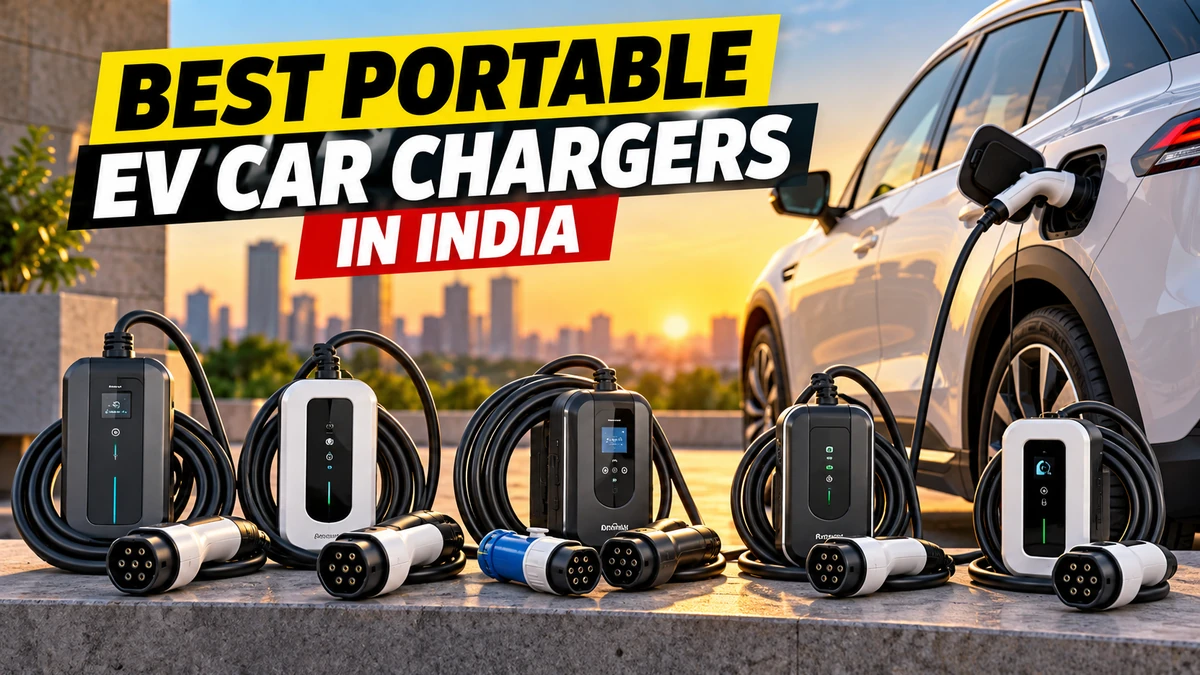
The best portable EV car chargers in India let you charge an electric car from a suitable socket without mounting a wall unit. Each is an AC charger with a control box and a Type 2 car connector. It is not a DC fast charger, and it cannot charge a car faster than the car’s onboard charger allows.
This guide compares five portable chargers listed on Amazon India. They are two 7.5 kW Zevpoint models, two Statiq models (7.4 kW and 3.3 kW) and a ZeroFootprint 7.4 kW unit. We checked specifications against manufacturer pages where we could and marked everything we could not verify. Prices and stock change often, so confirm them on each listing. Prices below were checked on 26 October 2026.
Quick Comparison of the Best Portable EV Chargers in India
| Product | Max AC power | Connector | Supply needed | Cable | Price |
|---|---|---|---|---|---|
| Zevpoint Dash 2.0 | 7.5 kW | Type 2 | 32A single phase, 32A industrial plug | 5 m | ₹18,799 – ₹19,990 Check Current Price |
| Zevpoint Aveo Pro | 7.5 kW | Type 2 | 32A single phase, 32A industrial plug | 6 m (8 m XL) | ₹19,999 – ₹21,880 Check Current Price |
| Statiq 7.4 kW | 7.4 kW (3.3 kW via home adapter) | Type 2 | 32A industrial socket, or adapter | Not verified | ₹13,990 – ₹15,350 Check Current Price |
| ZeroFootprint 7.4 kW | 7.4 kW | Type 2 | 32A single phase | Not verified | ₹17,099 – ₹18,550 Check Current Price |
| Statiq 3.3 kW | 3.3 kW | Type 2 | 3-pin domestic plug | Not verified | ₹12,700 – ₹13,800 Check Current Price |
Top 5 Best Portable EV Chargers in India
Zevpoint Dash 2.0 7.5 kW Portable EV Charger
Best for: Single-phase homes with a dedicated 32A circuit
Price: ₹19,999 on Zevpoint’s own store (26 October 2026). Amazon price not verified.
Charging power: Up to 7.5 kW (manufacturer rating)
Connector: Type 2 (IEC 62196-2)
Zevpoint says the Dash 2.0 draws up to 32A through a 32A industrial plug, with a matching socket in the box. It has an LED display, touch and app control, a 5 m cable, a carry bag and a wall bracket. The listed protections include overload, short-circuit, leakage, earthing and over-temperature cut-offs, and the unit is rated IP66. Warranty is five years on the cable and enclosure and two years on other parts.
The main catch is the electrical work. Zevpoint’s product page specifies a dedicated 32A circuit, a 40A double-pole MCB, surge protection and earthing, so budget for an electrician. The manufacturer page says the current switches between 8A and 32A, while the Amazon title says 8–32A adjustable, so check which you receive. Skip it if you only have an ordinary home socket.
Check the latest price on Amazon India.
Zevpoint Aveo Pro 7.5 kW Portable EV Charger
Best for: Parking spots far from the socket
Price: ₹21,999 to ₹23,999 on Zevpoint’s store (26 October 2026). Amazon price not verified.
Charging power: Up to 7.5 kW (manufacturer rating)
Connector: Type 2 (IEC 62196-2)
The Aveo Pro takes the same 32A single-phase approach as the Dash 2.0. It adds a 6 m cable (an 8 m version exists) and Wi-Fi and Bluetooth app control, with current adjustable from 8A to 32A. Zevpoint lists it as IP65, with a -35°C to +60°C operating range and a 4.2 kg weight. A carry bag, wall bracket and 32A socket are included.
It suits owners who park well away from the wall socket or want finer current control. The trade-offs are a higher price on Zevpoint’s store and identical installation requirements. The Amazon title mentions IP66, while Zevpoint’s page says IP65, so confirm the rating before buying.
Check the latest price on Amazon India.
Statiq 7.4 kW Portable EV Charger
Best for: People who charge at both industrial and home sockets
Price: Could not verify. Statiq’s own shop shows its portable range from ₹12,200, without naming variants.
Charging power: Up to 7.4 kW on a 32A industrial socket; up to 3.3 kW through the included home-socket adapter (per the Amazon listing)
Connector: Type 2 AC
The Amazon listing describes a 6A–32A adjustable charger with an LED display, IP66 rating, carry bag, wall bracket and a two-year warranty. Its appeal is flexibility. Use a 32A industrial socket for full speed, or the adapter at a lower 3.3 kW limit when that is all you have. Statiq’s guide says it sells the 7.4 kW unit with or without the industrial plug, so pick the variant carefully.
Cable length is not stated in the sources we could access. The warranty is shorter than Zevpoint’s cable and enclosure cover. Statiq advises against extension cords, which is sound for any charger. Buy it if you charge in more than one place. Avoid it if you need a documented long cable.
Check the latest price on Amazon India.
ZeroFootprint 7.4 kW Portable EV Car Charger
Best for: Buyers with a 32A single-phase supply who will verify details before ordering
Price: Could not verify.
Charging power: 7.4 kW (listing)
Connector: Type 2
The listing shows a 7.4 kW, 32A single-phase charger with 8A–32A adjustable current, an LCD, “multiple protections”, IP65 and an “up to 5-year warranty”. It is the least documented product in this guide. We could not verify cable length, plug type, price or what the warranty covers, and we found no manufacturer page for this portable model. Related ZeroFootprint listings sell the socket and a jumper cable separately, so check exactly what is in the box.
Choose it only after reading the full listing and confirming the warranty terms. If key details are missing, a better-documented model is the safer buy.
Check the latest price on Amazon India.
Statiq 3.3 kW Portable EV Charger
Best for: Renters and travellers with only a domestic socket
Price: Could not verify.
Charging power: 3.3 kW
Connector: Type 2 AC
This model uses a three-pin domestic plug, with current adjustable from 6A to 16A, an LED display, IP66 rating, earth detection and a two-year warranty, based on the Amazon listing and Statiq’s guide. It is slow by design, which suits overnight top-ups or a backup in the boot.
Whether your socket and wiring can carry the load depends on your home, not the charger. Have an electrician check it, and never use an extension lead. Avoid it if your daily driving needs more energy than a few hours of 3.3 kW can supply, or if you have a 32A connection and want faster charging.
Check the latest price on Amazon India.
How to Choose the Right Portable EV Charger for Your Car
Start with your car and your wiring, not the brand.
- Connector: Confirm your car’s AC inlet. Most EVs sold in India use Type 2 for AC.
- Car’s AC limit: The charger cannot exceed what the car’s onboard charger accepts.
- Power, voltage and phase: A 7.4 kW unit needs a 32A single-phase supply. A 3.3 kW unit draws far less.
- Socket and circuit: The socket, wiring and breaker must match the charger’s rating.
- Cable length: Measure from your socket to the charging port.
- Adjustable current and protections: Look for documented leakage, overload, earthing and temperature protection.
- Warranty and service: Compare what is covered and who supports you.
- Price and portability: A cheaper charger you cannot safely power is no bargain.
Read your owner’s manual and the charger’s documentation before ordering. They list the connector, current limits and safety instructions that marketing pages leave out.
Are Portable EV Chargers Compatible with All Electric Cars in India?
No. Compatibility depends on your car’s inlet, the charger’s connector, the car’s AC limit and your electrical supply.
Many electric cars in India use Type 2 for AC charging, but confirm yours. The CCS2 DC fast-charging gun is a different connector from a Type 2 AC plug. Many cars have a combined CCS2 inlet whose upper part accepts Type 2 AC, so check the manual. Do not assume an adapter fixes a mismatch, and treat any “universal” claim with caution.
Compatibility checklist:
- Confirm the AC connector in your manual.
- Find your car’s maximum AC charging rate, not its DC rate.
- Check the charger’s rated current and phase.
- Confirm your socket, circuit and earthing suit that rating.
- Ask a qualified electrician if you are unsure.
Portable EV Charger vs Home Wall Charger
| Feature | Portable charger | Wall charger |
|---|---|---|
| Portability | Moves with you | Fixed |
| Typical use | Travel, rentals, backup, flexible home use | Daily home charging |
| Charging power | Varies by model (3.3–7.5 kW here) | Varies by model |
| Installation | Needs a suitable socket or circuit | Dedicated installation |
| Convenience | Plug in and unplug each time | Always ready |
| Main limitation | Depends on socket quality | Stays at one location |
Power ratings can be similar, so the difference is mainly installation and flexibility.
Is It Safe to Use a Portable EV Charger at Home in India?
It can be, but only on a suitable setup. The socket, wiring, earthing and protective devices must support the charger’s rating, and you should follow the manufacturer’s instructions.
For the 7.5 kW Zevpoint models, the manufacturer asks for a dedicated 32A circuit, a 40A double-pole MCB, surge protection and earthing. Never use an undersized extension lead, a damaged socket or an improvised adapter. No standard household socket should be assumed suitable. If you are unsure about your circuit, ask a qualified electrician to inspect it before first use. Also check that society rules permit the installation.
Which Portable EV Charger Should You Buy?
There is no universal winner. Match the charger to your car, supply and budget.
- Dash 2.0: You have, or will install, a 32A circuit and want a display plus app.
- Aveo Pro: You need extra cable reach and finer current control.
- Statiq 7.4 kW: You charge at both industrial and home sockets and accept a shorter warranty.
- Statiq 3.3 kW: You only have a domestic socket and charge overnight.
- ZeroFootprint 7.4 kW: Consider it only after verifying cable, plug and warranty details.
Before any purchase, confirm connector compatibility, your car’s AC rate and your electrical supply. Then compare current prices.
FAQs
Can a portable EV charger charge all electric cars in India?
No. It works only with cars that have a compatible AC inlet, usually Type 2, and speed is capped by the car’s onboard AC charger. Check your owner’s manual and the charger’s compatibility details, and treat “universal” claims with caution.
Can I charge my electric car using a normal 15A socket?
Only if the charger is designed for it, the socket and wiring are in good condition and earthed, and the manufacturer allows it. Domestic-plug chargers like the Statiq 3.3 kW are built for this. 7.5 kW models need a 32A circuit. Avoid extension leads.
How long does a portable EV charger take to charge an electric car?
It depends on battery size, charger power and the car’s AC limit. As a rough estimate, a 30 kWh battery needs about 4–5 hours at an effective 7 kW and 9–10 hours at 3.3 kW, allowing for losses. Real times vary.
Is a portable EV charger safe for home use?
It can be, if the socket, wiring, earthing and protective devices suit the charger’s rating and you follow the manufacturer’s instructions. No charger is safe on unsuitable wiring. If you are unsure, have a qualified electrician inspect the circuit first.
What is the difference between a portable EV charger and a home wall charger?
A portable charger plugs into a suitable socket and travels with you, while a wall charger is fixed to a dedicated circuit. Wall chargers suit daily home charging. Portable ones suit rentals, travel and backup. Power ratings can be similar.
Sources: Zevpoint Dash 2.0, Zevpoint Aveo Pro, Statiq portable EV charger guide, and the Amazon India listings linked above. Verify vehicle details in your owner’s manual.