
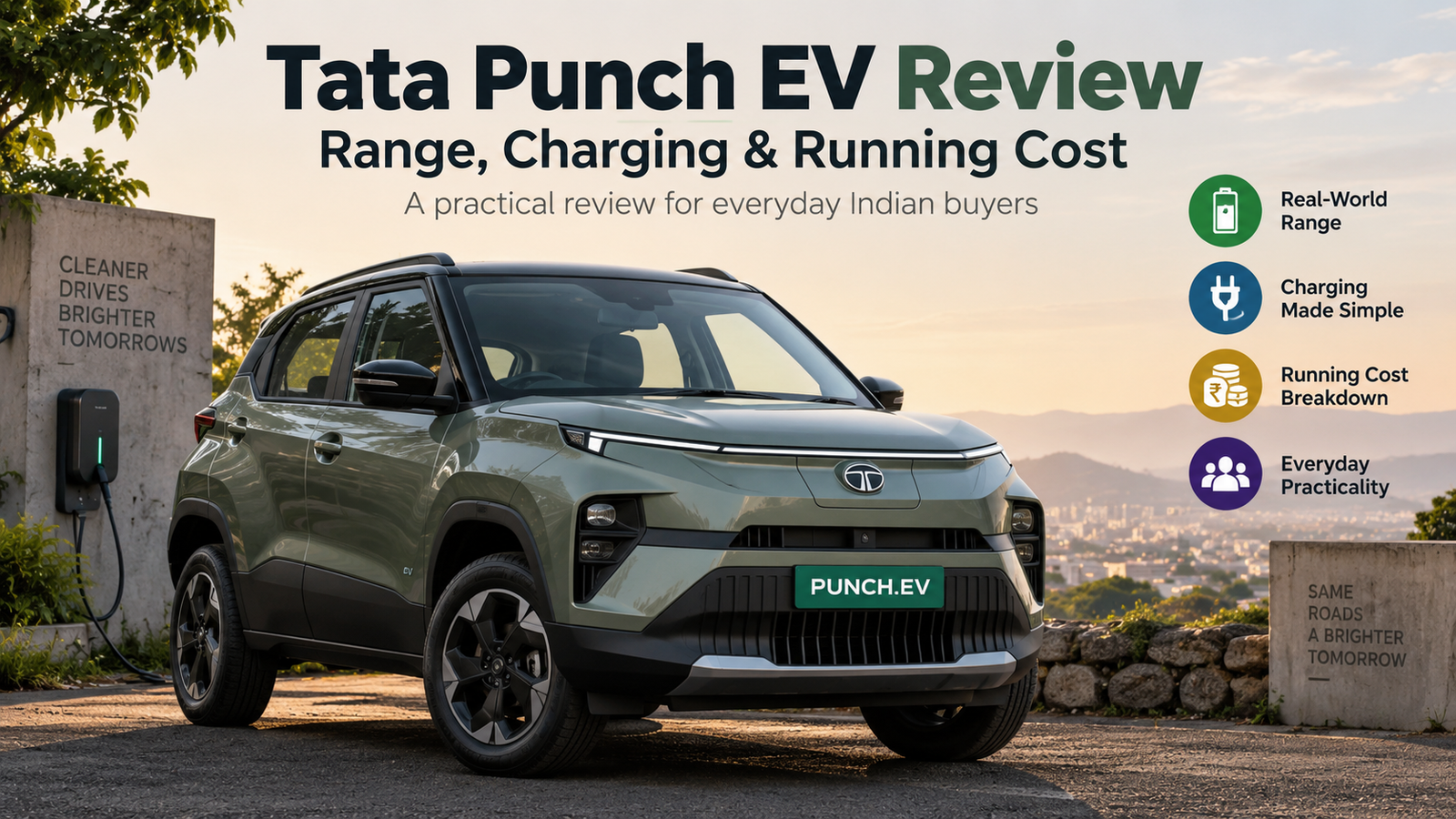
Tata Punch EV Review: Real-World Range, Charging, Running Cost & Practicality
If you are shortlisting an electric car under ₹13 lakh in India right now, the Tata Punch EV is almost certainly on your list. It sits at the intersection of two things Indian buyers care about most — a manageable price and a size that works in city traffic. But most online write-ups on the Punch EV stop at copying the spec sheet. What buyers actually want to know is simpler: how far will it really go, what will it cost to charge, and does it make sense for a family that also needs to drive out of the city once in a while?
This review tries to answer those questions using Tata Motors’ official figures, independent road test data from Indian automotive publications, and straightforward cost calculations — with the assumptions behind every number stated clearly.
A quick note before we start: the Punch EV was updated in February 2026 with a facelift that brought larger battery options (30 kWh and 40 kWh, up from the earlier 25 kWh and 35 kWh packs) along with faster charging. This review is based on the current facelifted model, since that is what you will find at dealerships today.
Tata Punch EV at a Glance
| Specification | 30 kWh variant | 40 kWh variant |
|---|---|---|
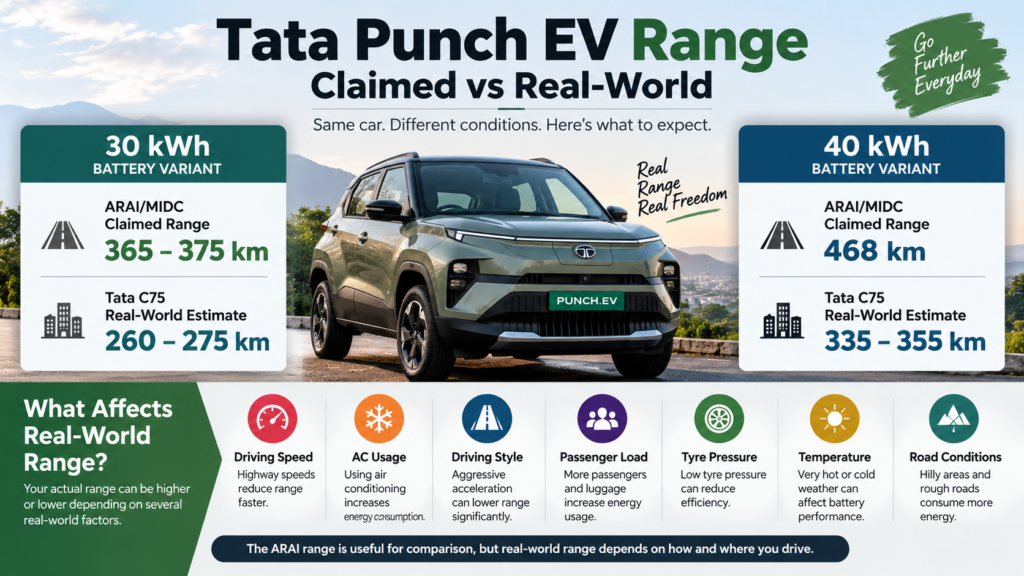
| Claimed range (ARAI/MIDC) | 365–375 km | 468 km |
| Tata’s C75 real-world estimate | 260–275 km | 335–355 km |
| Motor output | 88 PS | 127–129 PS, 154 Nm |
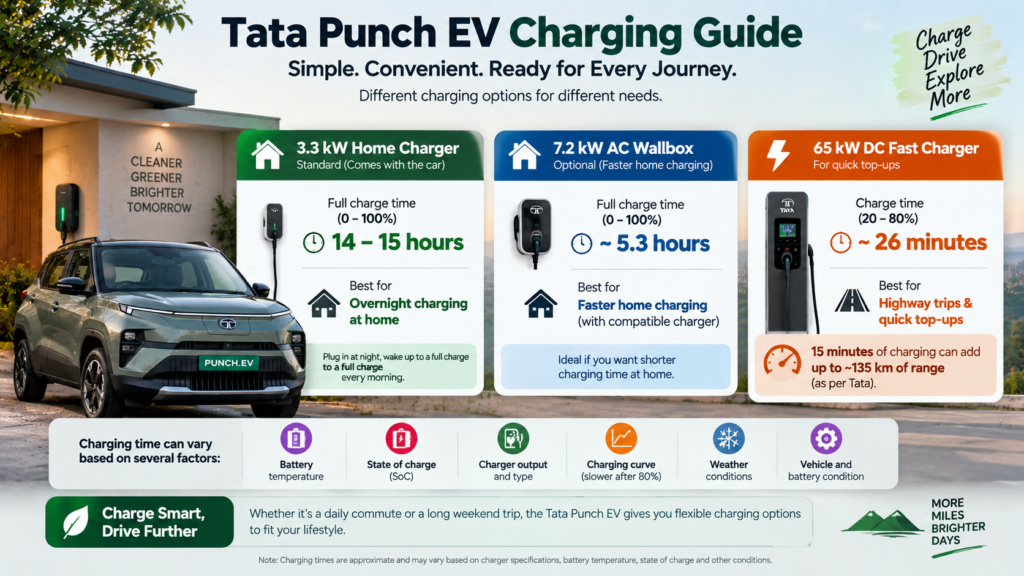
| DC fast charging | Supported | Up to 65 kW, 20–80% in ~26 min |
| AC home charging | 3.3 kW standard | 3.3 kW standard, 7.2 kW optional |
| 0–100 km/h | Not officially highlighted | Approx. 9 seconds |
| Boot space | 366 litres | 366 litres |
| Ground clearance | ~190–195 mm | ~190–195 mm |
| Seating | 5 | 5 |
| Battery warranty | Lifetime, unlimited km (as offered by Tata on the current model) | Lifetime, unlimited km |
| Ex-showroom price (approx.) | From around ₹9.7 lakh | Up to around ₹12.6–13 lakh |
Tata also sells the Punch EV under a Battery-as-a-Service (BaaS) scheme, where the car itself starts around ₹6.5 lakh and the battery is paid for separately through a per-kilometre rental. This lowers the upfront cost significantly but adds a running charge, so it needs its own cost comparison — something to discuss with your dealer rather than assume.
Two numbers matter more than any others in this table for everyday ownership: the C75 real-world range and the DC fast-charging time. The ARAI-certified figure is useful for comparing cars on paper, but it is measured under lab conditions that few owners replicate in daily driving.
Tata Punch EV Real-World Range
This is the number that actually decides whether you enjoy owning the car or spend your time anxious about the battery meter.
Tata itself now publishes two different range figures for the Punch EV, and it is worth understanding why. The ARAI/MIDC certified number — 468 km for the 40 kWh pack, for instance — comes from a standardised lab test cycle. It is a useful yardstick for comparing cars, but it does not reflect how most people actually drive.
To address this gap, Tata introduced what it calls a “C75” rating, designed to represent the range that roughly 75 percent of owners can expect in typical daily use. For the 40 kWh battery, that figure is 335–355 km. For the 30 kWh battery, it works out to roughly 260–275 km. Independent road tests by Indian automotive publications have broadly supported these figures, suggesting that around 300 km or a little more is realistic for the larger battery under normal, non-aggressive driving.
Several factors pull real-world range away from the certified number, in either direction:
- City traffic: Slow, stop-start driving actually favours EVs because of regenerative braking recovering energy during braking, so city range can sometimes beat the highway figure.
- Highway speeds: Sustained speeds of 90–100 km/h increase aerodynamic drag sharply, which is the single biggest drain on range for any EV.
- Air conditioning: Running the AC continuously, especially in Indian summer heat, can reduce range noticeably — more so at low speeds where the AC draws a larger share of total energy use.
- Driving style: Aggressive acceleration and high average speeds reduce range; smooth, gradual inputs improve it.
- Passenger and luggage load: A fully loaded car with four or five occupants and luggage will return less range than a lightly loaded test car.
- Temperature: Very hot or very cold conditions affect battery efficiency and thermal management, though Tata’s newer prismatic-cell battery is designed to be more temperature-resilient than the outgoing cylindrical-cell pack.
- Tyre pressure: Under-inflated tyres increase rolling resistance and quietly eat into range over time.
- Regenerative braking level: The Punch EV offers multiple regen levels; using a stronger setting recovers more energy in traffic.
The honest takeaway is that no single number can be promised to every buyer. Treat the ARAI figure as a ceiling, the C75 figure as a reasonable planning number for mixed driving, and expect it to dip further on highway-heavy trips.
Range numbers can look impressive on paper, but the right EV range depends on your daily driving pattern. Our guide explains how much EV range you really need in India and what factors should influence your choice.
Tata Punch EV City Range
City driving is where the Punch EV, like most EVs, tends to perform closer to its best-case numbers. Frequent braking and low average speeds mean regenerative braking gets more opportunities to recover energy, and aerodynamic losses stay low since the car rarely holds highway speeds for long.
For a typical Indian city commute — mixed traffic, moderate AC use, average speeds of 20–30 km/h — the 40 kWh Punch EV should be capable of getting close to or even slightly exceeding its C75 figure of 335–355 km on a full charge, based on how regenerative braking-heavy driving typically behaves in EVs. This effectively means most urban commuters, even those driving 40–50 km a day, would only need to charge two or three times a week rather than daily.
Short trips of a few kilometres, done repeatedly through the day, are less efficient than one longer continuous trip, since the climate control and other systems draw a fixed amount of energy each time the car is started, regardless of trip length. This is a minor factor, but worth knowing if most of your driving is short school runs or nearby errands.
Tata Punch EV Highway Range
Highway use is where the gap between the claimed and real-world numbers becomes most visible. At a steady 100 km/h with the AC running, expect the real-world range to drop meaningfully below the C75 estimate — this is standard behaviour for EVs generally, not a Punch EV-specific weakness, because aerodynamic drag increases roughly with the square of speed.
Practically, this means a 40 kWh Punch EV that returns 340 km in mixed city driving might realistically manage somewhere closer to 250–280 km on a fast, continuous highway run, depending on speed and AC load. This isn’t a criticism unique to Tata — it applies to nearly every electric car sold in India today, and buyers cross-shopping other EVs in this segment should apply the same logic to those cars’ claimed figures.
For occasional highway trips — say, a monthly drive to a nearby town 150–200 km away — the Punch EV’s 65 kW DC fast-charging capability makes a mid-route top-up manageable, adding roughly 135 km of range in about 15 minutes at a compatible fast charger, according to Tata’s own figures. For buyers who do frequent long-distance highway driving as a primary use case, it is worth honestly assessing whether a larger-battery EV, or even a petrol or CNG Punch, might suit that specific need better.
Tata Punch EV Charging Time
Charging time depends heavily on which charger you use, so it helps to separate the scenarios:
Home AC charging: With the standard 3.3 kW charger, a full charge of the 40 kWh pack from a low state of charge can take close to 14–15 hours — essentially an overnight charge. The optional 7.2 kW wallbox cuts this down substantially, with Tata quoting around 5.3 hours for a 10–100% charge on the larger battery. For most owners who charge overnight at home, this speed difference matters less than it seems, since the car simply sits plugged in while everyone sleeps.
DC fast charging: This is where the facelifted Punch EV has genuinely improved. With access to a 65 kW-capable DC fast charger, Tata quotes a 20–80% charge in around 26 minutes, and a 135 km range top-up in just 15 minutes. This is useful for topping up during a highway break or when you’re in a hurry, but it is not meant to be a daily charging method — frequent fast charging can add extra wear to any lithium battery over its lifetime, so it’s best used occasionally rather than as routine.
A few practical caveats apply here. The quoted charging times assume the charger itself is capable of delivering 65 kW continuously — many public charging points in India, especially outside major cities, cap out lower than this, which will stretch the charging time. Charging speed also naturally slows down as the battery approaches full charge, which is why the 20–80% window is quoted rather than 0–100%. Extreme heat or cold can also affect how fast a battery accepts charge. In short, treat these numbers as best-case figures achievable under ideal conditions with a compatible charger.
If you’re new to EV charging, it’s also worth understanding EV charging cables and connector types, including Type 2 and CCS2, before relying on public charging stations.
Tata Punch EV Charging Cost
This is one of the most useful numbers for anyone comparing running costs against a petrol or CNG car, so let’s work through it with clear assumptions.
The basic formula is straightforward:
Battery capacity × electricity tariff = approximate charging cost per full charge
However, this understates the real bill slightly, because charging any EV involves some energy loss — typically in the 10–15% range — between what comes out of the wall socket and what actually ends up stored in the battery. A more realistic estimate accounts for this loss.
Before calculating the Punch EV’s charging cost, it helps to understand how much electricity an EV actually uses and why energy consumption can vary depending on driving conditions.
Using the 40 kWh battery as the example, and assuming roughly 15% charging loss (so around 46 kWh drawn from the socket for a full charge):
| Home electricity tariff | Approx. cost without charging loss | Approx. cost including ~15% charging loss |
|---|---|---|
| ₹6/kWh | ₹240 | ₹276 |
| ₹8/kWh | ₹320 | ₹368 |
| ₹10/kWh | ₹400 | ₹460 |
Your actual electricity tariff depends on your state and your monthly consumption slab, since most Indian discoms charge more per unit as usage rises — so charging an EV at home can sometimes push your household into a higher tariff slab. It’s worth checking your recent electricity bill to see which slab you fall in before assuming the lowest rate applies.
Public DC fast charging works out considerably more expensive per unit than home electricity — public charging tariffs in India commonly range from around ₹15 to ₹25 per kWh depending on the operator and location, sometimes more at premium highway charging hubs. This means a full charge at a public fast charger could cost roughly ₹600–₹1,150 for the 40 kWh pack, well above the home-charging estimates above. Fast charging is best treated as an occasional convenience rather than the primary way you charge the car.
Tata Punch EV Running Cost Per Km
Once you know the charging cost, the per-kilometre running cost follows from:
Charging cost ÷ real-world driving range = approximate cost per km
Using the C75 real-world range of roughly 335–355 km for the 40 kWh pack (we’ll use 345 km as a midpoint) and the home-charging cost including losses from the table above:
- At ₹6/kWh: ₹276 ÷ 345 km ≈ ₹0.80 per km
- At ₹8/kWh: ₹368 ÷ 345 km ≈ ₹1.07 per km
- At ₹10/kWh: ₹460 ÷ 345 km ≈ ₹1.33 per km
The 30 kWh variant works out to a broadly similar per-km cost, since both battery sizes and their respective real-world ranges scale roughly together — the smaller battery isn’t meaningfully more or less efficient per kilometre.
These figures assume predominantly home charging. If a meaningful share of your charging happens at public fast chargers, your blended cost per km will be noticeably higher, possibly ₹2–3 per km or more depending on how often you rely on them.
What Does the Tata Punch EV Cost to Run for 1,000 km?
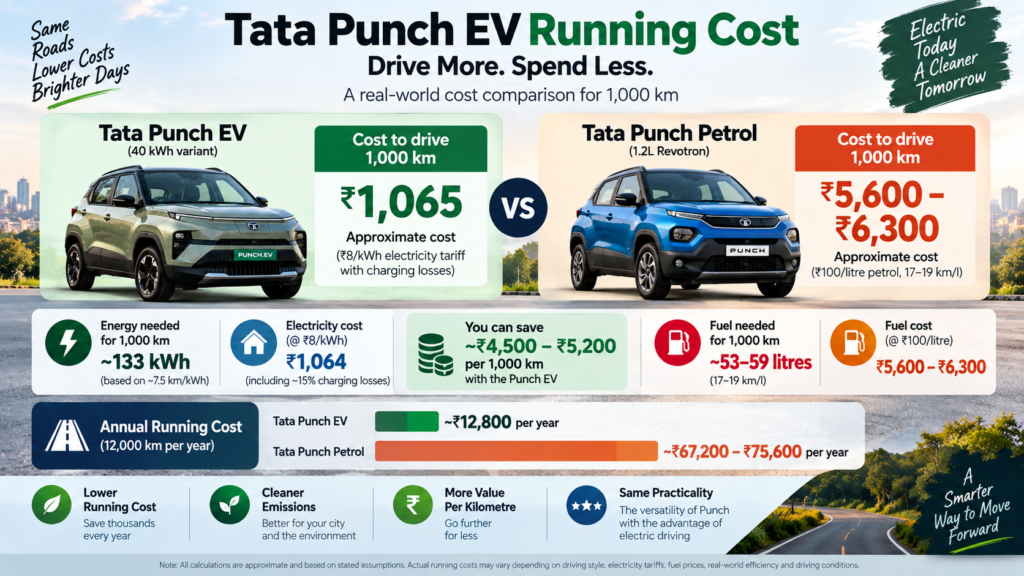
Taking the 40 kWh variant with a real-world range of around 345 km, covering 1,000 km requires roughly 2.9 full-charge equivalents, or about 116 kWh of usable energy — which translates to around 133 kWh drawn from the socket once charging losses are factored in.
At a representative home tariff of ₹8/kWh, that works out to approximately ₹1,065 for 1,000 km of driving. Over a year, assuming 12,000 km of driving (a reasonably typical figure for a city-focused second or primary car), that comes to roughly ₹12,800 in charging costs annually — again, assuming mostly home charging at this tariff.
For comparison, a petrol Punch returning a real-world mileage of around 16–18 km/l, at a petrol price of roughly ₹100 per litre, would cost approximately ₹5,600–₹6,300 to cover the same 1,000 km — around five times more than the EV’s estimated charging cost. Scaled to 12,000 km a year, that’s a difference of roughly ₹55,000–₹65,000 annually in fuel versus charging costs alone.
This comparison uses illustrative fuel and electricity prices that will vary by your city and current market rates, and it does not account for the EV’s higher upfront price, potential state subsidies, insurance differences, or maintenance costs — all of which affect the total cost of ownership over several years. It is a fuel-cost comparison, not a complete ownership cost comparison.
Is the Tata Punch EV Practical for City Driving?
For city use, the Punch EV’s compact dimensions (under 3.9 metres long), tight turning radius, and 190mm-plus ground clearance make it comfortable in narrow lanes and over speed breakers — a genuine advantage in most Indian cities where road quality varies block to block. The C75 real-world range comfortably covers a typical daily commute of 30–60 km with charging only needed every few days for most users, which removes a lot of the daily friction associated with range anxiety.
The main dependency here is charging infrastructure at home. Owners living in independent houses or those with dedicated parking with an electrical point have a straightforward experience — plug in overnight, unplug in the morning. Apartment dwellers without dedicated charging access, or without permission to install a wallbox in their building’s parking, face a harder ownership experience and would need to rely more on public charging, which is both costlier and less convenient.
Is the Tata Punch EV Suitable for Highway Trips?
For occasional highway trips of a few hundred kilometres, the Punch EV’s 65 kW DC fast-charging capability makes a single top-up stop manageable rather than a major inconvenience, particularly with Tata’s growing network of charging points along major highways. However, buyers whose routine includes frequent, long highway drives — weekly trips of 300+ km each way, for instance — should factor in the extra planning and time that charging stops add compared with a quick petrol fill-up, and should honestly weigh whether the car fits that use case as well as it fits city and short-distance driving.
Is the Tata Punch EV a Good Family Car?
With 366 litres of boot space and seating for five, the Punch EV is reasonably practical for a small family, similar in this respect to its petrol and CNG siblings. It comfortably handles a family’s daily errands, school runs, and weekend outings within city limits. Where it asks for more planning is on family road trips beyond the comfortable real-world range — a family vacation involving a 400–500 km one-way drive will need at least one, possibly two, charging stops, which changes the nature of the journey compared with a petrol car.
Families who primarily use the car within a city or region and occasionally take moderate-distance trips will likely find the ownership experience smooth. Families whose lifestyle involves frequent long-distance travel should weigh this against the substantial running-cost savings the EV offers for everyday use.
Strengths and Limitations
Strengths:
- Meaningfully improved real-world range with the facelifted 30/40 kWh battery options compared with the earlier Punch EV
- Fast DC charging (65 kW) that makes highway top-ups reasonably quick
- Strong safety credentials, including a 5-star Bharat NCAP rating and six airbags across variants
- Low running cost per kilometre compared with petrol or CNG, especially when charged at home
- Compact size and high ground clearance suited to Indian city and semi-urban roads
- Lifetime battery warranty offered by Tata, which addresses one of the biggest long-term ownership concerns for EV buyers
Limitations:
- Real-world highway range drops meaningfully below the claimed figure, as with most EVs
- Ownership is significantly easier with home charging access; apartment dwellers without dedicated charging face more friction
- Public fast charging costs considerably more per kWh than home charging, and availability still varies by region
- Some feature gaps compared to rivals in certain variants, such as the absence of rear AC vents, which matter for rear-seat comfort on longer drives
- Actual charging times at public stations depend on the charger’s real output, which is not always as fast as the vehicle’s maximum rated capability
Who Should Consider the Tata Punch EV?
- City-first buyers with home charging access: This is where the Punch EV makes the most sense — low running costs, manageable range for daily use, and the convenience of overnight charging.
- First-time EV buyers wanting a manageable price: The BaaS option in particular lowers the entry barrier, though it adds a separate running cost that needs its own comparison.
- Small families needing a second car for local use: Boot space and seating are adequate for this role, with occasional out-of-town trips being manageable rather than routine.
- Buyers whose primary need is frequent long-distance highway driving: This group should look closely at charging infrastructure along their specific routes before deciding, and may find a larger-battery EV or a conventional Punch variant a better fit.
What to Check Before Buying
- Confirm your home electricity tariff slab, since EV charging can push a household into a higher per-unit rate depending on your discom’s structure.
- Check whether your residence allows installation of a home charging point, especially if you live in an apartment complex.
- Look up DC fast-charging station availability along routes you drive regularly, not just in your home city.
- Ask your dealer for the exact battery warranty terms applicable to your specific variant, since coverage details can vary.
- Compare the outright purchase price against the Battery-as-a-Service option based on your expected annual driving distance, since the per-km rental cost changes which option is cheaper over time.
- Test drive both the 30 kWh and 40 kWh variants if range is a priority, to judge whether the price difference is justified for your typical usage.
Conclusion
The Tata Punch EV’s facelift has addressed the two things that held back the earlier version — range and entry price — without changing what already worked about the car: its size, ground clearance, and safety credentials. For a city-focused buyer with reasonable home charging access, the numbers in this review suggest it can be a genuinely low-cost car to run day to day. Where it asks for a more careful decision is around frequent highway use and charging access for apartment dwellers — areas where the right answer depends on your specific circumstances rather than the car itself. As with any EV purchase, it’s worth test-driving the exact variant you’re considering and speaking to current owners in your city about their real-world experience before finalising a decision.
FAQs
What is the real-world range of the Tata Punch EV?
Tata’s own C75 estimate puts the 40 kWh variant at 335–355 km and the 30 kWh variant at 260–275 km in typical daily driving. Actual range depends on speed, AC use, and load, so treat this as a planning figure rather than a guarantee.
How much does it cost to fully charge the Tata Punch EV?
At a home tariff of ₹8/kWh, a full charge of the 40 kWh pack costs roughly ₹320–₹370 once charging losses are included. Public DC fast charging costs considerably more per unit, often ₹600–₹1,150 for a full charge.
How long does the Tata Punch EV take to charge?
On a 7.2 kW AC home charger, the 40 kWh pack takes about 5.3 hours for a 10–100% charge. On a 65 kW DC fast charger, it goes from 20–80% in around 26 minutes.
Is the Tata Punch EV good for highway trips?
It handles occasional highway trips well thanks to fast DC charging, but real-world highway range drops below the city figure, so longer routes need at least one planned charging stop.
What is the running cost per km of the Tata Punch EV?
Based on home charging at ₹8/kWh, the running cost works out to roughly ₹1–1.10 per km — about a fifth of what a comparable petrol Punch costs to run.