
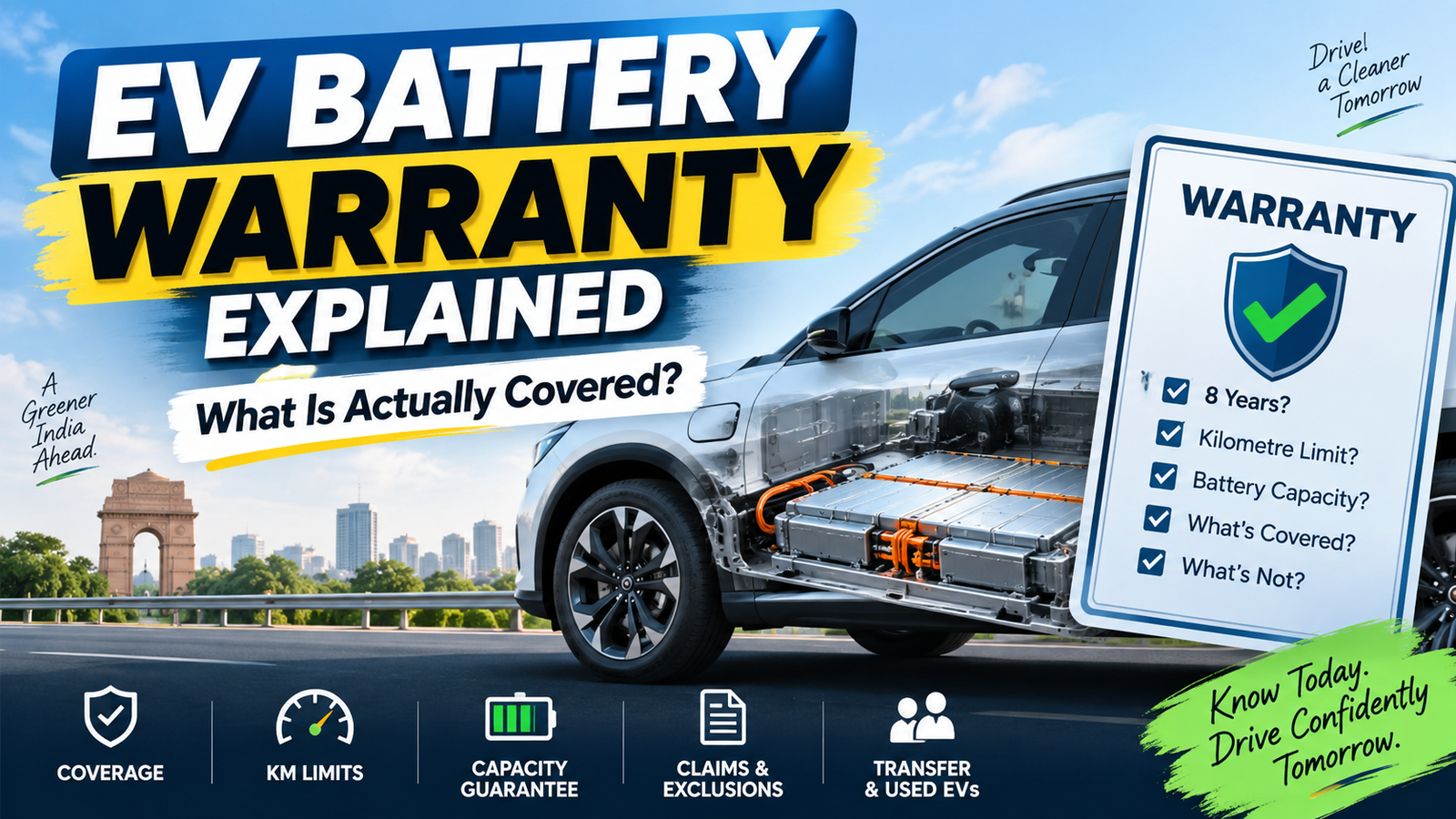
If you’re shortlisting an electric car in India right now, you’ve probably already seen the number: 8 years, or sometimes “lifetime.” It shows up in every brochure, every dealer pitch, every YouTube review. But an EV battery warranty is one of the most misunderstood documents in Indian car buying, and the gap between what people assume it covers and what it actually covers is where expensive surprises live.
A long warranty period sounds reassuring, and mostly it should be — battery packs are the single costliest part of an EV, often 30-40% of the car’s price. But “8 years” does not automatically mean every battery problem gets fixed for free. A cracked pack from a pothole, water damage from last year’s flooded underpass, or a battery that’s lost 15% of its range after five years of ownership can each be treated very differently under the same warranty booklet.
This guide walks through what an EV battery warranty in India genuinely protects, where the coverage stops, how it differs between manufacturers, and what to check whether you’re buying new or picking up a used electric car.
What Is an EV Battery Warranty?
An EV battery warranty is a manufacturer’s promise to repair or replace the high-voltage battery pack — the large unit sitting under the floor of the car — if it fails or degrades beyond an agreed point, within a set time and distance limit, at no cost to the owner.
It’s a separate document from the standard vehicle warranty. Most manufacturers give the rest of the car (infotainment, suspension, electrical wiring, AC, and so on) a shorter cover, typically 3 years. The battery and, usually, the electric motor get a much longer window because they’re the components manufacturers are most confident about, and the ones buyers worry about most.
That confidence comes with a catch, expressed as “whichever comes first.” Say a car carries an 8-year or 1,60,000 km battery warranty. If you drive it hard and cross 1,60,000 km in year six, your battery cover ends in year six — the remaining two years on paper don’t matter. Flip it around: if you barely drive and you’re at 40,000 km when year eight arrives, the warranty still lapses at year eight, regardless of the unused kilometre allowance. Time and distance are two separate ceilings, and hitting either one closes the warranty.
This is exactly why the number alone is a poor way to compare EVs. A high-mileage cab or long-distance commuter should weight the kilometre limit more heavily than the years; an occasional city driver should weight the reverse.
Why Do EV Batteries Have Such Long Warranties?
Eight years on a battery, against three years on the rest of the car, looks unusual — until you understand what’s driving it.
Lithium-ion cells, the type used in nearly every EV sold in India, age gradually rather than failing suddenly. Manufacturers have years of lab and real-world data on how these packs behave under heat, repeated fast charging, and thousands of charge cycles, so they can offer a long warranty period with reasonable confidence the majority of packs will outlast it.
There’s also a Battery Management System — usually shortened to BMS — running quietly inside every EV. Think of it as the battery’s nervous system: it monitors temperature, balances charge across hundreds of individual cells, and steps in to slow down charging or limit power when conditions get extreme. A well-tuned BMS is a big part of why manufacturers can promise long coverage without it becoming a routine payout.
And then there’s the market reality. Indian buyers are still cautious about EVs specifically because of battery replacement cost anxiety. A strong, well-marketed battery warranty directly answers that fear, which is why warranty length has become a genuine competitive battleground — and why “lifetime” battery warranties have started appearing from Tata, Mahindra, and MG on select models.
None of this means every battery will comfortably outlive its warranty. It means the warranty period reflects genuine engineering confidence, not just a marketing number picked to sound impressive.
What Does an 8-Year EV Battery Warranty Actually Mean?
Let’s use a hypothetical example — not a real manufacturer’s terms — to make this concrete. Say you buy an EV in January 2026 with an 8-year/1,60,000-km battery warranty. That cover runs until January 2034 or until the odometer touches 1,60,000 km, whichever happens first.
If you’re an average Indian city driver covering roughly 10,000-12,000 km a year, you’d reach around 80,000-96,000 km by year eight — comfortably inside the kilometre limit, so the 8-year clock is what actually decides when your cover ends. But if you’re an app-based cab driver covering 40,000+ km a year, you could hit 1,60,000 km in year four, and your battery warranty would end four years earlier than the “8 years” headline suggests.
The start date also matters and isn’t always obvious. Some manufacturers count from the date of first registration at the RTO; others count from the date of delivery. A car that sat at the dealership for two months before you took delivery could start its warranty clock slightly differently depending on which date the manufacturer uses — worth confirming when you sign the paperwork.
And, as covered above, these numbers are not universal. Tata’s mainstream battery warranty and Hyundai’s Creta Electric both commonly run 8 years/1,60,000 km, but MG’s Comet EV is warranted for 8 years/1,20,000 km, its ZS EV for 8 years/1,50,000 km, and Mahindra’s BE 6 and XEV 9e carry a lifetime warranty for the first owner with a 10-year/2,00,000 km fallback after resale. Treat every figure in this article as illustrative unless it’s tied to a specific model in the comparison table below — always confirm against your own warranty booklet.
Battery Capacity Guarantee: The Part Many Buyers Miss
This is where most EV battery warranty confusion actually starts, so it’s worth slowing down.
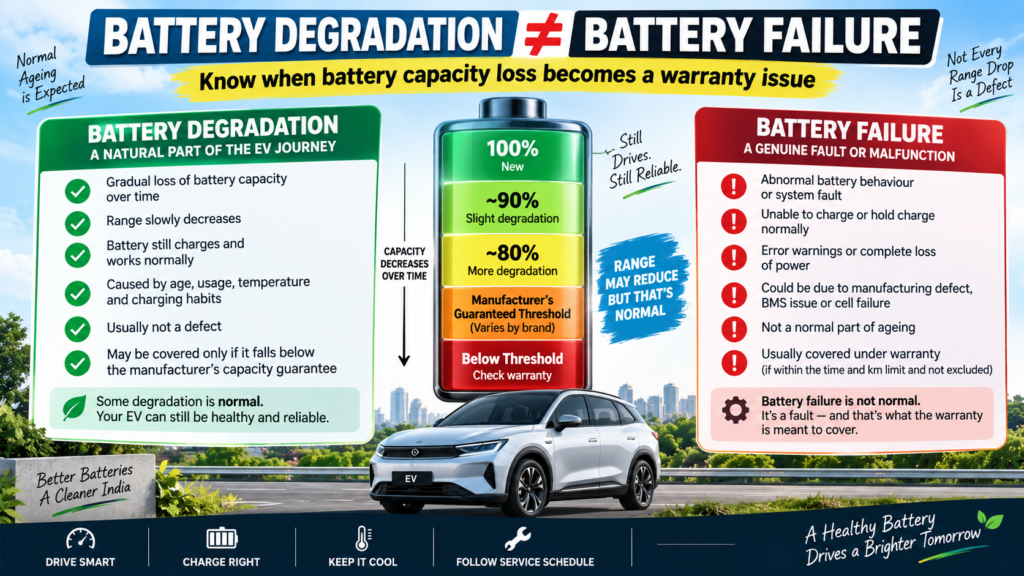
Every lithium-ion battery loses a little capacity over time, even under ideal conditions. A battery that held, say, 50 kWh of usable energy when new might hold closer to 40 kWh after several years of daily charging and driving. This is called degradation, and it shows up to the driver as a gradually shrinking range — the same car that once did 400 km on a full charge might do 340-350 km after five or six years.
That drop, on its own, is not a defect. It’s expected chemical ageing, the same way a laptop or phone battery holds less charge after a couple of years. Reduced range by itself does not mean something is broken.
What manufacturers add on top of the basic battery warranty is a capacity guarantee — a promise that the battery won’t drop below a certain percentage of its original capacity within the warranty period. Industry commentary in India frequently references a 70% state-of-health floor as the common benchmark across several brands, where State of Health (often written SoH) is simply a percentage score of how much usable capacity remains compared to when the battery was new. If your battery’s SoH falls below that floor while you’re still inside the warranty’s years/km window, you may qualify for a repair or replacement.
The specific percentage, and whether a manufacturer states it publicly at all, varies by brand and sometimes by model. Not every manufacturer’s official India website publishes an exact capacity-guarantee figure, so treat any percentage you see — including the 70% figure above — as something to verify against your specific car’s warranty document rather than an assumed universal standard.
What Happens If the Battery Falls Below the Guaranteed Capacity?
If you suspect your battery has degraded past its guaranteed threshold, the process generally starts at an authorised service centre rather than with an automatic replacement.
A typical sequence looks like this: the service centre runs a battery health diagnostic through the BMS to get an accurate SoH reading (this is more reliable than judging degradation from the dashboard’s estimated range, which shifts with driving style, weather, and traffic). If the reading confirms capacity has genuinely dropped below the guaranteed floor, the manufacturer’s warranty team reviews the case, checking service history and usage pattern along the way.
The remedy from there depends on the manufacturer and the nature of the shortfall. Some cases are resolved with a software recalibration if the BMS itself was under-reporting capacity. Others involve replacing a specific module — a group of cells within the larger pack — rather than the entire unit, which several Indian manufacturers now do routinely and relatively quickly. Full pack replacement is reserved for more serious cases.
The key point for owners: a subjectively “shorter range than I expected” complaint is not the same as a documented SoH reading below the warranty threshold. Get the official diagnostic first. Assuming you’re automatically entitled to a new battery because your commute suddenly feels tighter is one of the more common and avoidable disappointments EV owners run into.
Battery Failure vs Battery Degradation: What Is the Difference?
This distinction sits at the centre of almost every EV battery warranty conversation, so it deserves its own section.
Battery failure means something has actually gone wrong — a genuine malfunction. This could be a manufacturing defect, a fault in the BMS, a cell that’s developed an internal short, or the battery simply refusing to charge or hold charge normally. Failure is abnormal. It’s the kind of fault a warranty is explicitly designed to catch, and in most cases it’s covered as long as you’re within the time/distance window and the cause isn’t excluded (more on exclusions below).
Battery degradation, on the other hand, is the slow, predictable loss of capacity every lithium-ion battery experiences with age and use. It isn’t a fault — it’s expected chemistry. Degradation only becomes a warranty matter once it crosses the manufacturer’s stated capacity-guarantee threshold, which is why the capacity guarantee section above matters so much.
In short: a battery that won’t charge past 20% no matter what you do is likely a failure. A battery that charges to 100% fine but now takes you 350 km instead of the original 400 km is degradation, and whether that’s a warranty case depends entirely on where your current SoH sits relative to the guaranteed floor.
Is Accidental Battery Damage Covered?
Generally, no — not under the standard EV battery warranty. Manufacturer warranties are built to cover manufacturing defects and the specific conditions spelled out in the policy, not damage from external events.
If your car goes over a deep pothole and the underbody impact cracks the battery enclosure, or a collision damages the pack, this typically falls outside the manufacturer’s warranty and into comprehensive motor insurance territory instead. Most EVs today have some underbody protection built into the battery casing precisely because Indian roads present this risk, but protection isn’t immunity.
The practical path after any physical impact to the underside of the car is: get it inspected at an authorised service centre immediately, even if there’s no visible external damage, and separately check what your comprehensive insurance policy covers for battery damage from accidents. Some insurers now offer specific EV battery protection add-ons for exactly this scenario. Don’t assume either the warranty or a standard insurance policy automatically covers underbody impact — confirm both, in writing, for your specific policy and warranty booklet.

Is Water or Flood Damage Covered Under an EV Battery Warranty?
This question matters more in India than almost anywhere else, given how many cities deal with waterlogged roads every monsoon.
EV battery packs are built to a water and dust resistance rating — commonly an IP67 rating on Indian models — which means they’re designed to handle normal exposure: rain, splashes, driving through shallow standing water. That’s a meaningful, tested level of protection, and it’s why EVs generally aren’t more fragile in the rain than petrol or diesel cars.
But an IP67 rating is not the same as flood-proof. It has defined limits on depth and duration. If a car is driven into or parked in deep, standing floodwater — the kind that submerges the underbody for an extended period — that’s outside the tested and warranted conditions, and the resulting damage is commonly treated differently from a manufacturing defect claim. In practice, this is more likely to be a matter for your motor insurance (again, check whether you have specific EV/battery protection cover) than for the battery warranty.
The safest assumption for Indian monsoon season: treat “IP67-rated” as protection against normal weather and driving, not as a guarantee against deliberately driving through deep flooding. When in doubt about water depth on a flooded stretch, it’s genuinely cheaper to wait it out or take a different route than to test the limits of a rating.
Can Charging Damage Void an EV Battery Warranty?
Not automatically — but how and where you charge does matter to a warranty claim in specific circumstances.
Regular home AC charging, public AC charging, and occasional DC fast charging at authorised stations are all normal use, and using them as intended doesn’t void your warranty. What can create a problem is charging through damaged equipment, an incorrectly installed home charging point without proper earthing, using unauthorised or non-compliant chargers, or an electrical fault on the home circuit that sends damage back into the car’s onboard charger or battery.
If a claim investigation traces battery damage to something like faulty non-standard charging equipment, an unauthorised electrical modification, or clear misuse rather than normal operation, the warranty can be denied for that specific incident — this is a standard exclusion category across manufacturers, not something unique to one brand. The manufacturer’s warranty booklet will list the specific exclusions relevant to your car; DC fast charging itself, used within manufacturer specifications, is not one of them for any major Indian EV brand’s official terms as of now.
The practical takeaway: use the charger that came with the car or an authorised equivalent, get home charging point installation done by a certified electrician with proper earthing, and keep any installation documentation. It’s cheap insurance against a claim dispute later.
Does Battery Degradation Depend on Charging Habits?
Yes, to a meaningful degree — though the picture is more nuanced than “fast charging is bad.”
A few things genuinely do influence how quickly a battery ages: consistently charging to 100% and leaving it there for long periods, frequent exposure to high heat (parking in direct summer sun for extended stretches, for instance), and very frequent high-power DC fast charging as opposed to occasional use. None of these will destroy a battery overnight, but they can nudge the degradation curve a little steeper over years of ownership.
That said, modern EVs aren’t passive about this. The BMS actively manages charging speed, cuts back power in high heat, and in many cases limits how aggressively the car will fast-charge as the battery gets warmer, precisely to protect long-term health. Occasional fast charging on a road trip is not going to meaningfully shorten your battery’s life. The habits that matter more are the everyday, repeated ones — where you park, how often you sit at 100% unnecessarily, and how consistently you charge rather than any single charging session.
If you want a simple rule of thumb that most Indian EV owners find workable: charge to around 80% for daily use, reserve 100% charges for longer trips, and park in shade when you can. None of this is required by any warranty, but it’s a reasonable way to keep your battery’s SoH comfortably above the guaranteed floor for as long as possible.
Does the EV Battery Warranty Transfer to the Second Owner?
Often, yes — but not automatically, and not always on identical terms to the first owner.
Most Indian EV manufacturers allow the remaining battery warranty period to transfer to a second owner when the car is resold, provided the ownership change is properly registered with the RTO and, in many cases, formally notified to the manufacturer within a specified window. Skip that notification step and you can find the “transferred” warranty disputed later.
Where this gets more complicated is with the newer “lifetime” battery warranties some manufacturers now offer. These are frequently structured as a first-owner-only benefit. Mahindra’s BE 6 and XEV 9e, for example, carry a lifetime battery warranty for the first private, registered owner, but that reverts to a fixed 10-year/2,00,000-km warranty from the original delivery date once the car changes hands — not a fresh lifetime term for the new owner. Tata’s newer lifetime battery warranty programs on select models carry similar first-owner conditions. This is exactly the kind of detail that’s easy to miss if you’re relying on a dealer’s verbal summary instead of the written warranty policy.
If you’re buying new and plan to sell in a few years, or buying used and counting on remaining warranty, read the transfer clause specifically — don’t assume the headline “lifetime” or “8-year” figure applies the same way to whoever owns the car next.
What Happens to the Battery Warranty When You Buy a Used EV?
For a used-EV buyer, the battery warranty isn’t a bonus feature — it’s arguably the single most important thing to verify before signing anything, given what a battery replacement costs outside warranty.
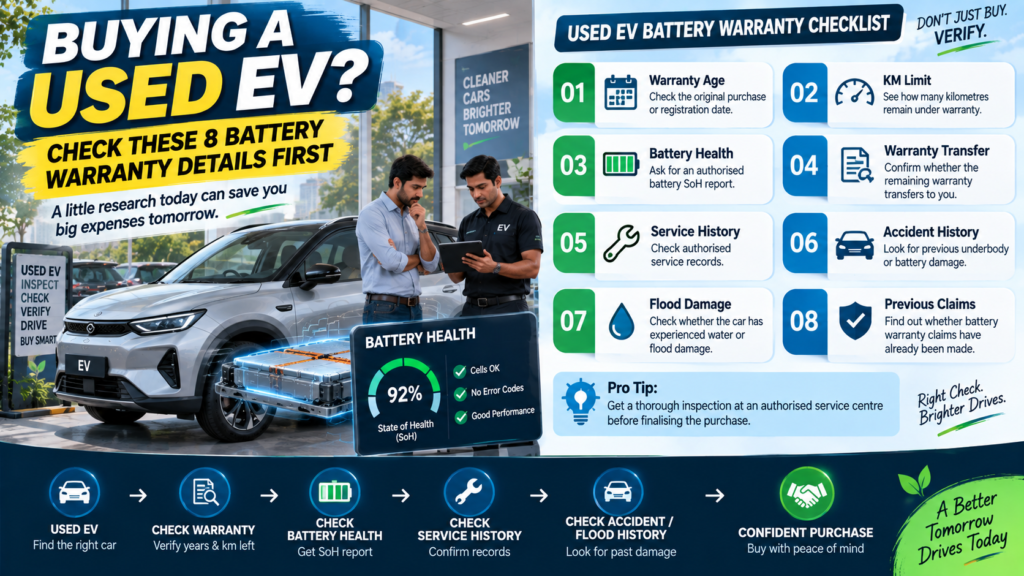
Before finalising a used EV purchase, check:
- Original purchase/registration date — this is the anchor point the years-based warranty counts from
- Current odometer reading — compare against the kilometre limit to see how much room is actually left
- Remaining battery warranty period, calculated from both the time and distance limits, not just whichever the seller mentions
- Remaining kilometre allowance, since a low-mileage but old car and a high-mileage but newer car can have very different remaining cover
- Battery health report, if the seller or dealer can provide one from an authorised service centre — this tells you actual SoH, not just warranty status
- Full service records, to confirm the car has been maintained at authorised centres, which matters for both warranty validity and resale trust
- Accident history, since underbody or pack-area damage can affect both warranty status and future degradation
- Flood or water damage history, especially for cars previously registered in flood-prone cities
- Warranty transfer requirements, so you know exactly what paperwork needs to be filed and by when
- Whether any warranty claims have already been made on the battery, which can sometimes affect what remains covered
A used EV with five years of remaining battery warranty and a clean service history is a fundamentally different purchase from one that’s a year away from the warranty ceiling with no service records — even if both are listed at a similar price. This is the single area where a used-EV buyer should spend the most diligence.
EV Battery Warranty Comparison in India
Warranty terms vary meaningfully by manufacturer and, within a manufacturer, often by model or battery variant. The table below reflects commonly reported terms for a sample of current Indian-market models; always verify the exact figure for your specific variant against the manufacturer’s current warranty document before purchase, since terms are periodically revised.
| Manufacturer / Model | Battery Warranty (Years / Km) | Capacity Guarantee |
|---|---|---|
| Tata Motors — standard EV lineup (e.g. Nexon EV, Punch EV 30 kWh, Curvv EV variants) | 8 years / 1,60,000 km | Not publicly specified in exact percentage; verify with dealer |
| Tata Motors — Lifetime HV Battery Warranty (select models: Nexon EV 45 kWh, Curvv.ev, Punch EV 40 kWh; first private owner only) | Lifetime (15 years) / unlimited km for first owner | Not publicly specified |
| Mahindra BE 6 / XEV 9e (first private, registered owner) | Lifetime for first owner; 10 years / 2,00,000 km after ownership transfer | Not publicly specified |
| MG Comet EV | 8 years / 1,20,000 km | Not publicly specified |
| MG ZS EV | 8 years / 1,50,000 km | Not publicly specified |
| Hyundai Creta Electric | 8 years / 1,60,000 km | Commonly cited around 70% SoH; confirm in owner’s manual |
| Hyundai Ioniq 5 (India) | 8 years / 1,60,000 km | Commonly cited around 70% SoH; confirm in owner’s manual |
| BYD Atto 3 / eMAX 7 / Seal / Sealion 7 | 8 years / 1,60,000 km | Not publicly specified |
Warranty terms can change by model, variant, purchase date and manufacturer policy. Verify the latest warranty document before making a purchase.
Last updated: September 2026
EV Battery Warranty Checklist Before You Buy
- Confirm the exact warranty duration (years) for your specific model and variant
- Confirm the exact kilometre limit — don’t assume it matches the years figure of a different model
- Check whether a capacity guarantee percentage is publicly stated, and if not, ask the dealer to confirm it in writing
- Understand what counts as battery failure versus degradation in the warranty document
- Ask what SoH threshold, if any, triggers a covered claim
- Check whether accidental physical damage is excluded, and what your comprehensive insurance covers instead
- Check the specific water/flood damage clause, especially if you live in a flood-prone city
- Understand the charging-related conditions, including which equipment counts as “authorised”
- Confirm whether the warranty transfers to a second owner, and under what process
- For used EVs, verify remaining warranty period, remaining km, and service history before purchase
- Ask for a battery health report if buying used, rather than relying on displayed range
- Keep all service and installation records in one place from day one of ownership
Frequently Asked Questions
1. How long is an EV battery warranty in India?
Most EVs in India offer around 8 years or 1,50,000–1,60,000 km of battery warranty, whichever comes first. The exact coverage varies by manufacturer and model, so always check the official warranty terms.
2. What does an 8-year EV battery warranty cover?
An 8-year EV battery warranty generally covers manufacturing defects, battery failure and, in some cases, excessive capacity loss below the manufacturer’s guaranteed level. Accidental, flood or misuse-related damage may be excluded.
3. Is EV battery degradation covered under warranty?
Normal battery degradation is expected as an EV ages. It may be covered only when the battery’s capacity falls below the manufacturer’s guaranteed threshold during the warranty period. A reduction in driving range alone does not automatically mean a warranty claim.
4. Does an EV battery warranty transfer to the second owner?
It depends on the manufacturer and model. Many standard EV battery warranties can transfer to a new owner, subject to the manufacturer’s conditions. Some lifetime battery warranties may be limited to the first registered owner.
5. Is EV battery replacement covered under warranty?
Battery replacement may be covered when the battery has a qualifying defect or its capacity falls below the manufacturer’s guaranteed level within the warranty period. Damage caused by accidents, flooding or excluded misuse may not be covered.