
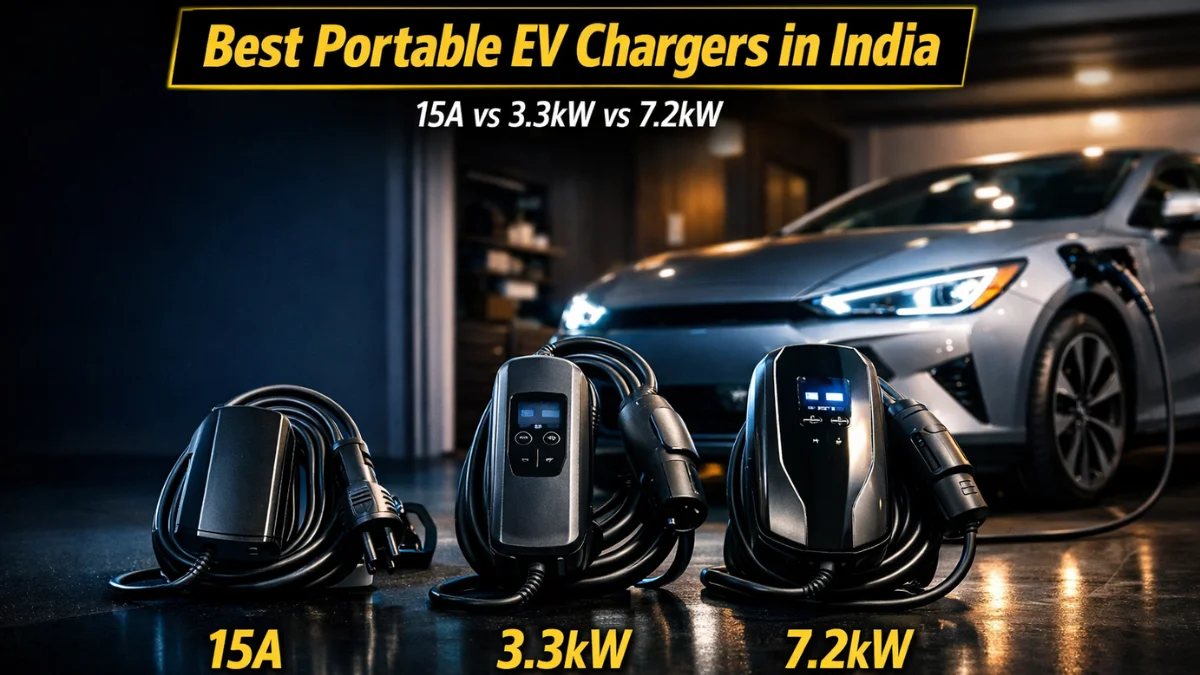
Compare speed, safety, cost and when to use 15A (granny) chargers, 3.3kW units and 7.2kW portable chargers — practical advice for Indian EV owners.
Electric vehicle owners in India often ask: Which portable charger should I keep — the simple 15A “granny” charger, a 3.3kW portable unit, or a faster 7.2kW portable charger? This guide explains the best portable EV chargers in India, compares 15A vs 3.3kW vs 7.2kW in plain language, and tells you when each makes sense — safety, costs, real charging times, and buying tips for Indian homes.
Quick summary — which one to pick
- 15A (granny) charger: Cheapest, uses normal home socket. Very slow. OK for small daily use if your EV’s onboard charger is low-power and you have light daily run. Needs careful electrical safety checks.
- 3.3kW portable charger: A sensible balance — charges overnight on single-phase supply, safer/ faster than 15A. Most common “home portable” option.
- 7.2kW portable charger: Fastest of the three on single-phase; halves charging time vs 3.3kW. Needs a higher-rated circuit (and possibly electrician work) but excellent for busy users.
(Official manufacturer guidance and Indian EV charging pages describe similar speed differences between 3.3kW and 7.2kW chargers.)
What “portable EV charger” means in India
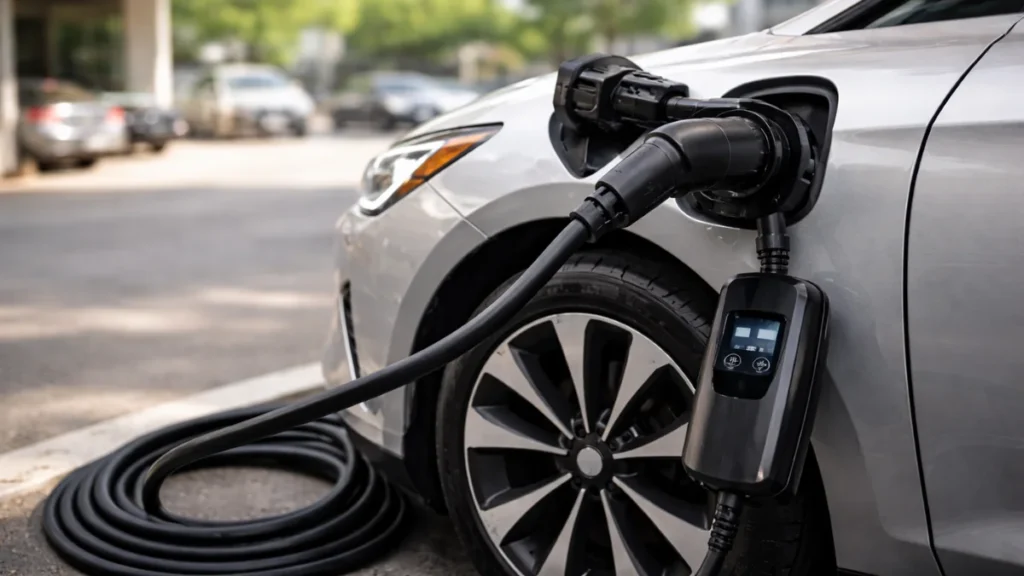
A portable EV charger is a carry-friendly AC charger that you can plug into a compatible socket (or into a dedicated wall socket) and connect to your EV when needed. Unlike fixed wallboxes, portable chargers are not permanently installed — they are useful when travelling, or if your car didn’t come with a dedicated home charger.
Some are simple “granny” chargers that plug into a domestic 15A socket (very slow, sometimes called Mode 2), while higher power portable chargers (3.3kW, 7.2kW) are enclosed units with protections (RCD, overcurrent, surge) and often a Type 2 socket or cable.
Difference between 15A, 3.3kW and 7.2kW — plain math
| Type | Typical current draw | Power (approx) | Suitable socket / setup | Typical overnight (8–10 hr) charge (30 kWh battery) |
|---|---|---|---|---|
| 15A “granny” | ~10–13 A continuous | ~2.3–3.3 kW (but many behave lower) | Domestic 15A/16A socket (not ideal long-term) | ~8–12+ hours (very slow) |
| 3.3 kW portable | ~15 A | 3.3 kW | Dedicated circuit, often 15–16A with safety device | ~8–10 hours |
| 7.2 kW portable | ~30 A | 7.2 kW | Requires 30A-capable circuit or special wiring (may need upgrade) | ~3–5 hours |
Note: actual times depend on vehicle battery size and onboard charger limits. For real-world guidance, Tata and other OEM charging docs show 3.3kW vs 7.2kW can cut charging time roughly in half.
How Long Does It Take to Charge an EV with Different Portable Chargers?
| Charger Type | Approx Charging Time (30 kWh battery) |
|---|---|
| 15A Socket Charger | 12–14 hours |
| 3.3kW Portable Charger | 8–10 hours |
| 7.2kW Portable Charger | 3–5 hours |
Safety: can I use a 15A socket to charge EVs overnight?
Short answer: Yes, but be careful. Many owners use the 15A plug that came with their car for overnight charging. However:
- Domestic 15A sockets and wiring were not designed for continuous high-current loads for many hours. Poor wiring, old sockets, or no earth leakage protection increase fire risk. Community discussion and technical forums strongly recommend proper safety protections if you rely on a 15A plug.
- If you plan to charge nightly, it’s better to install a dedicated circuit (with proper RCD/MCB and wiring) and consider a 3.3kW or 7.2kW portable charger that includes safety protections.
Practical advice:
- Have a licensed electrician check your wiring and meter capacity.
- Add an RCD (earth leakage breaker) and an MCB of appropriate rating.
- Never use long extension cords — they increase risk.
- Prefer portable chargers with built-in protections (overcurrent, surge, temperature).
Pros & cons — quick comparison
15A (granny) charger
- Pros: Cheap (comes with many cars), works on any household socket, portable.
- Cons: Slow, may stress domestic wiring, less safe for continuous use if wiring is old.
3.3kW portable charger
- Pros: Good overnight charging, cheaper than wallbox, safer (if from a reputable brand), often includes protections.
- Cons: Slightly slower than 7.2kW; still limited for heavy daily use.
7.2kW portable charger
- Pros: Fast charging on single-phase supply, halves charging time vs 3.3kW; best for busy users.
- Cons: More expensive, may require electrical upgrade, heavier/less plug-and-play on all sockets.
Prices and manufacturers (India)
Portable charger prices vary by brand, features and certification. As of recent market info:
- 3.3kW portable units: often start around ₹12,000–₹18,000 for basic models.
- 7.2kW portable units: typically cost more — range ₹18,000–₹35,000 and up for established brands or smart features.
- Many chargers are available from Indian brands, marketplaces and specialised EV accessory retailers. (Price ranges reported by online listings and Indian EV accessory shops.)
Tip: Look for manufacturers or sellers who provide clear warranty, CE/IS/other certifications, and safety features like RCBO/RCD, surge protection, and temperature cutouts.
Real-world buying checklist — choose the best portable EV chargers in India
When shopping, use this checklist:
- Match charger power with vehicle onboard charger — your car may not accept more than 3.3kW/7.2kW anyway.
- Safety features — RCD/RCBO, overcurrent protection, surge protection, temperature sensor.
- Connector type — Type 2 (common in India) or vehicle-specific cable. Confirm plug/cable compatibility.
- Build & IP rating — IP44 or higher if you live in a rainy area.
- Certification & warranty — at least 1 year, clear customer support.
- Portability — weight, bag, cable management.
- Smart features (optional) — app, scheduling, power limit adjustments.
- Price vs support — cheap is tempting, but post-sales service matters more for chargers.
When to prefer which charger — user scenarios
- I drive <50 km/day, single shift, and have limited budget: 15A (with safety checks) or 3.3kW.
- I need full charge overnight reliably: 3.3kW portable charger is a good balance.
- I drive a lot daily or want quick top-ups: 7.2kW portable charger, after upgrading supply if needed.
- I rent or move often: Portable unit (3.3kW) is handy — you can carry it between homes.
Manufacturer and OEM docs emphasise checking car compatibility and suggest 3.3kW vs 7.2kW as primary choices for home charging upgrades.
Installation & electrical tips for Indian homes
- If you stick to 15A plug: get wiring checked, avoid extension cords, and never leave visibly damaged sockets.
- For 3.3kW/7.2kW portable chargers: a dedicated socket or a wall-mounted socket with a dedicated breaker is best. Some chargers are sold with a dedicated socket (Type 2 socket + safety devices). Retailers sell “smart sockets” for 3.3kW compatibility.
- If in an apartment: check building rules and common electrical capacity before installing a higher-power charger.
Charging time examples
Assumptions: 30 kWh usable battery, charger efficiency 90%.
| Charger type | Power (kW) | Effective kW (90% eff) | Time to charge 0→100% (30 kWh) |
|---|---|---|---|
| 15A (simple) | 2.3–3.3 kW | 2.1–3.0 kW | 10–14 hours |
| 3.3 kW | 3.3 kW | 2.9 kW | ~10–11 hours |
| 7.2 kW | 7.2 kW | 6.5 kW | ~4.5–5 hours |
(Numbers rounded for easy planning — real results depend on car acceptance rate and battery SOC.)
Simple range graph (distance per hour charged)
Assume EV consumes 0.16 kWh/km (typical):
- 15A (~2.5 kW) → ~15 km range per hour
- 3.3kW → ~18–20 km per hour
- 7.2kW → ~40 km per hour
Common myths — busted
- Myth: A 7.2kW portable charger will damage my battery.
Reality: Modern EVs regulate charging. The car’s onboard charger controls acceptance. 7.2kW just supplies more power — battery management prevents damage. - Myth: “Granny” 15A plug is always safe.
Reality: It can be used but only if wiring and socket are in good condition and you use protective devices. Long-term heavy use favors dedicated chargers.
Where to buy (India) — quick pointers
- Official OEM accessories (Tata, MG, Hyundai) often offer recommended home chargers.
- Reputable EV-charging vendors and marketplaces sell portable 3.3kW and 7.2kW units — check warranty and reviews. Online listings show price ranges and features; compare before purchase.
Final recommendation — choose based on your daily life
- If you want a plug-and-forget low-cost option and drive modest distances, you can use the 15A charger temporarily — but get your wiring checked.
- For reliable overnight charging with better safety, make 3.3kW your baseline — many owners find it ideal.
- If you want speed and convenience and are willing to invest in a small electrical upgrade, choose 7.2kW — you’ll spend less time waiting and more time driving.
FAQs
Are 15A chargers safe for regular use?
They can be used, but only if your home wiring, socket and earthing are in good condition and you have protective devices. For continuous nightly charging, a dedicated circuit (3.3kW or higher) with RCD/MCB is safer.
Will my car accept 7.2kW charging if I buy a 7.2kW portable charger?
Only if the car’s onboard charger supports that power. Many EVs accept up to 3.3kW or 7.2kW — check your vehicle specs or OEM charging guide.
How much does a 3.3kW or 7.2kW portable charger cost in India?
Prices vary by brand and features — ballpark: 3.3kW units often start around ₹12k–₹18k; 7.2kW units typically ₹18k–₹35k+. Always confirm current prices and warranty.
Can I use an inverter or UPS to charge my EV?
Charging an EV from a household inverter is complex — most inverters are not designed for continuous high-power EV charging. Specialized EV-compatible inverters/solutions exist but consult an electrician and the inverter maker before trying.
What safety features should I insist on when buying a portable EV charger?
RCD / RCCB (earth leakage), MCB/overcurrent protection, surge protection, temperature cutoff, IP rating for weather protection, and a minimum 1-year warranty with local service.
🔗 Also Read: Suzuki e-Access – A New Smart Electric Scooter for India
Explore Suzuki’s upcoming electric scooter with smart features, practical range, and a focus on everyday commuting in India.
I have been following your blog for a while now and have to say I am always impressed by the quality and depth of your content Keep it up!