
Buying a car in India in 2026 is more confusing than ever — and honestly, that’s a good thing.
A few years ago, the choice was simple: petrol for small cars, diesel for highway driving or high mileage. Today, you have electric vehicles knocking on the door with serious numbers, and the old rules don’t quite apply anymore.
But here’s the thing — most people make the mistake of only comparing the sticker price at the showroom. The real story is what you spend over the next 5 years. Fuel, service, insurance, road tax waivers, battery health, resale value — it all adds up, and the final number can surprise you.
This article breaks it all down in plain language, with actual 2026 numbers for India. No marketing spin, just the real cost of owning an EV, petrol, or diesel car.
First, Let’s Set the Ground Rules
To keep this comparison fair, we’re looking at cars in the ₹12–18 lakh segment — compact SUVs and hatchbacks being the most popular category in India. Think Tata Nexon EV vs Nexon Petrol, or similar comparisons.
Assumptions for this article:
- Monthly driving: 1,200 km (roughly 40 km/day, typical urban commuter)
- Petrol price: ₹100/litre (national average, 2026)
- Diesel price: ₹90/litre
- Home electricity rate: ₹8/kWh (standard domestic slab)
- Holding period: 5 years
These numbers are indicative — your city, your driving pattern, and your electricity slab will shift the final figure slightly. But the direction of the comparison stays the same.
1. Purchase Price: Who Costs More to Buy?
This is where most people get stuck — and understandably so. EVs are still priced higher than their petrol and diesel counterparts at the showroom.
| Car Type | Approximate Ex-Showroom Price (₹) |
|---|---|
| Petrol (compact SUV) | 9–14 lakh |
| Diesel (compact SUV) | 11–16 lakh |
| Electric (compact SUV) | 14–20 lakh |
So yes, an EV costs roughly ₹4–6 lakh more upfront compared to an equivalent petrol car. That’s a real number and it matters.
But wait — there are some offsets:
- GST on EVs is just 5%, while petrol/diesel cars attract 28% GST plus cess
- Most states offer road tax waivers of 50–100% on EVs
- Delhi, Maharashtra, Karnataka, Tamil Nadu, and several other states waive registration charges entirely
- FAME-II subsidies are still active for select EV categories in 2026
Net effect? In cities like Delhi, the on-road price difference between an EV and an equivalent petrol car can shrink by ₹1–1.5 lakh just from tax savings and registration waivers. The gap is real, but it’s smaller than the sticker price suggests.
2. Running Cost Per Km: The Biggest Difference
This is where EVs absolutely destroy petrol and diesel cars. No exaggeration.
Petrol Running Cost
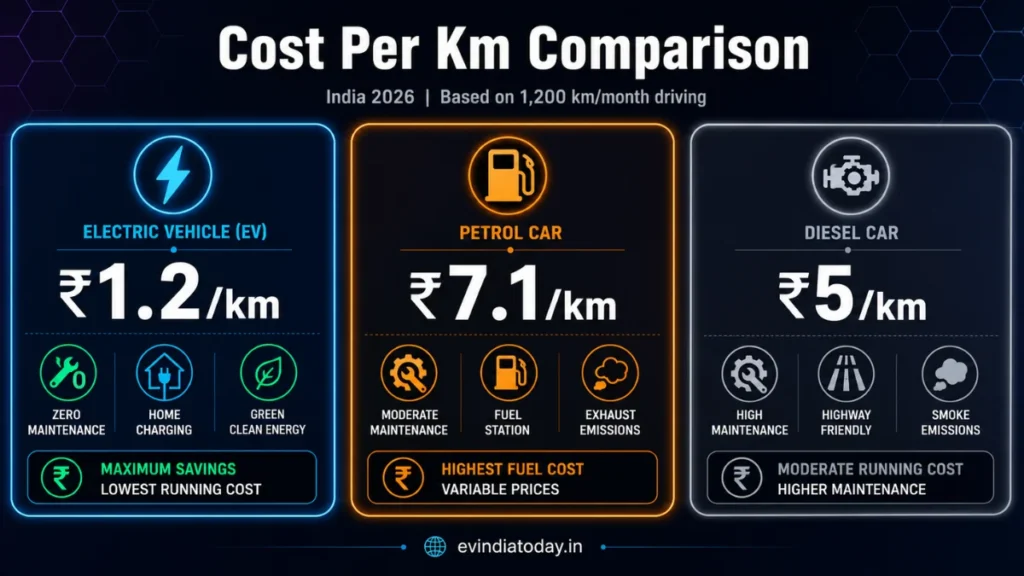
A compact SUV getting 14 km/litre in mixed city/highway conditions at ₹100/litre comes to:
₹100 ÷ 14 = ₹7.14 per km
Diesel Running Cost
Diesel cars typically give better mileage — around 18–20 km/litre in real-world conditions. At ₹90/litre:
₹90 ÷ 18 = ₹5 per km
EV Running Cost (Home Charging)
Home electricity rates in India currently range between ₹5.50 per unit in Gujarat to ₹8–₹9 per unit in Maharashtra, Delhi and Karnataka depending on your consumption slab. At ₹8/kWh and an efficiency of roughly 6–6.5 km per kWh:
₹8 ÷ 6.5 = ₹1.23 per km
That’s not a typo. Running cost is ₹1–1.5 per km for EVs versus ₹6–8 for petrol.
Monthly Fuel Cost Comparison (at 1,200 km/month)
| Fuel Type | Cost Per Km | Monthly Fuel Cost |
|---|---|---|
| Petrol | ₹7.14 | ₹8,568 |
| Diesel | ₹5.00 | ₹6,000 |
| EV (home charging) | ₹1.23 | ₹1,476 |
| EV (public fast charger) | ₹3.00–₹4.00 | ₹3,600–₹4,800 |
Annual fuel savings with an EV vs petrol: ₹85,000–₹90,000
That’s money back in your pocket every single year. Over 5 years, the savings cross ₹4 to ₹5 lakh on fuel alone.
One important note: the smart approach most EV owners follow is to do 80 to 90 percent of their charging at home overnight where the cost is lowest, and use public fast charging only when needed on trips.
3. Maintenance Cost: Fewer Parts, Less Trouble
This is the second big advantage of EVs that people underestimate.
Petrol Car Maintenance
A petrol car engine has hundreds of moving parts. Engine oil, oil filter, air filter, spark plugs, clutch plates, timing belts, coolant — all of these need periodic replacement. A petrol car needs an engine oil change every 5,000 to 10,000 km, which costs ₹2,000 to ₹5,000 each time.
Over 5 years with 60,000 km of driving, routine petrol maintenance typically costs ₹60,000 to ₹1,20,000 depending on the model and service centre.
Diesel Car Maintenance
Diesel engines are more robust for highway driving but also more complex and costlier to service. High-pressure fuel injectors, diesel particulate filters (DPF), and turbochargers all add to the service bill.Diesel has the highest maintenance cost at ₹85,000 over 5 years in the mid-segment.
EV Maintenance
An EV has no engine oil to change, no spark plugs, no clutch, no exhaust and significantly fewer moving parts overall. The main maintenance items are tyres, brake pads which actually last longer on EVs due to regenerative braking, AC filter and battery health checks.
EVs have fewer components as they do not have an engine, clutch, and complex gears, thus having a 5-year maintenance cost at just ₹30,000.
5-Year Maintenance Cost Summary
| Car Type | 5-Year Maintenance Cost |
|---|---|
| Petrol | ₹70,000–₹1,20,000 |
| Diesel | ₹85,000–₹1,00,000 |
| EV | ₹25,000–₹35,000 |
The savings here aren’t as dramatic as fuel costs, but they’re consistent and compound over time.
4. Insurance Cost
Insurance for EVs is slightly higher than petrol cars because the insured declared value (IDV) of an EV is higher due to its purchase price. However, EVs have fewer claims on average because of their simpler mechanics and regenerative braking that extends brake pad life.
Rough annual insurance cost:
- Petrol: ₹12,000–₹20,000 (comprehensive)
- Diesel: ₹14,000–₹22,000
- EV: ₹18,000–₹28,000
The difference isn’t massive, but over 5 years you’re paying roughly ₹25,000–₹40,000 more in insurance for an EV compared to petrol.
5. Resale Value: The EV’s Weak Spot Right Now
This is the honest part of the article. EVs are not perfect, and resale value is currently their biggest weakness in India.
Electric cars retain 35–45% today — buyer hesitation about battery health drags value. As battery warranties become clearer, this should improve.
In comparison:
- Petrol cars: 50–55% resale after 5 years
- Diesel cars: 42–50% (affected by 10-year ban uncertainty in some cities)
For a car bought at ₹16 lakh:
- Petrol resale: ~₹8–8.8 lakh
- Diesel resale: ~₹6.7–8 lakh
- EV resale: ~₹5.6–7.2 lakh
The EV loses more on depreciation. This is a real cost that should factor into your decision — especially if you plan to sell after 3–4 years. However, if you’re keeping the car for 6–8 years, the fuel and maintenance savings more than compensate.
6. The Full 5-Year Ownership Cost: Who Actually Wins?
Let’s put it all together. This is the number that actually matters.
Scenario: 1,200 km/month driving, 5 years (60,000 km total)
| Cost Head | Petrol | Diesel | EV |
|---|---|---|---|
| Purchase Price | ₹13,00,000 | ₹15,00,000 | ₹17,00,000 |
| 5-Year Fuel Cost | ₹5,14,000 | ₹3,60,000 | ₹88,560 |
| 5-Year Maintenance | ₹80,000 | ₹90,000 | ₹30,000 |
| 5-Year Insurance | ₹90,000 | ₹95,000 | ₹1,10,000 |
| Total Spent | ₹19,84,000 | ₹20,45,000 | ₹19,28,560 |
| Resale Value (–) | ₹6,50,000 | ₹6,75,000 | ₹6,00,000 |
| Net 5-Year Cost | ₹13,34,000 | ₹13,70,000 | ₹13,28,560 |
Note: These are approximate figures. Actual numbers vary based on model, city, electricity tariff, and driving pattern.
At 1,200 km/month, EVs are neck and neck with petrol on total ownership and slightly better. They clearly beat diesel overall.
If your running is more than 15,000–18,000 km per year and you charge mostly at home and plan to keep the car for a longer duration of 5–8 years, then EV is a clear winner. However, if you drive less than 10,000 km in a year, stick to diesel and let your financial data be the key factor.
7. Driving Experience: What It Actually Feels Like
Cost is important, but you’re going to spend years inside this car. So let’s talk about the real-world experience.
EV
- Silent and smooth — no engine noise, no gear shifts, effortless acceleration
- Electric cars deliver maximum torque at 0 RPM, meaning rapid off-the-line acceleration. The Nexon EV hits 0 to 60 km/h in 3.8 seconds, outpacing most petrol SUVs in its segment.
- Brilliant for stop-and-go city traffic — regenerative braking means less brake wear and free energy recovery
- Range anxiety is still real if you’re travelling intercity without planned charging stops
Petrol
- Familiar, comfortable, widely serviced
- Good for short to medium drives
- Feels more “alive” on highways with the engine sound (some people genuinely prefer this)
- Fuel prices are unpredictable — linked to global crude oil
Diesel
- Best power and torque for highways and long drives
- Excellent fuel efficiency at highway speeds
- Slightly noisier than petrol, especially cold starts
- In some cities (Delhi NCR, for example), diesel cars older than 10 years face restrictions — worth keeping in mind
8. Charging vs Refuelling: The Convenience Question
This is the one area where petrol and diesel cars win without argument — refuelling takes 5 minutes and there’s a fuel station at every corner.
EVs require a different mindset:
- Home charging (overnight): Most EV owners do 90% of their charging this way. Wake up to a full “tank” every morning. No trips to the fuel station.
- AC slow charger (public): Takes 6–10 hours. Useful at offices, malls, hotels.
- DC fast charger (public): 30–60 minutes for 80% charge. Networks like Tata Power EV, ChargeZone, and Statiq are rapidly expanding.
If you have a dedicated parking spot at home, charging an EV is actually more convenient than petrol — you never need to make a detour to a fuel station during your busy day.
If you live in a flat with no dedicated parking, this becomes a real problem. Public charging infrastructure in smaller cities is still catching up.
9. Environmental Impact: The Bigger Picture
From most polluting to least: Diesel has the highest particulate matter and NOx emissions and is a major contributor to winter smog in Delhi. Electric cars produce zero tailpipe emissions. Actual carbon footprint depends on electricity grid mix. In states with more solar/hydro, EVs are genuinely clean. In coal-heavy grids, lifecycle emissions are still lower than petrol.</cite>
India’s power grid is getting greener every year — solar capacity has crossed 100 GW. As the grid gets cleaner, your EV automatically becomes cleaner too. A petrol or diesel car, no matter what you do, keeps burning fossil fuels.
This matters more and more as emission regulations tighten in Indian cities. Older diesel cars are already facing restrictions in Delhi and other metro areas.
10. Who Should Buy What? — The Final Verdict
There’s no single right answer. Here’s the honest breakdown:
Choose an EV if:
- You drive more than 1,200 km per month
- You have a dedicated parking spot with home charging access
- You live in a metro or Tier-1 city with good charging infrastructure
- You plan to keep the car for 5+ years
- You hate trips to the fuel station and love the idea of waking up to a “full tank”
Choose Petrol if:
- You drive less than 800–1,000 km per month
- You frequently travel intercity on routes without reliable charging infrastructure
- Your budget is tight and you can’t stretch to the EV price
- You need the flexibility of quick refuelling anywhere in India
Choose Diesel if:
- You cover 1,500+ km per month but can’t charge at home
- You do a lot of highway driving (diesel efficiency is best on open roads)
- You’re in a city without the 10-year diesel restriction risk
- Your work involves frequent state-border travel with uncertain charging access
Quick Reference: EV vs Petrol vs Diesel at a Glance
| Parameter | EV | Petrol | Diesel |
|---|---|---|---|
| Purchase Price | Highest | Lowest | Medium |
| Running Cost/km | ₹1–1.5 | ₹6.5–7.5 | ₹4.5–5 |
| Monthly Fuel Cost* | ₹1,500 | ₹8,500 | ₹6,000 |
| Maintenance (5yr) | ₹30,000 | ₹80,000 | ₹90,000 |
| Resale Value | 35–45% | 50–55% | 42–50% |
| Road Tax | Waived (most states) | Full | Full |
| GST | 5% | 28%+ | 28%+ |
| Environment | Zero tailpipe | Moderate | High pollutant |
| Refuelling | Home/Public charger | Anywhere | Anywhere |
| Long Drive Ease | Needs planning | Very easy | Very easy |
*At 1,200 km/month
Final Thought
The “best car” in 2026 isn’t the one with the lowest price tag — it’s the one that fits your driving life the best. If you’re a city commuter clocking 40–50 km daily with parking at home, the EV math is hard to argue with. If you’re a travelling sales professional covering 500 km across three states every week, a diesel car still makes more sense today.
What’s changed in 2026 is that EVs are no longer a compromise. They’re a genuine first choice for a large section of Indian buyers — and the number is only going up.
FAQs
Is it actually worth buying an EV in India in 2026?
Yes — but it depends on your usage. If you drive 1,000+ km a month and have home charging, an EV starts saving you money from Year 2 onwards. The lower running cost (₹1–1.5/km vs ₹7/km for petrol) and almost no maintenance make it financially attractive for regular daily drivers. If you drive very little or frequently take long highway trips without charging options, wait a year or two until infrastructure catches up further.
What is the real running cost of an EV vs petrol car per km in India?
At home electricity rates of ₹8/kWh, an EV costs approximately ₹1.20–₹1.50 per km. A petrol car at ₹100/litre getting 14 km/litre costs around ₹7.14 per km. That’s nearly 5–6 times more expensive for petrol. Even at public fast charger rates (₹18–25/kWh), EVs cost ₹3–4 per km, which is still cheaper than petrol.
Which car has the best resale value — EV, petrol, or diesel?
Currently, petrol cars hold the best resale value at 50–55% after 5 years. Diesel has dropped to 42–50% due to ban uncertainties in some cities. EVs currently retain 35–45%, mostly because buyers are still cautious about battery health in used EVs. However, as battery warranties become more transparent and the used EV market matures, EV resale values are expected to improve steadily over the next 2–3 years.
Can I charge an EV at home in India? What does it cost to install?
Yes. Most EV manufacturers provide a basic home charger (called IOCL or OEM wall box charger) either free or at nominal cost with the car purchase. Installation typically costs ₹5,000–₹15,000 for a standard 7.2 kW AC wall box, depending on your building wiring and electrician charges. Once installed, you simply plug in overnight and wake up to a full charge. The per-unit cost is your regular domestic electricity tariff — usually ₹5.50 to ₹9 per kWh depending on your state and consumption slab.
Should I buy diesel or EV for long highway trips in India?
For highway-heavy driving right now, diesel still has a practical edge — you can fill up in 5 minutes at any highway dhaba, and diesel mileage is excellent at 18–22 km/litre. EVs on highways face two challenges: range reduces faster at 80–100 kmph (compared to city driving), and DC fast chargers — while growing rapidly — aren’t uniformly available on every national highway. That said, on popular routes like Delhi–Jaipur, Delhi–Agra, Mumbai–Pune, or Bengaluru–Mysore, fast charging infrastructure is already solid. If 70% of your driving is city/suburb and only occasional highway, an EV works fine today.