
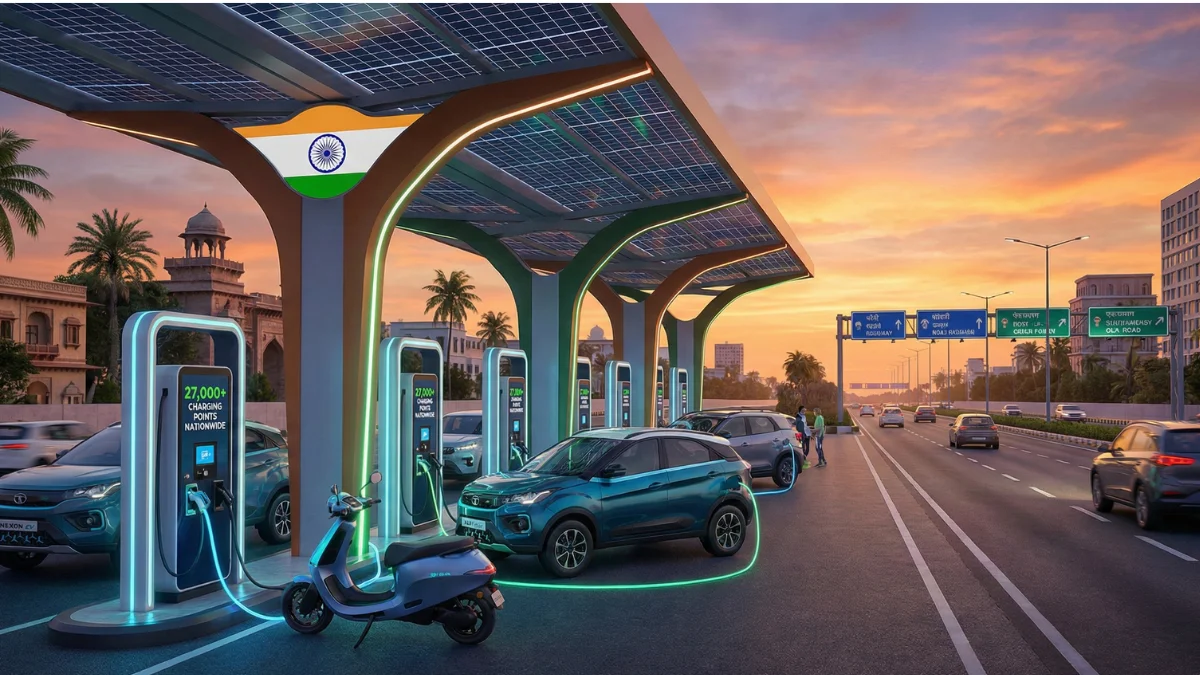
India Crosses 27,000+ EV Charging Stations in 2025, Major Push for Electric Mobility
India has taken a big step forward in its electric vehicle (EV) journey. In 2025, the country added 27,000+ new EV charging stations, making electric mobility more practical and accessible for people across cities, highways, and smaller towns. This rapid expansion is being seen as a strong signal of India’s commitment to clean transportation and reduced dependence on fossil fuels.
Most importantly, a large number of these charging points have been installed at petrol pumps, a move that helps EV users charge their vehicles at places they already trust and visit regularly. This strategy is expected to reduce one of the biggest concerns among buyers—range anxiety—and encourage more people to switch to electric vehicles.
Petrol Pumps Turning into EV-Friendly Mobility Hubs
According to official information shared by the Ministry of Petroleum and Natural Gas, the majority of the newly installed EV charging stations are located at fuel retail outlets. Instead of building charging points only at new locations, the government and oil companies have focused on upgrading existing petrol pumps.
This approach offers several advantages:
- Easy visibility and access for EV users
- Familiar locations reduce hesitation among first-time EV buyers
- Better use of existing land and infrastructure
- Faster nationwide rollout without long construction delays
By installing chargers at petrol pumps, India is slowly transforming traditional fuel stations into integrated mobility hubs, where customers can either refuel or recharge depending on their vehicle type.
Government Support Through FAME-II Scheme
A significant portion of the charging stations has been installed under the government’s FAME-II (Faster Adoption and Manufacturing of Electric Vehicles – Phase II) scheme. Under this initiative, 8,932+ charging stations were set up at retail outlets across the country.
The FAME-II scheme plays a crucial role in:
- Supporting EV adoption through subsidies
- Encouraging charging infrastructure development
- Promoting electric two-wheelers, cars, and commercial vehicles
- Reducing vehicle emissions in urban areas
This scheme has been one of the key drivers behind the rapid growth of India’s EV ecosystem over the past few years.
Oil Companies Add 18,500+ Charging Points
Apart from government-funded installations, public sector oil marketing companies have also made heavy investments using their own funds. These companies collectively installed 18,500+ EV charging points, pushing the total count to 27,000+ stations nationwide.
Major oil companies involved in this effort include Indian Oil Corporation and Bharat Petroleum Corporation, which are actively upgrading their fuel stations to support electric mobility.
This partnership between the government and oil companies shows how public infrastructure can be adapted to meet future transportation needs.
Energy Stations: The Next Big Step
India is not stopping at just EV chargers. Public sector oil companies are now working on a larger vision called Energy Stations. These stations aim to provide multiple energy options under one roof.
As of November 2025, 1,000+ Energy Stations have already been set up across the country. Over the next few years, the target is to develop 4,000+ Energy Stations along major highways, transport corridors, and busy urban locations.
These Energy Stations may offer:
- Petrol and diesel
- EV charging facilities
- CNG and LNG (where feasible)
- Biofuels and alternative energy options
This model is expected to make India’s fuel infrastructure more flexible and future-ready.
Growing EV Sales Driving Infrastructure Demand
The rapid growth of EV charging infrastructure is closely linked to the rising sales of electric vehicles in India. Over the last few years, electric two-wheelers, cars, and commercial EVs have seen strong demand, supported by:
- Central and state government incentives
- Lower running and maintenance costs
- Rising fuel prices
- Increasing environmental awareness
The government aims to increase EV penetration significantly by 2030, with electric vehicles expected to form a sizable share of total vehicle sales. To achieve this goal, charging infrastructure must grow at an even faster pace—and the current numbers show that India is moving in the right direction.
Automakers Also Investing in Charging Networks
Vehicle manufacturers are also stepping in to strengthen India’s EV charging ecosystem. Tata Motors, which holds a strong position in India’s EV market, has announced plans to double its charging network in the coming years.
The company aims to expand its EV charging points to 4 lakh+ by 2027, working closely with charge point operators and oil marketing companies. Tata Motors has also launched its Tata.ev Mega Charger Network, featuring fast chargers rated at around 120 kW, designed to reduce charging time significantly.
Similarly, Mahindra & Mahindra has entered the ultra-fast charging space by launching dedicated EV charging stations. These stations are equipped with multiple ultra-fast chargers capable of charging several EVs simultaneously.
Highways and Long-Distance Travel Get a Boost
One of the biggest challenges for EV adoption has been long-distance travel. The installation of charging stations along highways and major corridors is helping address this issue.
With Energy Stations and fast chargers being set up on highways, EV owners can now plan intercity travel with greater confidence. This development is especially important for commercial vehicles, taxis, and logistics operators who depend on reliable charging access.
The government has also focused on improving highway infrastructure through rest areas and transport hubs, which indirectly supports EV usage and safer travel conditions.
Biofuels and Clean Energy Integration
Along with EV charging, India is also pushing biofuels as part of its clean energy strategy. Ethanol blending in petrol has seen a major increase, helping reduce fuel imports and carbon emissions.
Government-backed initiatives are supporting advanced biofuel production, including second-generation ethanol plants. These efforts, combined with EV adoption, are part of a broader plan to make India’s transportation sector cleaner and more sustainable.
Investment Needs and Future Outlook
Experts believe that meeting India’s EV charging demand by 2030 will require capital investment of around ₹16,000+ crore. While this is a significant amount, the current pace of infrastructure development suggests that both the public and private sectors are willing to invest.
Key factors supporting future growth include:
- Strong government policy support
- Participation from oil companies and automakers
- Growing consumer acceptance of EVs
- Technological improvements in fast charging
If this momentum continues, India could emerge as one of the leading EV markets globally.
Why This Expansion Matters for Indian Consumers
For everyday users, the increase in EV charging stations means:
- Easier access to charging points
- Reduced waiting time
- More confidence in switching to EVs
- Lower overall running costs
Installing chargers at petrol pumps is a smart move, as it blends old habits with new technology. For many Indians, this familiarity could be the final push needed to choose an electric vehicle.
Conclusion
India’s addition of 27,000+ EV charging stations in 2025 marks a major milestone in the country’s clean mobility journey. With strong support from the government, oil companies, and automakers, the EV ecosystem is becoming more robust and user-friendly.
As charging infrastructure continues to expand across petrol pumps, highways, and cities, electric vehicles are expected to become a common sight on Indian roads. This progress not only supports environmental goals but also strengthens India’s position as a future-ready automobile market.
The road to electric mobility is clearly gaining speed—and India is charging ahead.