
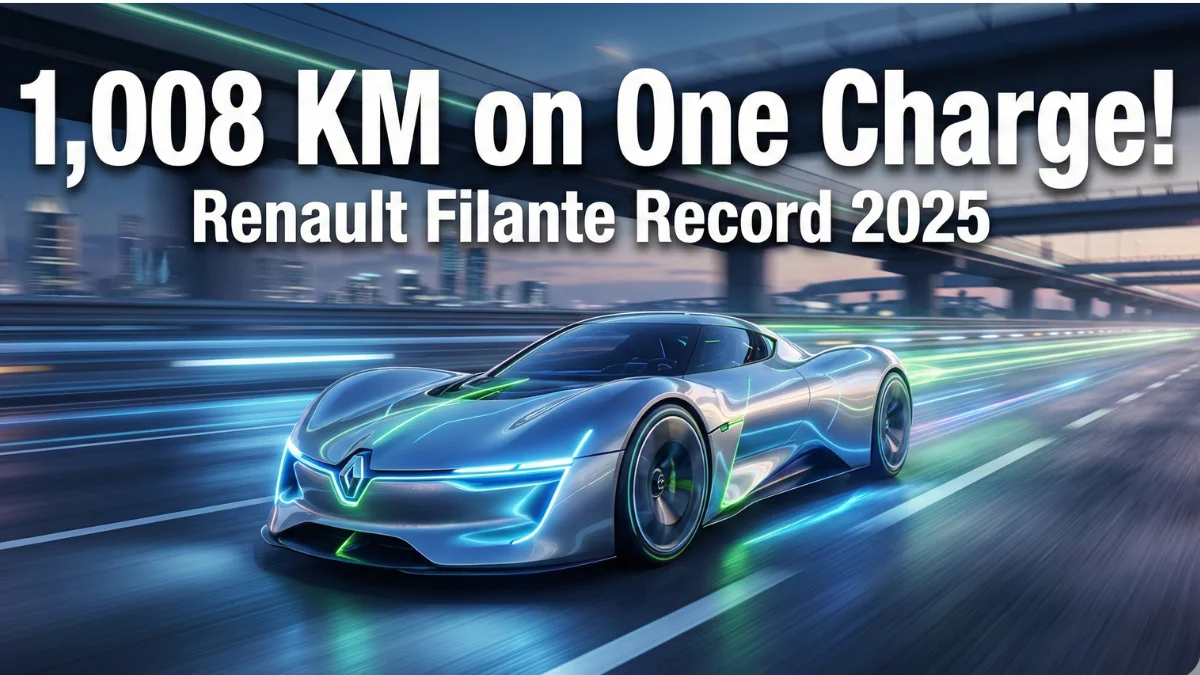
Electric vehicles are often criticised for limited range and charging concerns, especially for highway driving. But Renault has now delivered a powerful response with its latest concept car — the Renault Filante Record 2025.
In a real-world efficiency test, this electric prototype covered 1,008 kilometres on a single charge, while maintaining highway-like speeds of over 100 km/h. This achievement proves that long-distance EV travel is possible without using oversized batteries.
What Is the Renault Filante Record 2025?
The Renault Filante Record 2025 is a single-seat electric concept car built purely to test how far EV efficiency can be pushed using smart engineering.
Instead of focusing on comfort or design, Renault engineers focused on:
- Extreme aerodynamics
- Lightweight construction
- Intelligent energy use
The goal was simple: drive 1,000 km on one charge at real highway speeds — not slow, controlled lab conditions.
1,008 km in Under 10 Hours: The Record Run Explained
The efficiency test was conducted on December 18 at the UTAC high-speed test track in Morocco, chosen to simulate continuous highway driving.
Key Highlights of the Record Run:
- Distance covered: 1,008 km
- Battery capacity: 87 kWh
- Total time: 9 hours 52 minutes
- Average driving speed: ~102 km/h
- Energy consumption: Just 7.8 kWh per 100 km
- Battery remaining: 11%
Even more impressive — after completing the run, the car still had enough charge to drive another 120 km at similar speeds.
Same Battery as Production Renault EV
One of the most important takeaways from this achievement is that Renault did not use a larger or special battery.
The Filante Record 2025 used the same 87 kWh battery capacity that is found in the Renault Scenic E-Tech Electric, a production EV sold to customers.
This clearly shows that range improvements can come from efficiency, not just bigger batteries.
How Renault Achieved Such High Efficiency
Advanced Aerodynamics
Aerodynamics played the biggest role in achieving the record.
- Wind-tunnel testing was extensively used
- Wheel fairings were redesigned
- Drag coefficient reduced from 0.40 to 0.30
- Air intake was minimised
The result: much lower air resistance at high speeds, which is crucial for highway driving.
Lightweight Construction
The Filante Record 2025 weighs around 1,000 kg, which is extremely low for an electric vehicle.
This was achieved using:
- Carbon fibre body panels
- Aluminium alloys
- 3D-printed Scalmalloy components
Less weight means:
- Lower energy consumption
- Better efficiency
- Longer range
Special Tyres & Advanced Systems
Renault partnered with Michelin to develop low-rolling-resistance tyres, helping reduce energy loss.
The car also features:
- Steer-by-wire system
- Brake-by-wire system
These systems reduce mechanical complexity and further save weight.
Why This Record Matters for Everyday EV Buyers
Although the Filante Record 2025 is a concept car, the technology behind it is very relevant for future production EVs.
Key Learnings for Consumers:
- EVs can travel long distances at highway speeds
- Bigger batteries are not always required
- Better aerodynamics can significantly improve range
- Smaller batteries can reduce EV cost and weight
This directly addresses range anxiety, one of the biggest barriers to EV adoption in India and globally.
Comparison with Mercedes EQXX
Renault’s achievement naturally invites comparison with the Mercedes Vision EQXX, another efficiency-focused EV prototype.
What Makes Renault’s Run Special?
- Maintained higher average speeds (~102 km/h)
- Focused on real-world highway conditions
- Used production-sized battery capacity
While testing conditions differ, Renault’s result stands out for combining speed, distance, and efficiency together.
Renault’s Legacy of Efficiency Innovation
Renault has a long history of building experimental vehicles to test future technologies.
From streamliner cars in earlier decades to modern EV prototypes, Renault often uses such projects as “laboratories on wheels”. The learnings from the Filante Record 2025 are expected to influence:
- Future Renault EV designs
- Improved aerodynamics in mass-market cars
- Better energy management systems
What This Means for Future Renault EVs
The data collected from this record run could help Renault:
- Increase range in future EVs
- Reduce battery size and cost
- Improve efficiency in real-world driving
For customers, this could mean:
- More affordable EVs
- Longer driving range
- Lower charging frequency