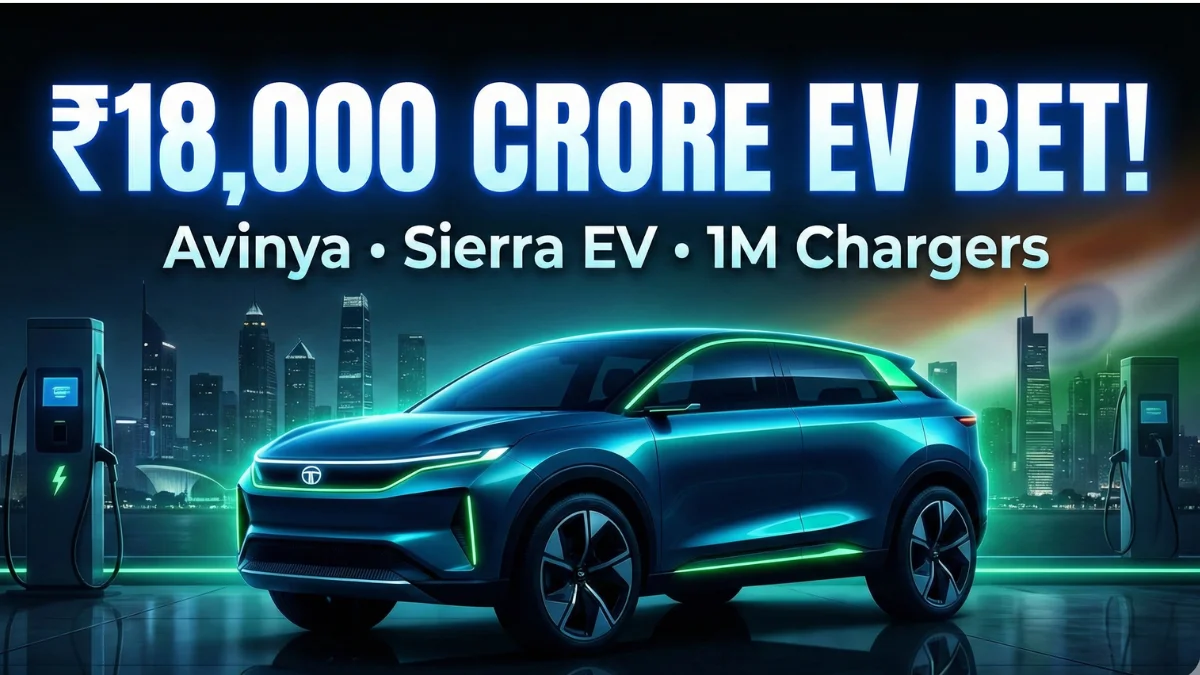
Tata Motors EV Investment plans have taken center stage as the Indian automaker announced a massive ₹18,000 crore commitment to accelerate electric vehicle adoption in India, including new EV models, a premium Avinya brand, and a nationwide charging expansion.
This strategic investment will fuel new electric models, a premium EV brand called Avinya, next-generation EV platforms, battery localisation, and a nationwide charging infrastructure. With this move, Tata Motors is targeting a 45–50% market share in India’s EV segment by 2030, at a time when competition from Mahindra, MG, Hyundai, and Maruti Suzuki is intensifying.
Tata Motors’ EV Vision for 2030
Tata Motors expects electric vehicles to contribute nearly 20% of India’s total passenger vehicle sales by the end of the decade. To prepare for this shift, the company is focusing on three key pillars:
- Product Expansion – Launching 5 new EV models by FY30
- Premiumisation – Introducing a new luxury EV brand (Avinya)
- Ecosystem Development – Scaling charging infrastructure to 1 million points
This approach ensures Tata’s presence across entry-level, mid-range, and premium EV segments, something no other automaker in India currently offers at scale.
The Avinya Brand: Tata’s Premium EV Leap
The biggest highlight of Tata Motors’ announcement is the launch of Tata Avinya, a dedicated luxury electric vehicle brand that will sit above Tata’s existing EV lineup.
What Makes Avinya Different?
Unlike current Tata EVs such as the Nexon.ev or Tiago.ev, Avinya will:
- Be built on a pure EV platform
- Offer luxury-focused design, technology, and performance
- Be sold via exclusive premium retail channels
- Target global-quality benchmarks
The Avinya brand is expected to debut in late 2026, marking Tata Motors’ direct entry into the premium and luxury EV space.
Technology Sharing with Jaguar Land Rover (JLR)
Avinya models will leverage JLR’s EMA (Electrified Modular Architecture), ensuring:
- Advanced software-defined vehicle architecture
- High energy efficiency
- Improved driving dynamics
- Future-ready autonomous and connected features
This technology transfer strengthens Tata Motors’ global EV ambitions while maintaining cost efficiency through localisation.
Tata Sierra EV: A Legendary Name Returns
One of the most awaited launches under Tata’s EV roadmap is the Tata Sierra EV, expected to arrive in 2026.
The Sierra nameplate holds a special place in Indian automotive history, and its electric comeback will feature:
- A bold, futuristic SUV design
- Advanced battery and motor technology
- Spacious interiors with modern infotainment
- Competitive range suited for long-distance use
The Sierra EV is expected to bridge the gap between mass-market EVs and premium electric SUVs, making it a key volume driver.
Five New Tata EV Models by FY2030
Beyond Avinya and Sierra EV, Tata Motors has confirmed five new EV nameplates by FY2030. These will span multiple price brackets to ensure EV accessibility for all buyers.
Confirmed & Expected Launches:
- Tata Sierra.ev – Mid-size electric SUV
- Punch.ev Facelift – Updated design and improved range
- Avinya Premium EV – Luxury electric offering
- New EV based on Acti.ev platform
- Additional compact or mid-size EV
This aggressive product pipeline ensures Tata Motors remains the widest EV portfolio holder in India.
Acti.ev Platform: Made-for-India EV Architecture
A significant portion of the ₹18,000 crore investment will go into developing indigenous EV platforms, including Acti.ev.
Benefits of Acti.ev Architecture:
- Optimised for Indian driving conditions
- Better cost control through localisation
- Flexible battery and motor configurations
- Faster product development cycles
This platform will power future Tata EVs and help the brand meet PLI (Production Linked Incentive) scheme requirements.
Tata Nexon EV: The Backbone of Tata’s EV Success
The Tata Nexon EV remains Tata Motors’ most successful electric vehicle and a cornerstone of its EV journey.
Nexon EV Achievements:
- 1 lakh cumulative units sold (India-first milestone)
- Real-world range improved from ~230 km to 375 km (C75 cycle)
- Sales grew from 300 units/month to nearly 3,000 units/month
- Pricing closer to ICE equivalents
The Nexon EV proved that EVs can be practical, affordable, and mainstream, paving the way for wider adoption.
Strengthening the EV Ownership Ecosystem
Tata Motors isn’t just focusing on cars—it’s building an end-to-end EV ecosystem.
Retail & Service Expansion:
- Over 1,200 EV-enabled sales and service outlets
- 5,000+ trained EV technicians
- Tata EV owners across 1,000+ cities and towns
EV Usage Trends:
- Average Tata EV owner drives 20,000 km/year
- ICE vehicle average: 12,000 km/year
- 84% of Tata EV owners use EV as primary car
- Many users complete 400+ km trips in a single day
These numbers clearly show rising confidence in EV ownership.
1 Million Charging Points by 2030
Charging infrastructure remains the biggest concern for EV buyers, and Tata Motors is addressing it head-on.
Charging Network Goals:
- 1 million charging points by 2030
- Over 100 Mega Charging Hubs operational
- Fast chargers delivering 120 kW+ speeds
- Each hub with 4 to 16 charging points
Current Ecosystem:
- 2 lakh+ home chargers
- 20,000+ public & partner chargers
- 500+ verified fast chargers
- Coverage across 91% of national highways
This expansion will be supported by Tata Power and ecosystem partners, ensuring nationwide coverage.
Battery Strategy & Local Manufacturing
Tata Motors is also focusing heavily on battery localisation to control costs and ensure long-term sustainability.
Key Battery Highlights:
- Adoption of LFP (Lithium Iron Phosphate) chemistry
- Higher thermal stability and safety
- Better lifecycle durability
- Reduced dependence on imports
This aligns with India’s push for Atmanirbhar Bharat and qualifies Tata for government incentives under the PLI scheme.
Competition Heats Up, Tata Stays Ahead
With rivals like Mahindra, MG Motor, Hyundai, and Maruti Suzuki stepping up their EV plans, competition is intensifying. However, Tata Motors currently enjoys:
- Market leadership in passenger EVs
- Deep ecosystem integration
- Strong brand trust
- First-mover advantage
The ₹18,000 crore investment ensures Tata doesn’t just defend its position—but extends its lead.
Final Thoughts: Tata Motors Shapes India’s EV Future
Tata Motors’ bold EV investment strategy is more than just business expansion—it’s a blueprint for India’s electric future.
From affordable EVs to luxury Avinya models, from Sierra EV nostalgia to next-gen platforms and massive charging infrastructure, Tata Motors is building a complete EV ecosystem that few global automakers can match.
As India moves rapidly towards clean mobility, Tata Motors appears well-positioned to remain the undisputed EV leader well into 2030 and beyond.